



The seven peaks of Tirumala have witnessed countless sunrises; they are now witnessing a ‘sonrise’, or to be precise, a grandson’s rise.
In January 1983, N.T. Rama Rao became chief minister of Andhra Pradesh, ending the Congress’s dominance. His victory marked the arrival of regional parties as decisive actors in national politics. Four decades later, NTR’s Telugu Desam Party, a key coalition partner in the ruling National Democratic Alliance, is busy scripting a new chapter with his grandson Nara Lokesh leading the charge.
Growing out of his father and Chief Minister N. Chandrababu Naidu’s shadow, Lokesh is emerging as a regional heavyweight. His recent political interventions and business engagements with global players are proof. After Andhra Pradesh bagged Google’s $15 billion investment for a data and AI centre in Visakhapatnam, the minister of IT and human resources development took potshots at Karnataka saying, “Neighbours are feeling the burn.” A miffed D.K. Shivakumar, Karnataka’s deputy chief minister, hit back saying that Lokesh had to take Bengaluru’s name to market his state. An amused Lokesh called it healthy competition. Moreover, Lokesh proved his region’s heft when he backed C.P. Radhakrishnan of Tamil Nadu as vice president over opposition’s nominee Justice B. Sudershan Reddy from Andhra. These incidents gave a glimpse of his national vision, even as he fulfilled regional commitments.
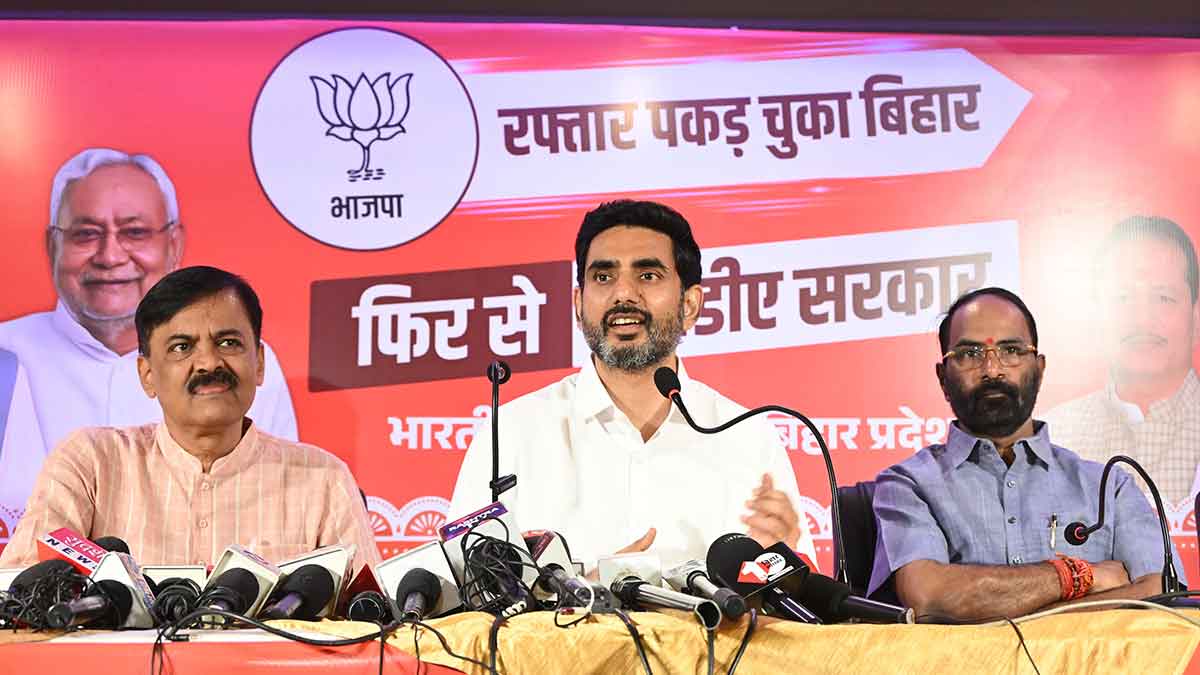
Lokesh’s national visibility further grew during the NDA’s campaign in Bihar, where he spoke of jobs, infrastructure and Centre-state coordination, stitching a distant geography with no common linguistic and cultural thread with the Andhra narrative. His Patna pitch got noticed by the BJP’s top brass, which is eyeing him as a potential bridge to regions where organisational reach and cadre mobilisation need a helping hand.

The TDP may not be a political force in states going to the polls this year—Tamil Nadu, Kerala, West Bengal, Assam and Puducherry. But insiders say its leadership, particularly Lokesh, can step in to allay federal anxieties and concerns around regional pride in states like Kerala and West Bengal. This will be in tune with the NTR-era mantra of federal assertion without overt confrontation. In Puducherry and Goa, where coalition politics stitches the electoral fabric, the TDP’s historical role as a strong national ally can be used to drive home the importance of stable governance and consistent development.
For Lokesh, these national forays are inseparable from family history. He was born soon after his maternal grandfather became chief minister. His mother, Bhuvaneswari, saw little of NTR during that period, as he was constantly on the road. If mass mobilisation and charisma became NTR’s trademark, the 1990s saw Naidu don the role of CEO CM, as he brought IT jobs and investments to the state. Soon after, the TDP grew to acquire the reputation of a kingmaker in the Vajpayee-led NDA in 1998 and Naidu helped usher in national-level reforms like the liberalisation of the telecom sector.
Despite his lineage, Lokesh has had his share of struggles—he lost his maiden election from Mangalagiri assembly constituency in 2019, triggering criticism that he lacked political acumen and ground connect. Five years later though, he “won with one of the highest-level majorities in Andhra’s history”. Today, at 42, Lokesh stands at an inflection point, where he can steer his party, which was shaped by mass appeal and coalition leverage.
“India’s development trajectory is written by her states,” says Richard M. Rossow, senior adviser and chair on India and Emerging Asia Economics at the Center for Strategic and International Studies, Washington, DC. “Natural advantages like coastlines and minerals help, but leadership is crucial to improve public service delivery, reduce corruption and secure investments. Strong state leaders can also become advocates for national-level reforms.”
Rossow, who has been working on US-India relations for over 25 years, recalls Naidu’s visionary leadership and his party’s clout in Delhi to remove obstacles to growth. “This drive was quite evident during his period as chief minister of undivided Andhra from 1995 to 2004, when I first got to know him,” he says. At the time, Hyderabad was becoming a core IT hub of the country. “He (Naidu) did important work to reform electric power distribution, improved health care delivery in the state and used his sizeable parliamentary delegation to ensure key reforms like the original Insurance Act amendments that created competitive insurance markets.”
Today, Lokesh is leading the drive to create a new state capital at Amaravati, and the Naidu 4.0 government is leveraging other key commercial hubs like Visakhapatnam to land new technology investments. Also, the government’s policies in areas like quantum space, battery storage and electronics components manufacturing—released in the last 12 months—are generating excitement in business corridors.
“I was one of the first industry representatives who engaged with him when he convinced Foxconn to come to India. This happened because of the good governance we had at the state level at that time,” says Dr Ravindra Sannareddy, founder and managing director of Sri City. “When companies look at multiple locations, they also look for an ecosystem that aligns with their long-term India business plan. We were happy that Sri City was chosen.” The results brought dividends for the people. “It resulted in employment for nearly 15,000 people, most of them women, working in Foxconn-related projects,” he adds. “It was a big win in terms of empowerment.”
But the Foxconn story also has a caveat. “Electronics assembly companies (like Foxconn) are nomadic by nature,” explains Reddy. “These companies typically relocate every five to 10 years.” Reddy says they were conscious of this risk. “From the beginning we prepared for workforce transition. Fortunately, when Foxconn scaled down, HVAC (heating, ventilation and air conditioning) manufacturers moved in,” he says. “Today, 60–70 per cent of India’s air-conditioning manufacturing capacity is located in Sri City. Companies like Daikin, LG, Blue Star and others are here. Workers who were earlier employed at Foxconn transitioned smoothly into these more sustainable, long-term manufacturing jobs. Japanese companies, in particular, invest heavily in land and infrastructure, making them more committed for the long run.” Earlier this year, South Korean major LG Electronics decided to set up a manufacturing facility in Andhra Pradesh with an investment of over Rs5,000 crore.
In both business and bureaucratic circles, Lokesh has earned himself the title of a “new-age administrator”. He has shed the old style of taking briefings from collectors or secretaries through notes and files; he prefers a dashboard with facts and figures. “As panchayati raj minister (from 2017-2019), he tracked various interventions through dashboards. For him, every number had to be backed by evidence collected systematically from the ground,” says B. Srinivasa Rao, an IAS officer who has worked closely with him. “He focused on basic infrastructure for gram panchayats, since he believed that self-reliant gram panchayats would build real Andhra Pradesh.”
The fact that Lokesh, who did his bachelor’s in science at Carnegie Mellon and MBA at Stanford Graduate School of Business, holds the education portfolio in the state is no coincidence as it aligns with the broader vision of educating and skilling youngsters to help them tap opportunities of tomorrow. Rao says the first thing Lokesh spoke about as education minister was learning outcomes. “Mega parent-teacher meetings were designed so that everyone, from ward members to the chief minister, participated only to discuss children’s academic progress,” says Rao. “He believes students should be empowered to make independent choices as citizens.”
When asked what would be his legacy, Lokesh had a blunt answer—chief job creator. Aware of everyday anxieties of people, ranging from unemployment, migration, tariff troubles, farmers’ distress and lack of quality education, he says his targets are set—AI hubs, data centres, undersea cables, MSME parks and curriculum reforms.
At the same time, Lokesh is also learning to walk the tightrope. He is mindful of not allowing rivals and chief ministers of other states in the south to steal a march on him on issues close to his heart and hearth. For instance, the Centre’s proposed Constitution Amendment Bill, 2025, which proposes to remove Central or state ministers from office if they are jailed for more than 30 days in serious offences, finds Lokesh take a nuanced approach. He is demanding safeguards against vendetta politics and greater accountability to protect democratic institutions. The TDP scion speaks from experience. When Naidu was jailed for 53 days in 2023 for alleged corruption during the YSR Congress regime, Lokesh not only rallied for support within the state but campaigned in New Delhi and beyond to muster support against the “wrongful arrest”.
Another battle that can test his political acumen is the contentious issue of delimitation. The southern states, especially Tamil Nadu, are strongly opposing the redrawing of boundaries of parliamentary and assembly constituencies to reflect demographic changes. They argue that reallocating seats, based on population data, can put them at a disadvantage.
Lokesh, the NDA’s southern face, has carefully stitched a counter pitch that seeks balance over discord. “My view is that the current ratios should be maintained,” he says. “It is important to protect the interests of all states. At the end of the day, strong states make a strong nation. Only when the state grows, the nation grows.”
According to supporters, with the charisma of NTR and the hard work and administrative acumen of Naidu, Lokesh is poised for a larger role in national politics. As he prepares for a scorching summer in the southern battlefield, Lokesh is aware that it will take more than political pull and personal charisma to reshape people’s aspirations and link their region’s pride to national goals. That will depend on outcomes, he agrees. But, for him, the first step is already taken—Andhra Pradesh has been repositioned on the development matrix. He will be spending the rest of the Naidu 4.0 tenure scripting its unique success story.
