



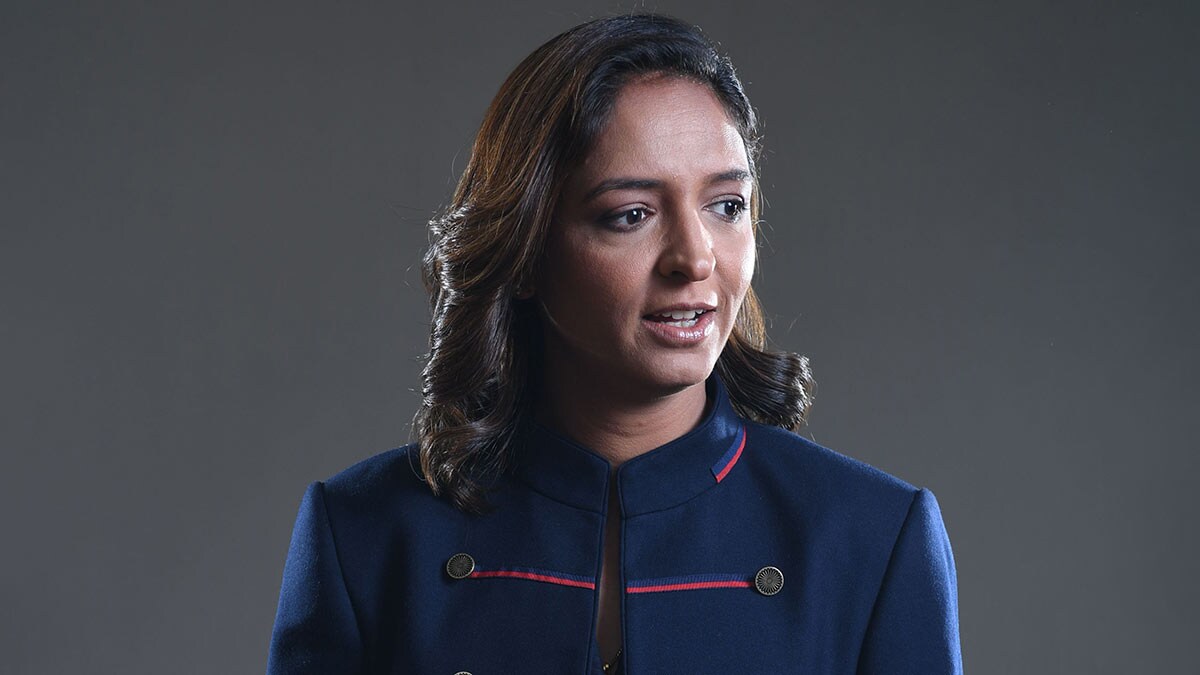
Delhi/ Photoshoot by Kritajna Naik
MAKE UP AND HAIR ADITYA SINGH
ASSISTANTS KAPIL, APOORVA TYAL, MUKESH DUBEY
CREATIVE FASHION STYLING BIKHANTA LUWANG
Q/ How has life changed after lifting the World Cup?
A/ I had been dreaming about this moment for so many years, and finally getting to a point where we can celebrate cricket feels incredible. Earlier, everything was always about comparisons, constantly being measured against men’s cricket. But now, I feel we’ve truly come into our own.
Q/ What was the moment you realised, “We’ve got this… now this cup is ours.”
A/ Honestly, from day one. We were in England when we first heard that the next World Cup would be held in India, and the excitement kicked in straightaway. We knew we would be playing on home turf, and that gave us a different kind of energy. We were positive, confident and deep down we knew we were going to win.
Q/ Since the previous World Cup, in ODIs, India has hit the most sixes. Has any specific work gone into this aspect?
A/ We have always wanted to be an aggressive batting line-up, so everyone in the team has worked on improving their individual skills. That effort is showing—all of us are coming in with good strike rates now.
Earlier, there used to be pressure about scoring 300 runs because we were not used to playing that kind of game. But now we do this in our practice matches—we put ourselves through situations where we ask, ‘What if we have to score 300 runs every day, or even more? How are we going to do that?’
That preparation is really helping us. We are much calmer now, and the training is clearly reflecting in our performances.
Q/ As leaders, there must have been immense pressure on you and Smriti [Mandhana] when India lost three games in a row in the World Cup. What did you talk about at the time?

A/ From the moment the World Cup began, we knew we were going to win this. So though we lost those matches, when we arrived in Mumbai and sat for the team meeting, everyone still looked positive. Not a single girl showed me that she was feeling low or lacking confidence.
Something Smriti and I discussed often was that we still hadn’t played our best cricket. The tournament was long, and we had to face multiple teams, so it was important to peak at the right time. I’m glad that’s exactly what happened.
Q/ Since you became captain, your batting has also soared. Which role influenced the other?
A/ As captain you always have additional responsibility—you cannot just think about yourself; you have to think of the other 14, too. But I’ve always believed that my contribution will motivate my teammates to give their best. They often tell me how watching me bat boosts their confidence. So that naturally pushes me to set an example. At the same time, I always want to keep adding to my batting.
Q/ You said your team needs to make winning a habit. What are the areas of improvement?
A/ For our future strategy, especially as we are scheduled to play a lot of T20Is, the most important thing is to work on fitness. Also, now that everybody knows what our strengths and weaknesses are, it’s time to add newer dimensions to our game—both in batting and bowling.
In the past seven to eight months, we have worked really hard on improving our fitness, and that showed in our fielding. As captain, I can say that we will continue to pay a lot of attention to this aspect.

Q/ Could you give more details about the fitness plan?
A/ We kept it specific. For batters, the focus was on improving our time at the wicket. Earlier, many of us didn’t have the stamina to stay for long durations. We started working on that so we could bat for three to four hours at a stretch. We also worked a lot on running between the wickets.
For bowlers, we increased the number of bowling hours and the overall frequency. Their running technique was refined so they could feel lighter and more efficient. [We worked with] our training coach [A.I.] Harrsha for seven to eight months. That made a huge difference.

Q/ How much of a role has the Women’s Premier League played in the World Cup win?
A/ We had been waiting for the WPL for a long time, and now that three seasons are complete, we can clearly see its impact. Every season, so many young girls have proved themselves; earlier, it was almost unfathomable for a domestic player to suddenly break into international cricket. Even today, there is a wide gap between the domestic and international levels.
The WPL has played a big role because the best players are selected, and we get to share the dressing room with international players. So now, when we go into international matches, we feel no pressure.
Take the case of [pacer] Kranti [Gaud]—she is quite young (22) to be playing a World Cup, yet her contribution was so important. Even spinner [Shree] Charani (21), who did not get many matches in domestic cricket, bowled with such maturity. That shows how much the WPL experience and confidence carries into international games.
Q/ Were there moments of self-doubt during a key match? If so, what did you do?
A/ Yes, when we lost two wickets in the first ten overs of the semifinal against Australia. When Smriti got out, I did feel that way because though we got the runs we had planned for in the first ten overs, we had also lost Shafali [Verma] and Smriti. I felt it was too early to lose both. At that moment, all I wanted to do was just bat and stay there. There was no point taking on any pressure.
Q/ Was there a flaw in your batting technique that was pointed out to you late in your career?
A/ If I had met my batting coach Himanshu bhaiyya a few years ago, I genuinely feel I would have added 3,000-4,000 runs to my kitty. I come from a background where I received no formal coaching. I learnt everything on the ground, playing in the dust. Himanshu made me understand aspects of batting that were completely unknown to me. He clarified my concepts so well that I actually felt, “Oh, yeh toh bahut easy tha (this was so easy).”
Earlier, I believed technique was everything. But the way he taught me to bring flow into my batting, and the way he explained different elements made a huge difference. For instance, my front toe would always be straight, and because of that I constantly felt I was far from the ball. When he pointed it out and made me close my front toe, it improved my technique drastically.
Q/ What is the toughest dressing room conversation you have had as captain?
A/ I have never really had one so far, thankfully. However, there was one common conversation that kept doing the rounds and one day I decided to address it. Many of the girls would say things like, ‘Right now, we are too junior to take on big responsibilities. When our time comes, we will take the team forward.’
This was not a good sign. I told them no matter what their age was, someone had seen something in them—that is why they were here. I discouraged them from talking like that.
I actually spent a lot of time and energy breaking this thought process. When I came into the team, I was very young, but I always felt I should be sent out for batting, that I wanted more responsibility, and I wanted to be the one who could win the game for my team.
Even now, after playing for so long, I still feel the same pressure when I am on the ground. So, this notion that the game becomes easier when you have played for years is an absolute lie.
Q/ What is the one shot that took you years to master?
A/ The cover drive. My natural game was always more [focused] on the leg side. Even now, when I play a cover drive, I feel like I’ve done something special.
Q/ We all know about the 171* innings. Tell us one untold detail from that knock.
A/ That entire tournament, my [position in the] batting order wasn’t very clear (she batted at four, five and six). It was also raining that morning, and I was suddenly told that if the match got reduced to 20 overs, I might have to open. But eventually, the match went on for 42 overs and [I batted at four].
What stands out to me is a feeling I had before going in—that despite all the experience Australia had, I was simply going to focus on playing my best cricket. And that is exactly what I told the others as well. We went out and played fearlessly.
Q/ Which young player has surprised you with her cricket intelligence?
A/ It has to be Kranti. She is new to the system, but yet she knows exactly where her ball will go. I personally feel that if a bowler knows where her ball will finish up, that is the key point. She understands her field placements and all the smaller details. The clarity she brings to the team, especially to our bowling, is something I really admire. I genuinely feel she is going to be the next superstar.
Q/ Is there a leadership style you prefer—aggressive or calm, instinctive or strategic?
A/ My leadership style differs from player to player. For instance, I am aggressive with Deepti [Sharma] because I feel I need to be that way to get the best out of her. With Kranti and Charani, the newbies, I need to be calm and relaxed. I have to read each player and alter my approach accordingly.
Q/ How do you discipline your players without breaking their confidence?
A/ Over the years, I’ve learnt my lessons. My own game is aggressive, and on top of that, I now have the responsibility of leading. Earlier, I would approach everyone the way [I was taught] as I grew up in Moga—with a rustic, no-nonsense and straightforward manner of speaking. My attitude was bold, direct and a bit loud. After a point, I started worrying that the girls might get scared of me.
I realised that leadership needs flexibility. I learnt from many people I met in the dressing room over the years; those experiences shaped me into who I am today. Off the field, I’m a different person now compared to when I started.
I learnt that I need to sit down, think carefully about each player’s temperament and condition myself accordingly. I meet them personally to understand their comfort zones, and I adjust my tone and approach based on what works for them. Thankfully, I’ve developed a strong comfort level with all of them, and I’d like to believe the reverse is true as well.
Q/ A dressing-room superstition before taking the field?
A/ [Head coach] Amol [Muzumdar] sir always says three words: ‘Saikda dekhna hai (I want to see a hundred.)’ In fact, if there’s ever a day when he forgets to say it before we go out, we make sure to remind him. And honestly, 90 per cent of the time he has said it in the meeting, someone has actually scored a hundred.
Q/ Was there a moment when you wanted to walk away from cricket?
A/ I have never felt that till date. I am born for cricket. Ever since I have known myself, I have always seen a bat in my hands.
Q/ One point of criticism that was actually true?
A/ ‘You are not making any runs. What is wrong with you?’ In those moments, I’ve often felt like saying, ‘Yes, even I know I’m not making runs, but I’m working hard. What else can I do?’
Q/ What is the biggest shift that the WPL has brought to women’s cricket and how did it change the way Indian players see themselves abroad?
A/ The WPL has filled the gap between domestic and international cricket. Earlier, it felt as if everything was moving in slow motion; but the WPL became that big push we needed to face the world. Now, even the training at the domestic level is taken seriously. Girls are hiring personal trainers to improve their fitness.
Q/ A batter from another team whose brain you would love to borrow for one innings?
A/ [England’s] Nat Sciver-Brunt, for sure. By now I’ve batted a lot with her [at Mumbai Indians], and she knows exactly what she is doing. Her clarity of thought and her skill in understanding how to maximise runs are things I would love to follow.
Q/ What is one fundamental change Indian women’s cricket needs urgently?
A/ Our fitness levels need a solid push. It is the only aspect that can really make a huge difference. With just a little push in the past few months, we saw this incredible improvement in our game. Imagine if we really take it up in a big way.
Q/ If you had to pick the future captain, what qualities would you look for?
A/ I personally like [keeper] Richa [Ghosh] a lot. Right now she is too young, but she has the potential to make it big because the wicketkeeper is the one who has a [central] view of the field and hence has more clarity. I often speak to Richa on field and she gives me info on the movement of the ball and the pitch. She has that spark in her. If groomed well, she can lead the team well.
Q/ What is the most difficult ball you have faced?
A/ We were at Lord’s and [England’s] Kate Cross was bowling cutters; the pitch, too, was a bit difficult. She is a pacer, but that one ball [seemed as though] somebody was bowling off-spin. It hit my pad and I must say that it was the most difficult ball I have ever faced.
Q/ What is the most satisfying shot you have ever played?
A/ Six over the covers, for which I have worked really hard. That shot remains in my mind long after I have played it in any game.
Q/ Is there an innings you rate higher than 171*?
A/ I think the 89 I made against Australia (2025 World Cup semi-final) was special. It was a different style of batting. I was very much in control. I was talking to myself just to remind myself to enjoy that moment because you never know if you would be able to live [a moment like that] again. Everything was exactly the way I wanted it to be.
Q/ Who is that one player you always turn to for advice in a tight situation?
A/ Smriti, as the vice captain and someone with a lot of experience. Then Richa and Deepti, too. The three of us discuss plans and strategies whenever I have something in mind.
Q/ There have been times when you lost your cool.
A/ Yes, I most definitely do. Many times, when a bowler concedes runs—though I know they don’t want to—I genuinely feel bad. I tell them, ‘If the ball goes to the fielder and we still concede a run, I don’t mind it. But when you bowl to an area where we don’t have a fielder, that’s when it really bothers me.’
But then I remind myself that it’s okay, it happens. You have to pull yourself back into the game immediately, especially in ODI cricket. It’s a long format and a bowler has to deliver 10 overs. If one or two overs go here and there, you still have to keep giving the bowler confidence. In fact, during this World Cup, I really enjoyed this part—talking myself down, regaining my composure and then motivating the bowler to stay focused.
Q/ What changes would you like to see in the WPL in the next few seasons?
A/ Maybe we could add a few more teams in two to three years. Now we have five teams and healthy competition, but if we have more teams, more domestic players will get an opportunity to play.
Q/ Any personal or team goals for the next major ICC event?
A/ The T20 World Cup is round the corner, and we have already started preparing for it. I have asked the girls to make winning a habit. We are not satisfied with just one trophy—we want many more.
Q/ One non-cricket thing always in your kit bag?
A/ A golf club my trainer gave me; I use it for warm-up before batting.
Q/ A pre-match ritual…
A/ During match mode, the body tends to get stiff and the mind feels heavy. So, I keep moving to and fro. Sometimes I just break into a dance or do some funny movements right before padding up. I don’t even realise I’m doing it, but my teammates find it funny—honestly, I do, too.
Q/ How important is increased financial investment and equal opportunity for the long-term success of the sport?
A/ A lot of girls have suddenly come in.... The main motive is to see more girls play cricket. Pay parity, the WPL, more games.... Jay (Shah, ICC chairman) sir has brought in all these. We have seen massive change. We have to give all the credit to him.
Q/ What is your advice to the millions of girls who look up to you?
A/ Keep following your dreams just like I did. And stay grounded because everyone is watching you.
Q/ What’s an inside joke in the dressing room?
A/ Once, after it had rained and the match was reduced to five overs, a coach [of another team] suddenly said that only five people will play now. All of us were completely startled to hear that and started laughing. It was such a funny moment—how could a coach not even be aware of the rules?
WATCH!
Captain Speaks
The full interview
