


Interview/ Ken Follett, author
It took Ken Follett just weeks to write his first novel—a thriller about drug dealers published under the pseudonym ‘Symon Myles’ in 1974. The book was not a success, but the modest advance was enough to repair his car. Then a young journalist, he realised through this experience that his future might lie in books rather than newspapers.
By the end of the year, he had joined Everest Books, a small firm run by former journalists that had brought out his debut novel. “We were a young company and nobody knew anything about publishing because we were all straight out of journalism,” Follett once recalled. “But we knew how to promote, we knew the media, and that saved us.”
His savvy helped Follett rise to the position of deputy managing editor at Everest, even as he continued writing thrillers under various pseudonyms—Martin Martinsen, Bernard L. Ross and Zachary Stone. Why so many pen-names? Because most publishers preferred to release only one book per author each year, and Follett was writing several.
Follett’s nose for business has held him in good stead through the decades. Today, he is a regular at the Frankfurt Book Fair—the world’s largest publishing event and a venue for networking, deal-making and industry strategy. Last year, he hosted a “Ken Follett Summit” at the fair, drawing around 100 participants from across the publishing scene, both in person and online. The event followed a headline-making announcement that, after 45 years with Pan Macmillan—the storied publishing house once led by former British prime minister Harold Macmillan—he was moving to Hachette. The French publishing giant also represents J.K. Rowling (writing as Robert Galbraith) and Fourth Wing author Rebecca Yarros.
Circle of Days, Follett’s latest novel, is the first under the new contract. He tries to trace the origins of Stonehenge. The narrative follows Joia, a young priestess of the Great Plain in the Stone Age, who, after witnessing the destruction of a sacred wooden monument used for rituals and timekeeping, tries to build a stronger, enduring stone structure. Her brother-in-law, a flint miner named Seft, must solve the monumental challenge of transporting and erecting massive stones.
In an exclusive interview with THE WEEK, Follett speaks about letting his imagination travel back in time to uncover the mysteries of Stonehenge—and what monuments mean to humanity. “Monuments remind us of not just what things used to be like,” he says, “but also how far we have come.”
In a wide-ranging conversation, he also reflected on his early years, creative struggle, writing and research methods, and the lessons drawn from his long career as one of the world’s most popular storytellers. Edited excerpts:

Q/ Circle of Days was launched at Salisbury Cathedral, which inspired The Pillars of the Earth and is just around 12km from Stonehenge. It must have felt like a strange sort of time travel—reading aloud from a book about a nearby monument that predates the cathedral by several millennia. How was the moment for you?
Well, it’s always a joy to go to Salisbury Cathedral and, of course, Stonehenge is a religious monument as the cathedral is. The cathedral was built in the Middle Ages and the monument was built 4,500 years ago.
Both are examples of people aspiring to build something that will last forever. And, in both cases, the actual builders were quite humble people…. In the case of the cathedral, they were masons and workmen. In the case of Stonehenge, they were basically ordinary people who banded together to bring those giant stones to the site. It took at least 200 people to move one stone—so it was a communal effort.
Q/ There is a lovely passage where a young Joia realises that there is a deeper meaning to the song-and-dance rituals at the monument. “She could make out some of the words of the song,” you write, “which mentioned winter and summer, spring and autumn, and other seasonal events: the appearance of new grass, the migration of deer, the falling of leaves. Somehow, Joia guessed, this dance was the way they always knew which day of the year it was.”
Your lines link ritual and knowledge, and faith and what we call science. As an atheist, what are your thoughts on the relevance of rituals—or even religion—in our modern, scientific world.
The rituals at Stonehenge were religious, but they were also a means of handing knowledge on to the next generation—because, of course, there was no writing in the Stone Age. There was no paper or pens in this part of the world. In western Europe, writing had not been invented. It was in the process of being invented in the Middle East and other parts of the world, but not here.
So, how did they pass knowledge from one generation to the next? It must have been through songs and poems. Of course, the oldest poems that we know are the work of Homer and the Epic of Gilgamesh, and they come to us because they were written down. But most historians believe that, long before they were written down, they were memorised by poets and spoken in a kind of ritual. In the old world, rituals were perhaps the only vehicle to pass knowledge through generations. And, in the modern world we live now, that’s not really necessary.
Q/ So have rituals lost their relevance?
Well, people do still have rituals, don’t they? We sing the same song at a birthday. We sing, ‘Happy birthday to you!’. The family gather, and there is always a cake. That is a ritual marking the passage of time for a member of the family.
In most countries in western Europe, you don’t have to go to church to get married. You can get married at the town hall. But most people do still have a ritual in the church where they make vows to one another and sing, and the priest blesses their marriage. The old rituals have survived very well into the technological 21st century.
 King of letters: Ken Follett with King Charles III during an event organised in March 2025 by the Queen’s Reading Room, a charity started by Queen Camilla in 2023 to promote reading among the public | Getty Images
Q/ You wrote 10 books before Eye of the Needle made you famous.
My early books were all too short and I wrote them too fast. So I made a decision that Eye of the Needle would be 100,000 words, and that I would take as much time as I wanted. In the end, I did, and I still wrote it quite quickly. But it wasn’t such a hasty novel as my previous ones.
Q/ Today, you are a towering figure in your field. What has success taught you?
Well, I wrote Eye of the Needle when I was 27. I am 76 now. So that’s almost 50 years—I have been living like this for a very long time.
It’s still a challenge to write a novel, and it’s a special challenge to write a popular novel that people will love. So it hasn’t become easy. Really, as far as work is concerned, writing the next bestseller is the main thing on my mind…. But I know that the most important things in my life are the people in my life—my family, my friends. That’s what really makes a man happy.
Q/ The last time you were in India was in 2010, to promote Fall of Giants—the first book in the Century trilogy. Between that trilogy, and the Kingsbridge series, and now Circle of Days, you have covered half a millennia of the history of western civilisation. Can we hope for a Ken Follett novel set in India?
Well, British people have written a lot of novels about India, but they always write about the British in India. They don’t really write about Indians in India.
I do like the novels of R.K. Narayan very much. I have read quite a lot of them, and they are very gently humorous, aren’t they? They are not, you know, laugh-a-minute—they are just quite wry.
Now, what kind of novel would I write if I were to write a novel about India? Well, I wouldn’t want to write about the British in India, because to be honest, I don’t find them a very attractive group of people. They were very cruel and exploitative, and completely racist. I just can’t imagine putting together a story about those rather unpleasant people.
And, I don’t know enough—I am so unfamiliar with all things Indian that I am not sure I could do it. But it’s not a bad idea. I mean, in western civilisation, people don’t know anything about the history of India except for when the British went there. The rest of the history of India is not generally known here. So it would be a good idea to write about that history.
But I also feel I would get so many things wrong. Indians would say to me, “Well, you see, that couldn’t have happened. You got that wrong. And you got something else wrong.” So, I would be very nervous about it. I would do it only if I thought of a really good idea.
 Follett at the Frankfurt Book Fair in October 1980 to promote the German translation of his novel Triple | Getty Images
Q/ Andrew Carnegie, the US steel magnate, visited Banaras in 1878 and wrote about being mesmerised by the beauty of the city. In a way, Banaras is so spiritually close to the monument in Circle of Days—both are living sites of the dead.
But while Stonehenge is in the UNESCO list of world heritage sites, Banaras is not, despite being one of the world’s oldest cities. As a writer of history, how do you view the fact that there are more UNESCO sites in the west than in Asia and other continents.
Certainly, UNESCO should consider all important monuments in the world, regardless of which country they are in, or what culture they represent. And it wouldn’t surprise me if Asia is underrepresented in the list, because the United Nations was set up by Europeans and Americans after World War II.
I wrote the Century trilogy to show how life has changed in the 20th century. Millions of people became freer. Countries became more democratic. More people got the vote—women got the vote—in many countries. And the monuments remind us of not just of what things used to be like, but also how far we have come. They remind us of the journey that we have all made. They remind us that the freedom we have is fragile…. The great thing about these monuments is that they remind us of that.
Q/ You have an interesting Carnegie connection—you grew up reading in the library that existed because of his philanthropy.
Yes. That’s right.
Q/ Carnegie gave away most of his fortune to build some 2,500 libraries around the world. One was in your hometown, Cardiff.
Yes. And it is still there, and it is still a library. I was there quite recently.
Q/ How important was that library to you?
I used to get a book for Christmas and a book for my birthday. I would read a book in a day in those days. I read very quickly, and I enjoyed it. All my aunts and uncles knew that they had to give me a book on my birthday. But the books were never enough, until I joined the library…. The Carnegie library looks like a church—very interesting architecture. For me, [joining] it was like Christmas. Suddenly, there was no end to books I could read, and I went to that library every week.
Q/ Were there restrictions on the kind of books you could read?
Strangely enough, no.
At first, of course, I just read children’s books, which were harmless. But, when I was a teenager, I used to go to the library and borrow James Bond books. And, strangely, my parents never objected to that. You know, they wouldn’t let me go to the movies. They wouldn’t buy a television. But they let me borrow any book I liked.
I did also read Shakespeare. I used to read the Shakespeare plays as if they were novels. So, you know, it wasn’t all James Bond.
 Star turn: Ken Follett performs with his son Emanuele (right) during a publisher’s night in Frankfurt, Germany, in October 2014 | Getty Images
Q/ Which is your favourite James Bond book?
I like Live and Let Die. The opening sentence—“There are moments of great luxury in the life of a secret agent”—tells you all about James Bond, doesn’t it? Because he enjoys luxury, but he is also a secret agent, so he gets into fights and so on.
It’s a great first line. And it’s a really good novel actually. I have reread it a couple of times since, and enjoyed it every time.
Q/ In place of Carnegie, you now have Jeff Bezos, who made his fortune from a website selling books. Do you think Bezos should perhaps take a leaf out of Carnegie’s book, considering the criticism that he has not done enough for the publishing industry.
Well, I would [emulate Carnegie], if I was as rich as him.
There are plenty of people in the UK who can’t read. They generally hide it because they are ashamed. But sometimes, they come forward and say, ‘I need to learn to read.’ We should do a lot more for literacy. If I were a billionaire, I would put some money into efforts to improve literacy.
Q/ Do you like physical books or e-books?
I prefer physical books. I do read e-books sometimes when it is convenient. But I prefer the physical one.
Q/ During Brexit, you started a “friendship tour” across Europe with fellow authors Lee Child, Jojo Moyes and Kate Mosse. What are your thoughts on the social and cultural impact of Brexit on Europe?
Well, I think it has been very bad for my country.
There are always people who say, “Our country is the best. We don’t want foreigners”, but they are wrong. A great deal of culture comes from the mixing of people.
Why do we have rock-and-roll? Because Africans went to America, and they heard European hymn tunes. Rock-and-roll is a mixture of European hymn tunes with African rhythms. And it is loved all over the world.
There are many examples where a country’s culture has been enriched by drawing on other cultures. But now in Britain, we present to the world a hostile face. People don’t want to come here, because they think they won’t be welcome. That’s very, very bad—it makes us insular; it makes us narrow-minded.
Q/ You mentioned rock-and-roll. What kind of music do you listen to?
I listen to most kinds of music. I like rock-and-roll; I like classical music. I am very fond of Mozart. I don’t like jazz very much, and I don’t much like 20th century classical music.
Q/ A columnist once wrote about the parties you host for your Labour Party friends, saying they rival those thrown by Jeffrey Archer for his Conservative Party friends. So I have to ask: whose party is better?
Well, Jeffrey invites me to his party, so I know what they are like. I would have to say his parties and mine are different, but they are both great.
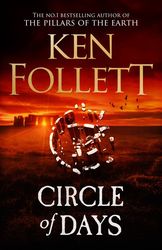
CIRCLE OF DAYS
By Ken Follett
Published by Quercus (Hachette)
Price Rs799; pages 595