


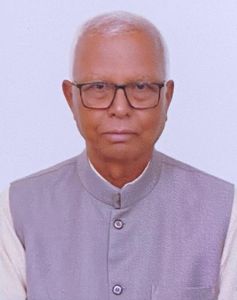
 Girish Chandra Lal
The three main political parties of Nepal—Sher Bahadur Deuba’s Nepali Congress, K.P. Sharma Oli’s Communist Party of Nepal (Unified Marxist-Leninist) and Pushpa Kamal Dahal’s Communist Party of Nepal (Maoist Centre)—have for long worked to keep power among them. They are enemies and friends at the same time.
They oppose each other politically, but show support when any of them is involved in corruption or other crimes.
Historically, in the backdrop of growing dictatorship, power in Nepal came to be concentrated within a certain community, mostly Brahmins and Chhetris. And though systems of governance changed, power remained with this group. Everything from the police to the army to the judiciary is in their grip, and there came to be a name for them: Permanent Establishment Of Nepal (PEON). The same castes rule and then their next generation follows.
Because of this, the democratic system is stifled—the other communities have suffered and they have harboured anger.
And this anger erupted with the Gen Z protest. Oli, the prime minister, was trying to grab all the power, be it the executive or within his party, and in this process, he banned social media apps. The Gen Z, furious, found ways to bypass the ban (using VPNs, for instance) and took forward their protest peacefully. They did not come with weapons or with the intent of arson.
But then others, like supporters of the out-of-power monarchy and some rogue elements, saw an opportunity and infiltrated the protest. The prime minister, fearful of losing his seat, used the state machinery to shoot the protesters. The death toll now stands at 72, and around 400 have been injured.
We saw the reaction the following day. Buildings were razed and politicians were targeted. However, more than 90 per cent of the violence came from the infiltrators, and the police and the army did not stop them. Interestingly, the monarchists were spared.
As the dust settles, Sushila Karki has become prime minister. I first met her during my early lawyer days; we would see each other at some functions. We got to know each other better when I became a high court judge and she was a lawyer in Biratnagar. And then when I became a justice in the supreme court, she was also appointed there as a justice elevated from the bar.
Sushila’s family has a history of fighting for democracy. Her husband was part of a team that hijacked a government plane carrying money into India. He only used the money for the purpose of democratic struggle.
Through her years in the judiciary, Sushila had built the image of a crusader against corruption. She is a courageous woman, perhaps a bit too courageous, and has her own moral standard. The Gen Z has turned to her as they saw hope.
But, notably, this takeover is not constitutional; it has come out of a people’s movement. And ideally, a former chief justice should not be taking part in an unconstitutional process.
However, it is not like she has full power. Right now, the politicians who fled after their offices and houses were attacked are in military camps. But they won’t be there forever. On the other hand, the Gen Z has also split into several groups as they did not have a political organisation or a leader. In the end, the people still believe in the multi-party system and in democracy.
There are supposed to be elections in six months, but they might not be held in time. We have seen the situation in Bangladesh. However, Sushila is not a person who will hold on to power forever.
Among those who have come to power because of the protests, there are genuinely honest people and those who could be fake honest. So, it is difficult to say which way they will take Nepal.
It is being heard that the Indian government had intervened, saying that it cannot support a dictatorship and that democracy should be protected. This is the right step. Most people in Nepal believe that India’s interventions to save democracy will always be positive.
Importantly, Nepal is a country with no enemies. Neither India nor China. So, in my opinion, all these troubles have been caused by our own politicians. It is an internal issue.
Now, I cannot be certain that Sushila can solve all these problems. She is also getting older; she must be 72 or 73. But what I can say is that there is no possibility of corruption.
Also Read
- Nepal uprising: The aftermath of a Gen Z-led political reset
- Why Nepal's leaders missed the Gen Z uprising
- From Maoist insurgency to modern unrest, Nepal's enduring struggle for stability
- India needs to preserve partnerships with Nepal, Bhutan without suffocating them
- Nepal is at the crossroads after political turbulence
- Nepal government needs to navigate social media regulation, national security
The role of a politician is quite different from that of a judge. A judge must go by the constitution and hear both sides before coming to a judgment. A politician might shout in the assembly, but it is a necessary part of that job.
What I hope is that the democratic system is strengthened. Elections should be held and the constitution should be improved and not abolished.
Going forward, the role of the Gen Z is also uncertain. They were, in a way, accidentally brought into this role. They are not politically mature and they cannot be in this role for long. They will be ready to fight, but they cannot do it in an organised manner. It could very well be a lull before the storm.
—As told to Anirudh Madhavan
The author is a former justice of the Nepal supreme court.