



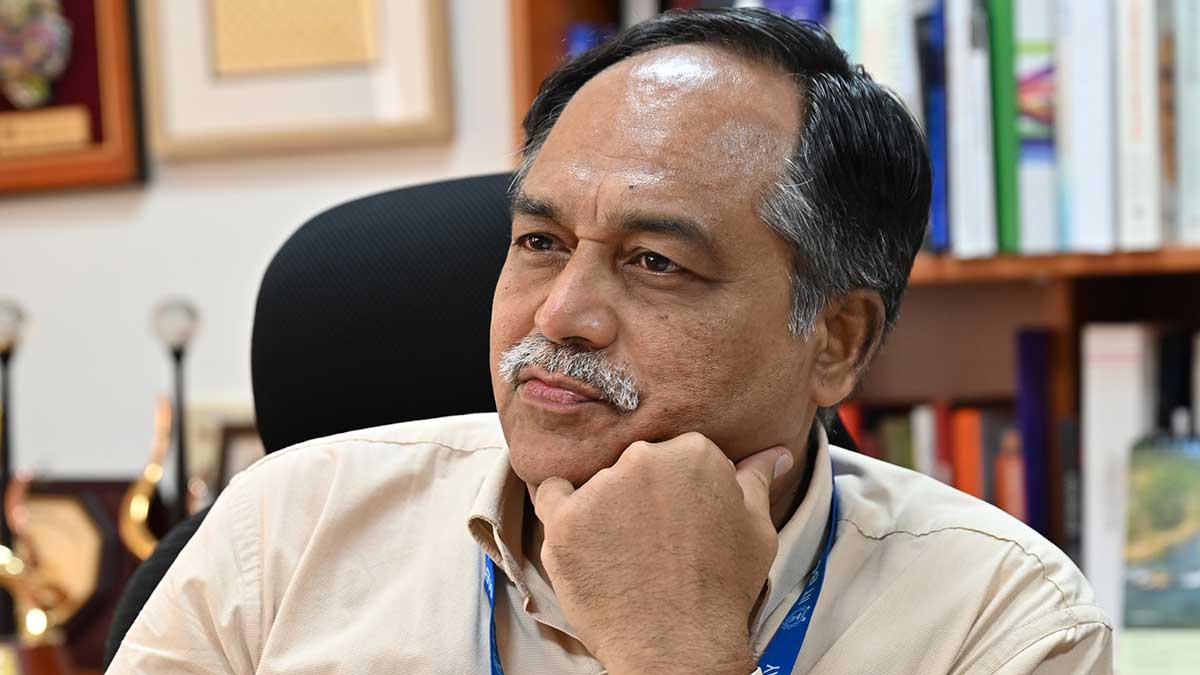
Interview/ Prof Shireesh Kedare, director, IIT Bombay
How does IIT Bombay help students excel?
When it comes to bringing students from different backgrounds and regions together, IITs are playing an important role. One of the most important aspects of IITs are the hostels and the campus environment, as students stay together, discuss various subjects, study late into the night. I was a student here. Most students and faculty stay on campus, facilitating an exchange of ideas. However, it is not only about academics. Students develop overall personalities by participating in sports and cultural activities. Our NSS students go to the slums near our campus to teach the students there. During their vacation, they go to camps in rural areas also.

What advantage does IIT Bombay have?
One of the major advantages is that the campus is located in Mumbai, a cosmopolitan hub where different cultures melt. We have students and faculty from the remotest places of the country. People look forward to coming to Mumbai to study or teach. Almost all the major corporates have a head office or office in the city. This helps our students get an industry connect like no other IIT in the country. It is a fact that among the top 100 students who pass the IIT JEE exam, [a majority] opt to join IIT Bombay. IIT Bombay also has a big asset of alumni (around 70,000) spread globally.
What projects are IIT Bombay working on?
We are involved in multiple projects in Mumbai and elsewhere. We were, for instance, involved in the master plan for the Mumbai [metro] network. We are working with the Maharashtra government for a drone project. A drone port is coming up and the Maharashtra government has given us funds for that. We have a very active incubation centre called SINE (Society for Innovation and Entrepreneurship). Around 250 companies have already been incubated from IIT Bombay and they are pure science companies.
What kind of innovation has students and faculty of IIT Bombay worked on in the recent times?
There are many significant innovations in recent times that IIT Bombay has developed and all of them have been of strategic importance. This has helped our students get a feel of the best and high end research-based innovations. For instance, IIT Bombay's Space Technology Cell developed advanced 'slosh' models to manage the liquid fuel inside the Chandrayaan-3 space craft. This innovation ensured that the Vikram lander had a smooth and precise landing near the Moon's south pole. IIT Bombay researchers have also developed a blood-based test method with 95 per cent accuracy for early Parkinson’s diagnosis. Another innovation is the next generation sodium-ion battery, a cost-effective alternative to lithium. This is significant because sodium is abundant and widely distributed.
What changes are you making in teaching methodologies?
As far as the teaching methodology is concerned, IIT Bombay is looking at a transition from teaching to learning. Talking is not teaching and we want to focus on learning. A few faculty members have committed that from the next semester; they will teach a course in a different way. For instance, in our design course, for all the 1,400 students during the first year from across streams of engineering, faculty provide the material on the web on the first day which can be read first and then students come prepared to class. In the class, they discuss and get assignments. It is an interactive and experiential way of learning.
