



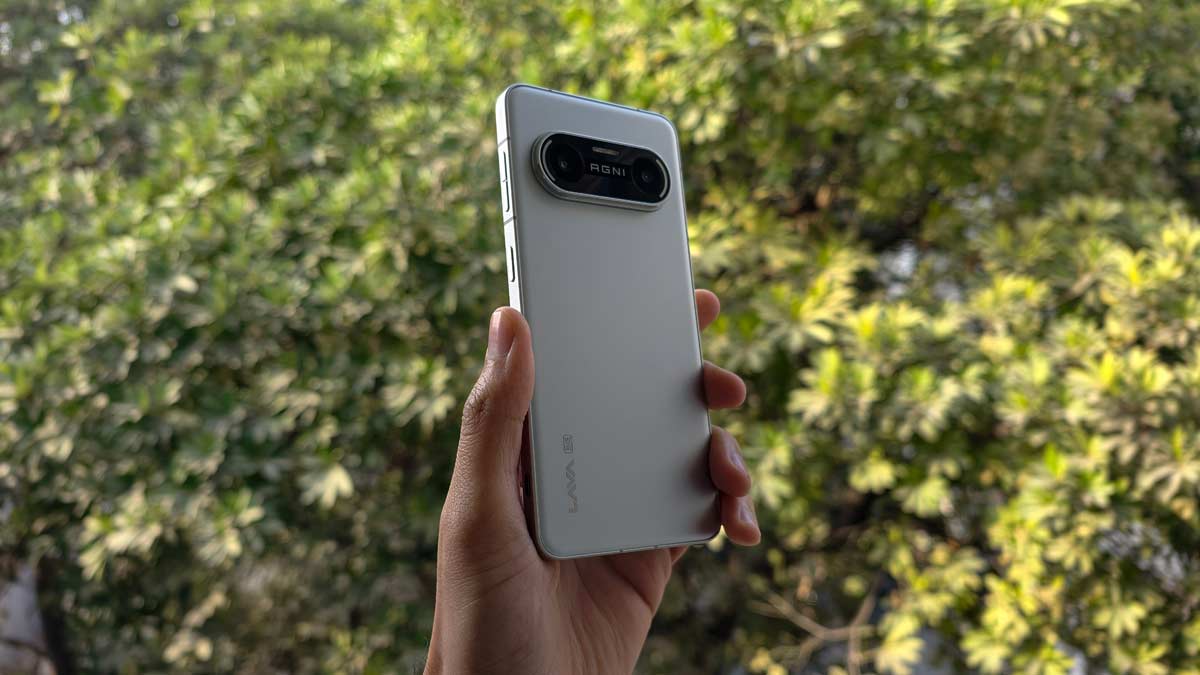
Lava's Agni series of smartphones has gradually made a decent name for itself in the mid-range smartphone market in India. The Lava Agni 4, priced at Rs 24,999, represents a price increase compared to the Agni 3, as seen with most smartphones these days. It aims to continue providing good value for money against competitors like the OnePlus Nord and Realme. So, let's try and check how well it performs.
Lava has eliminated the small second display at the back this time and has opted for a more conventional visor-type camera setup with the Agni branding on it, while the Lava logo sits near the bottom. This is a metal-frame phone with a glass back and a 6.67-inch display (2.2:1 aspect ratio) with Corning Gorilla Glass 5 on top. The right side features volume buttons, a power/lock key, and the Action key near the bottom. This key can be configured to open applications like the camera, switch to silent mode, take a screenshot, and so on – single tap, double tap, and a long tap – all customisable to determine its function. The top has one outlet for loudspeakers, a secondary mic, and an infrared port. The bottom houses the second outlet for loudspeakers, a USB Type-C port, a primary mic, and a dual SIM card tray. The phone weighs 208gm and is quite tall but manageable to carry around due to its curved corners and slightly curved edges. It comes in Phantom Black and Lunar Mist color options.
The 6.67-inch 1.5K (1220x2712) AMOLED display, with refresh rates of up to 120Hz, is bright and sharp for outdoor use under sunlight. It has decent viewing angles and handles high-resolution videos quite well in terms of colour reproduction and detail retention. The display has some tendency to throw glare, though, which isn't surprising at this price range. I preferred to use it in the normal mode rather than the default vivid mode, which seems to over-blow colours.
The device is powered by MediaTek's Dimensity 8350 chipset (up to 3.35GHz octa-core processor, Mali G615 GPU), 8GB LPDDR5X RAM, and 8GB UFS 4.0 internal storage. It would have been nice to have 12GB of RAM to make it stand out in this price segment, but it's acceptable. The phone runs on Android 15 (with the November security patch) along with some Lava tweaks and iconography. Animations and the menu launcher now appear a little more refined compared to the previous version, and it integrates well when changing icons, themes, and wallpapers. However, the status bar icons look dated and definitely need a refresh for Android's Material You design. There's Vayu AI, an AI agent, that can take on different roles such as an English teacher, math tutor, and horoscope reader, among others. An animated dog widget is placed on the home screen by default where you can give voice commands or type what you want. It works decently for basic questions, but it doesn't have the capabilities to take on the agentic AI of the world today. Performance on the phone is really good – snappy app opening and video playback with very little stuttering experienced during my usage. For gaming, you can play a heavy game like Genshin Impact at 60FPS smoothly without any hitches throughout the gameplay, which is nice to see. Lava could also further improve RAM management, as it appears that apps close frequently if DuraSpeed under Settings isn't enabled for an app. Also, there's now an option to have the back button on the left side when using on-screen keys for navigation; the option was strangely missing earlier.
The Agni 4 comes with a 5,000mAh battery unit that lasted me nearly a day most of the time. It can be charged using the bundled 66-watt fast charger in about an hour. I didn't see any major heating issues, either.
Coming to the camera, you get a 50MP (f/1.88) main camera (with OIS) and an 8MP (f/2.2) ultra-wide camera. The camera performance here is decent for most people. It can take relatively vivid shots in daylight and tends to overexpose the subject at times. Details are often retained, but colours could have been better reproduced. The camera application is fluid to use and has quite a few options to choose from. The front-facing 50MP (f/2.5) camera also oversharpens skin in selfies at times, though this has improved with the recent update. You can shoot 4K videos at 60FPS from both the main rear camera and front camera, and the output is okay for playing on a tablet, but don't expect a great output for playing on a larger display.
Wi-Fi performance of the phone is trouble-free, while 5G network reception doesn't disappoint for working on the go. Call quality has also been satisfactory for outdoor and indoor usage with VoWi-Fi in use.
In conclusion, the Lava Agni 4 is a pretty good option for those who want a smooth and bloatware-free software experience (3 years of OS upgrades and 4 years of security updates) with decent battery life. However, for camera enthusiasts, it seems to lag behind the OnePlus Nord in this price range as of now.
