



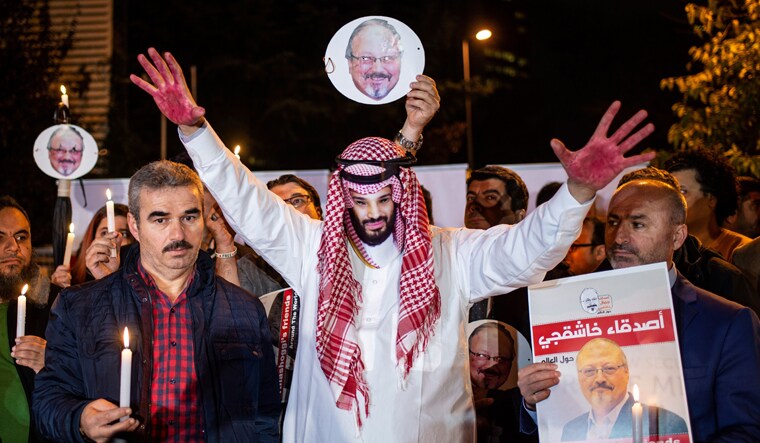
On October 21, Saudi Arabian Foreign Minister Adel al-Jubeir spoke exclusively with Bret Baier of Fox News about the murder of Jamal Khashoggi. Jubeir deftly sidestepped many questions and competently defended the kingdom and the royal family. One answer about the kingdom's political orientation, however, stood out particularly. After Baier called Saudi Arabia an autocracy, Jubeir forcefully countered it, saying the kingdom was a monarchy, and had its own system of checks and balances. While most people laughed at the answer, Jubeir certainly had a point. Governance in Saudi Arabia functions largely on the basis of consensus among various stakeholders. It began to change after the rapid ascent of Crown Prince Mohammed bin Salman.
In fact, the kingdom of Saudi Arabia came into existence as a result of a politico-religious compact between the House of Saud and the clerics of the House of Wahhab. The first Saudi state was established in 1744-45 after Muhammad bin Saud and Muhammad bin Abd al-Wahhab cemented an alliance to form a kingdom, challenging the Ottoman overlordship of the Arabian peninsula. The compact held on for centuries despite several ups and downs as Wahhabism gave religious legitimacy to the rule of the House of Sauds, while the monarchs helped propagate Wahhabism.
The royal family has a cumbersome and elaborate decision-making mechanism. The Saudi monarchs, for instance, have never been absolute despots. One reason for this is the large size of the royal family. King Abdul Aziz, the founder of the modern Saudi state, had 40 known sons; his son and successor king Saud had more than 100 offsprings. By most accounts, the extended royal family now has nearly 15,000 members of which about 2,000 are really influential. Organised into factions based on things ranging from tribal loyalty to financial gains, the various factions used to balance each other and even kept the king in check, unlike the kings and emirs of the neighbouring Gulf states, who enjoy unlimited powers.
The powerful cliques within the Saudi royal family acted as a check on absolute royal power. Some of the princes who led such fiefdoms, like Al-Waleed bin Talal, have been immensely rich, some of them controlled branches of armed forces, like Miteb bin Abdullah, son of the former king Abdullah who commanded the National Guard. Some had close links with intelligence agencies, while others like former crown prince Muhammad bin Nayef derived their influence from being very close to the US, especially its intelligence network. After MbS became crown prince, replacing Muhammad bin Nayef, he started dismantling this system of checks and balances. To begin with, MbS is a very young prince in a country which respects age, and which had a long line of geriatric kings. And, unlike his predecessors, he got to be the crown prince under his doting father. According to many reports, King Salman has been unwell for quite some time, giving MbS great leeway in acting on his own. And, being Salman's favourite son, MbS enjoys the privilege of staying with the king in the same palace.
The initial days of MbS’s reign pointed towards a great Arab reformer. It was a new beginning in Saudi Arabia, which was long dominated by conservative, geriatric old men as rulers, and MbS appeared as a breath of fresh change. President Donald Trump paid his first foreign visit to Saudi Arabia in the company of his son-in-law Jared Kushner. Kushner and MbS soon became close friends. With the US on his side MbS soon announced sanctions against the fellow Wahhabi emirate, Qatar. It came close on the heels of his war against the Houthis in neighbouring Yemen, who are backed by Iran. The war has turned out into one of the gravest humanitarian crises to have hit the region, according to the UN.
Yet, the move to target Qatar did not receive overwhelming support from the Gulf Cooperation Council, once literally owned by Saudi Arabia. Kuwait and Oman clearly expressed displeasure. The only active supporter was the UAE, which, like Saudi Arabia, was controlled by the young crown prince of Abu Dhabi, Mohammed bin Zayed. MbS and MbZ are said to be really close. The sanctions against Qatar failed spectacularly, as the tiny emirate had the support of the two other anti-Saudi regional bigwigs, Iran and Turkey. Turkish President Erdogan, in fact, send a small army contingent to Qatar to pre-empt a possible Saudi invasion of Qatar. MbS, meanwhile, overplayed his hand yet again, when he forcibly brought Lebanese Prime Minister Saad Hariri to Riyadh and was forced to announce his resignation. He backtracked on his word once he was back in Beirut. In August, Saudi Arabia took strong exception to the Canadian government’s demand to release Saudi human rights activists Raif Badawi and his sister Samar. Saudi Arabia expelled the Canadian ambassador, recalled its envoy to Ottawa, suspended trade relations, banned flights and asked Saudi students in Canada to return.
Yet, when he started off, MbS was feted globally as a reformer. Many of his initiatives, such as taking on hardline clerics, permitting women to drive and opening movie theatres were seen as progressive measures. Such measures, however, did not do anything to fundamentally alter the socio-political structure of the kingdom. MbS, instead, used such liberal measures to consolidate power. Ironically, most of the women leaders who led the struggle for the permission to drive are now languishing in prisons.
The problem was that Khashoggi saw through the façade, and was bold enough to write about it, alarmingly for MbS, on The Washington Post, which is one of the most influential dailies not just in the US, but the whole world. “I have been told that I need to accept, with gratitude, the social reforms that I have long called for, while keeping silent on other matters,” wrote Khashoggi a few months ago. And, it is quite likely that Khashoggi was close to American intelligence agencies. After all, he was once the handler of Osama bin Laden.
The decision to murder Khashoggi inside the Saudi consulate, and, that too, in a country with an exceptionally good intelligence network, and which has been competing with Saudi Arabia for the leadership of the Sunni Islamic world, was either foolhardy, or smacked of confidence bordering on arrogance. MbS probably forgot his history lessons, about the bitter feud between the Turks and the House of Saud. In 1818, Turkish soldiers captured and razed down the capital of the first Saudi state. They brought Saudi king Abdullah bin Saud and the Wahhabi imam to Istanbul in chains. Abdullah was beheaded outside the Hagia Sophia mosque, and his body was kept for three days for public viewing. The cleric was beheaded in the bazaar. Decades later, the second Saudi state was overran by Turkish forces in 1871. The Saudis had the last laugh though, as they allied with the British during World War I and reclaimed their territory, defeating the Ottomans. Under Erdogan, Turkey is once again targeting Saudi Arabia, with a more muscular foreign policy, making it quite clear that it is keen to reclaim the mantle of Sunni Muslim leadership, like it was during the heydays of the Ottoman empire. Khashoggi's murder has given Turkey the perfect chance to do so. While Erdogan did not blame King Salman for the murder, he was not prepared to absolve MbS. While he remained silent on the role MbS played in the murder, his close associates directly targeted the crown prince. Ilnur Cevik, one of Erdogan's closest advisers, said MbS had “Khashoggi's blood on his hands” and that the murder would “linger like a curse over him”.
Despite the Turkish resistance, MbS seemed confident that the US would be muted in its response. He has excellent relations with Trump and Kushner. Last year, Saudi Arabia spent $27 million in lobbying in Washington and promised weapons deals worth $110 billion. Yet, the blowback following Khashoggi's murder was huge. Cutting across party lines, American leaders condemned the murder. The media went berserk. Many of them pulled out of the investment conference held in Riyadh on October 23 and 24. Editorials, opinion pieces, tweets and television appearances, all were about Khashoggi. Even Thomas Friedman, who shared dishes of spicy lamb with MbS in his Riyadh palace sometime ago, and compared the crown prince's reform measures to Arab Spring, had to agree that he was wrong. Most senators were scathing in their criticism. Bob Corker, head of the senate foreign relations committee, said he was convinced that MbS ordered the hit. “He has crossed the line. There has to be a punishment and a price to pay for that,” said Corker. Senator Dick Durbin, the no. 2 Democrat in the senate, said MbS had his fingerprints all over the murder. The intensity and the bipartisan nature of the protests forced even Trump to acknowledge that it was the worst cover-up ever.
Will Khashoggi's murder cost MbS his throne? There is pressure on Salman to act. Rival factions in the royal family and conservative groups would like to see MbS replaced by someone senior and experienced. But it may not be easy. Over the past few months, MbS has systematically taken charge of all levers of power. His supporters now control all armed forces, the intelligence apparatus and all major sources of money. Unless the United States exerts maximum possible pressure for a change, MbS is likely to stay. Appearances, however, can be so totally deceptive when it comes to the House of Saud.
