



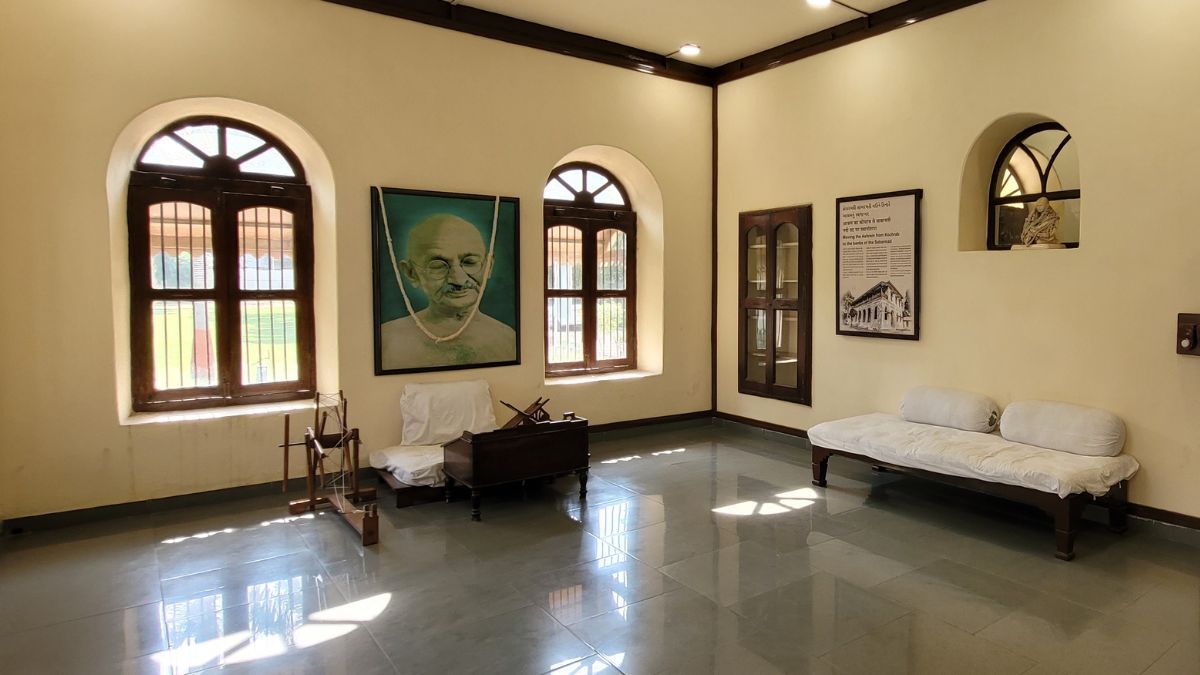
Seventy-seven years to the day of his assassination by Nathuram Godse on January 30, 1948, Mahatma Gandhi’s ideology lives on, giving hope in a world torn apart by conflict.
Say ‘Gandhi’ and the Sabarmati Ashram in Ahmedabad comes to mind straight away. But even before that was the Satyagraha Ashram, which stands as a testament to his way of life even today. When Mohandas Karamchand Gandhi returned to India after 21 years in South Africa, he was already being hailed by Indians as the Mahatma. At the time, Seth Mangaldas Girdharidas, patriarch of the family behind the luxury hotel The House of MG, convinced Gandhi to set up his first ashram in India. MG even offered to fund the first year’s functioning of the ashram at Kochrab, which came into being on May 25, 1915. A number of people moved in to live and work here at that time. It was only two years later after the plague hit Ahmedabad that Gandhi and his entourage moved to the Sabarmati Ashram on the banks of the Sabarmati River as the open area was considered more hygienic.
A few months ago, thanks to a stay at the beautifully designed jüSTa Diwan’s Bungalow, the ancestral home of celebrated architect IM Kadri, I found out about the original ashram and planned a visit. His great-grandfather Sayad Bavamiyan Kadri, who was the Diwan of Radhanpur, hosted many luminaries during India’s freedom struggle and was even visited by Gandhi. Kadri strongly recommended a visit to the Satyagraha Ashram in Ahmedabad’s Kochrab area.
The ashram today

The beautifully maintained colonial house that once belonged to a barrister named Jivanlal Desai, is set in well-maintained grounds. The Satyagraha Ashram comprises the main house and a few outhouses that used to be the communal kitchen, traditional latrines, and bath areas. The caretakers live in what was once the workshop where the weaving on the charkha was carried out by inmates. A modern auditorium built on the premises is used for public as well as private functions and programmes dedicated to keeping the Gandhi legacy alive.
You have to take off your shoes to enter the house. The ground level has a generous porch and large, airy rooms that have plenty of sunlight splashing in through the barred windows. Gandhi’s room and his wife Kasturba’s opposite are as spartan as you’d expect – a charkha, a writing table, a mattress with bolsters and a few cupboards built into the wall. On the floor above, a huge ‘conference hall’ with traditional seating is perhaps where some vital plans for the country were discussed.
Throughout, the polished wooden floors and freshly painted walls echo with memories of the erstwhile residents of the ashram. There were about 40 to 50 ‘ashramites’ at any given time. A sign details their daily activities and meals, giving the visitor an insight into the simplicity of their lives.
Life in the ashram
A gong on the first floor was rung at 4am daily (often by Gandhi himself), and everyone, except those who were ill, was expected to be up by 4.30am and bathed and ready for the day by 5am.
The day had hours set aside for prayers and reading, manual work that helped to keep the ashram running (cleaning of utensils, drawing water from the well, weaving, cooking, grinding, sweeping, etc), and schoolwork that included the study of Sanskrit, Gujarati, Tamil, Hindi, Arithmetic, History, and Geography. Meals were largely centred around fruit and simple dishes such as dal, rice, vegetables, and rotlis, eaten five days of a week.
Defining the ashram’s ideology
One wonders why ashrams like these existed in the first place. Walking around the house and reading all the information, I learned that the objective was delineated by Gandhi in a ‘constitution’. He defined it as a demonstration of ‘how to learn to serve the motherland one’s whole life’.
It's interesting to note that this ashram was where Gandhi first struck out against the abhorrent practice of untouchability. He invited a man called Dudabhai and his family into the folds of the ashram, although many inmates, including his wife Kasturba, were against the admittance of the lowest caste. He lost funding as a result but approached illustrious (and more forward-thinking) industrialist Ambala Sarabhai for help to sustain the ashram.
The Satyagraha Ashram in Ahmedabad is an excellent way to experience a slice of India’s history in a very quiet setting that is not overrun with hordes of tourists.
