



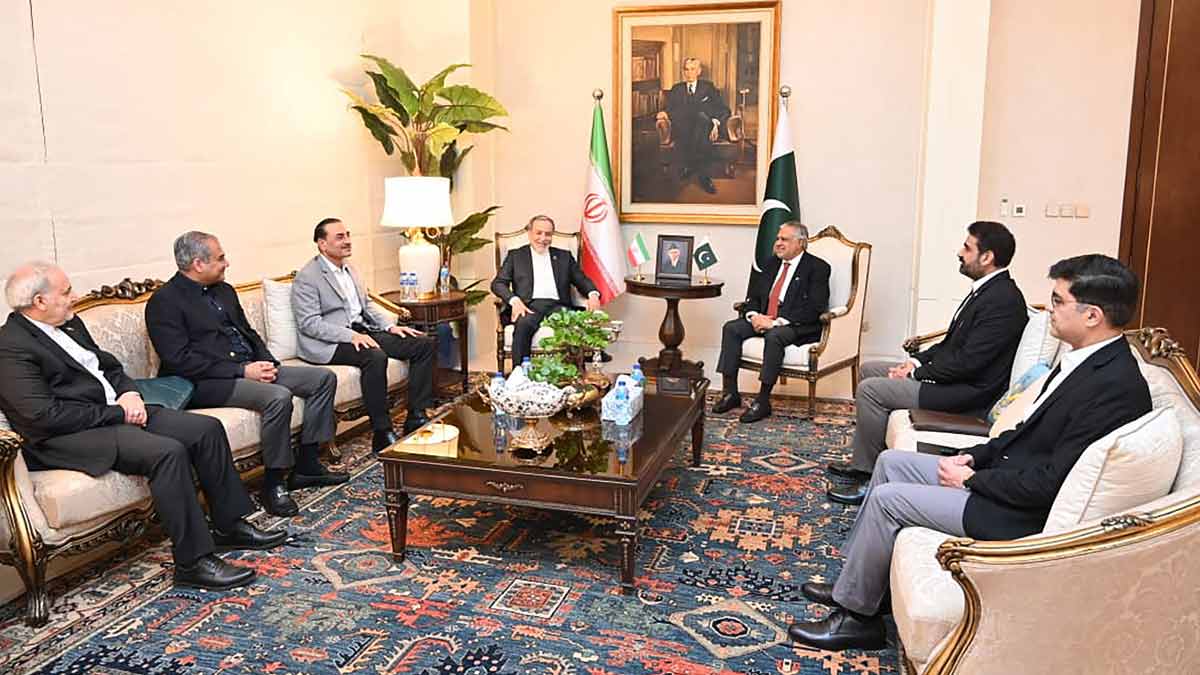
With the arrival of Iranian Foreign Minister Abbas Araghchi in Islamabad late last night, yet another fragile diplomatic opening has re-emerged around a war that has now dragged into its eighth week. His visit, described by Tehran as a “timely tour”, signals a renewed attempt to test pathways towards de-escalation, even as the conflict continues to harden on multiple fronts.
Yet expectations remain understandably tempered. Iranian officials have made it clear that there will be no direct engagement with American representatives. Instead, Araghchi’s mission relies on a mediated channel: Pakistan’s leadership will receive Tehran’s proposals and observations before relaying them to Washington. It is a familiar diplomatic workaround, but one that underscores the depth of mistrust between the two sides.
Notably absent from this round is Parliamentary Speaker Mohammad Bagher Ghalibaf, who led Iran’s negotiating team in earlier talks. His absence has fuelled speculation about internal recalibrations within Tehran’s power structure, though officials have publicly dismissed rumours of his resignation. Araghchi’s itinerary extends beyond Islamabad, with planned stops in Oman—where discussions will centre on the governance of the Strait of Hormuz—and Russia, where the groundwork for broader peace negotiations may be explored.
Washington, for its part, has responded with cautious openness. President Donald Trump has announced that he is sending his Middle East envoys, Steve Witkoff and Jared Kushner, to Islamabad to assess Iran’s position. At the moment, they are likely to leave the US tomorrow. The choice of envoys reflects a deliberate strategy: exploratory, deniable and short of high-level political commitment. Vice President J.D. Vance, who led the initial round of talks, remains in Washington on standby, signalling that any substantive breakthrough would quickly escalate to senior-level engagement.
Analysts believe the process aims to test intentions without overcommitting political capital, in what they call a “graded diplomatic process”. However, it only creates space for negotiations, without doing much to resolve the underlying tensions. And those tensions remain stark. The US continues to insist on verifiable guarantees that Iran will abandon its nuclear weapons ambitions entirely. Defence Secretary Pete Hegseth said yesterday that Tehran still had an opportunity to secure a “good deal”, but only if it relinquishes its nuclear programme in full.
Tehran, however, is reframing the conversation. According to foreign ministry spokesman Esmail Baghaei, the central issue is no longer narrowly nuclear but fundamentally about ending the war itself. Iran’s demands are sweeping: a permanent cessation of hostilities by both the US and Israel, formal non-aggression commitments, compensation for damages and the lifting of sanctions and naval blockades.
Bridging this gap will not be easy, though a novel proposal has begun to circulate. Under this framework, Iran would divide its roughly 400kg stockpile of highly enriched uranium into smaller parcels and gradually dilute them, with each step matched by targeted sanctions relief from Washington.
Russia may play a role in this arrangement. During Araghchi’s expected visit to Moscow, the Kremlin is likely to revive an earlier offer to take custody of part of Iran’s uranium stockpile, thereby reducing proliferation risks. At the same time, Tehran is exploring whether China could act as a guarantor for any eventual agreement, adding another layer to an already complex diplomatic matrix.
While diplomats manoeuvre, the conflict’s most volatile expression remains the Strait of Hormuz. The narrow waterway has effectively become the epicentre of a dangerous naval confrontation, with both sides enforcing rival blockades. The United States has significantly escalated its presence, with Hegseth announcing that operations have “gone global” and now involve multiple carrier groups. No vessel, he warned, can transit the strait without US approval.
Washington claims to have turned back dozens of ships and has issued stark warnings against any Iranian attempt to deploy naval mines. Hegseth has gone further, accusing Iranian forces of behaving like “pirates with flags”, a characterisation that reflects the increasingly confrontational tone of the standoff.
Iranian forces have attacked several vessels and seized others, showing that the country still has the ability to disrupt maritime traffic even with the US dominating the waters. Senior Iranian figures, including Ghalibaf and President Masoud Pezeshkian, have made clear that reopening the strait is out of the question under present conditions, particularly while US naval pressure continues and Israeli operations press on.
Despite the tough talk, some traffic through the strait has continued, though the risks are considerably higher than before. But the situation remains tenuous, with both sides ready to escalate at short notice.
The US has also stepped up its economic warfare. Latest measures include sanctions against a Chinese refinery processing Iranian hydrocarbons and dozens of other entities. The Treasury department has also frozen crypto assets worth hundreds of millions of dollars to stifle alternative financial channels.
On the regional diplomatic front, the continuing conflict is intensifying realignments. Gulf states such as Saudi Arabia and the UAE have indicated that Iran has done lasting damage to its ties with neighbouring states, which could speed up a realignment that has been quietly building for years. Riyadh and Abu Dhabi could still consider closer coordination with Israel, marking a fundamental reshaping of the Middle East's strategic order, even as diplomats in Islamabad work to find a way to end the fighting.
