



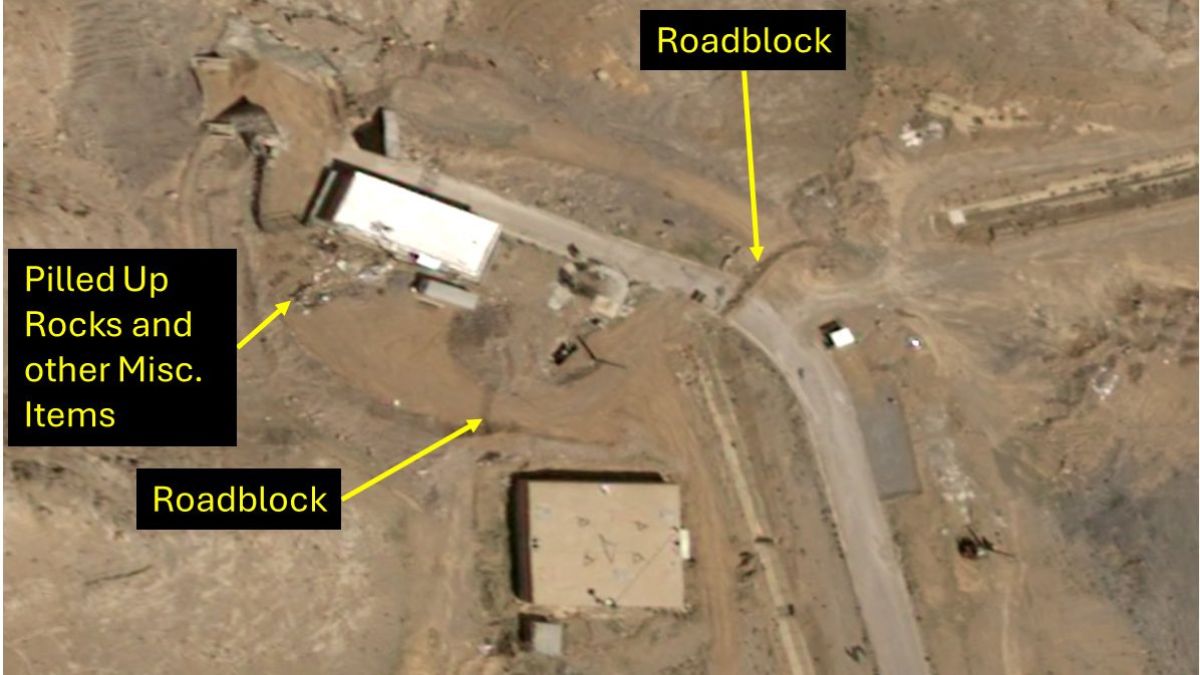
Amid reports that the US was mulling a special operation involving elite forces to remove 450 kilograms of enriched uranium stockpile, satellite images show Iran is preparing for the possibility by reinforcing its Isfahan nuclear facility with checkpoints and fortifications to deter a ground raid.
Satellite images show Iran is putting up earthen barriers, fences, piles of rubble and roadblocks in front of the three entrances to the facility’s tunnels. The construction of the defences began around March 18, reports quoting the Institute for Science and International Security. This, according to experts, is to delay any ground incursions and expose attacking forces to Iranian missile fire.
The underground complex in Isfahan has long been suspected of being the main storage location for Iran's stockpile of highly enriched uranium. The Director General of the International Atomic Energy Agency (IAEA), Raphael Grossi, stated that the complex holds at least half of Iran's stockpile of uranium enriched to a threshold level.
The satellite photos reveal that between March 18 and April 8, major changes took place at the site: barriers were added in front of the three entrances to the underground complex, which did not exist before. Notable is the southern entrance, where satellite photographs showed trucks arrived with 18 barrels, which are said to have contained an enriched uranium stockpile.
Two new barriers have now been placed there: a two-meter-wide dirt embankment and another barrier made of an unidentified material. Two vehicles parked at the nearby checkpoint testify to ongoing activity and security surveillance at the site.
Significant changes were also observed in the other two entrances. At the middle entrance, which was completely vacant in March, two dirt barriers and new fences have been erected. At the northern entrance, a large pile of dirt blocks the main road, and two more barriers have been added on the bypass road.
In June 2025, during the 12-day war, the mouths of the tunnels were attacked by the US and Israel. Since then, the public assessment in Israel and the US is that the reservoir is buried in the depths of the mountain.
According to the report, the barriers "are apparently intended to further limit traffic towards the tunnel complex, and to add complexity to any ground operation that seeks to enter it and seize the enriched uranium stored there." The institute notes that the barriers can be cleared using bulldozers and excavators, but "this will extend the schedule required to clear the tunnel openings and establish ground access."
Throughout the war, it was reported that Trump would launch a military operation to capture the enriched uranium. Military experts described the mission as one of the most complex, one that would require the occupation of Iranian territory, under constant fire and complex engineering operations. After announcing the ceasefire, Trump wrote on social media: "There will be no uranium enrichment, and the US will work, together with Iran, to dig up and remove all the nuclear dust buried deep. The material is under very precise satellite tracking.'
