



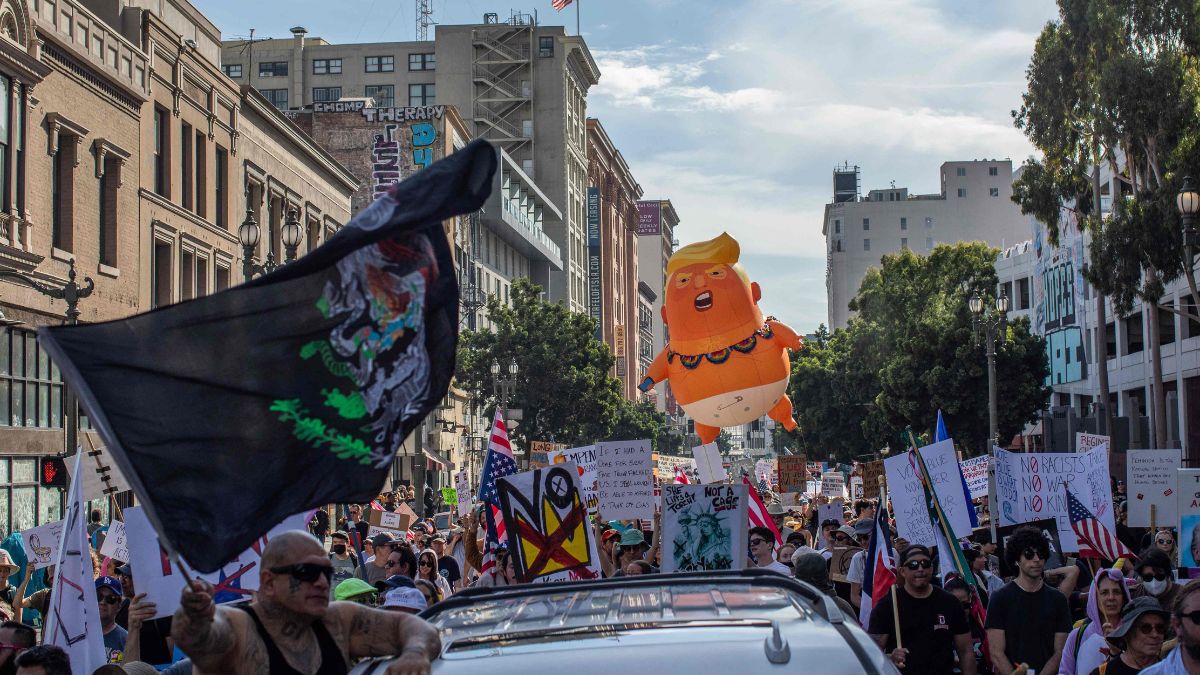
A month after the United States launched the war against Iran, the political mood in the country had shifted sharply against both the conflict and the president who ordered it. The customary surge of national solidarity that tends to happen at the opening of a war has not materialised. Instead, President Donald Trump finds himself confronting scepticism from across the political spectrum, and the polling numbers make for uncomfortable reading at the White House.
A clear majority of Americans now believe the decision to go to war was wrong. Disapproval of Trump's handling of the crisis has climbed above 60 per cent. Nearly as many say that military action should never have been authorised in the first place. For an administration that framed the operation as a demonstration of resolve, the domestic reaction has been the opposite of what was intended.
What is striking is not just the scale of the opposition but its texture. Americans are not simply reacting to the outbreak of fighting. They are anxious about what comes next. The memories of Iraq and Afghanistan have not faded, and there is a widespread and deeply felt reluctance to stumble into another prolonged engagement in the Middle East. The mere suggestion that ground troops might eventually be deployed has alarmed voters who fear a limited operation could spiral into something far larger and more costly.
Economic pressures are feeding that anxiety. Petrol prices, now approaching four dollars a gallon, have given the war an unwelcome presence in daily life. Presidents who allow foreign policy and household economics to become entangled in the public mind tend to pay a heavy price for it, and Trump seems caught in that trap. A large proportion of Americans believe the conflict will ultimately leave both the United States and the world less safe, an alarming situation for the president.
Even more worrying for the White House is the opposition from independent voters, who typically determine the outcome of close elections. Along with Democrats, they have turned against the war by a substantial margin. It could turn out to be a major problem for Trump and the Republican Party in the upcoming midterm polls.
Republicans, for their part, remain largely supportive. The president's base has not abandoned him, and at conservative gatherings, the war is often framed as an overdue reckoning with a hostile regime. But even within the Republican coalition, the unity is incomplete. A generational and ideological fault line has opened up that could widen if the conflict drags on. Many younger conservatives feel that military action in the Middle East goes against the America First message that defined Trump's political identity. He promised to end endless wars, not to begin new ones. For these voters, that tension is difficult to ignore, and while their disillusionment may not push them towards the Democrats, it is quietly draining enthusiasm for the president.
Prominent voices on the right have also begun to raise questions — about the strategic rationale for the war, about its economic consequences, and about the absence of any visible exit strategy. Within Congress, unease is growing on both sides of the aisle, though it has not yet translated into meaningful legislative action. A War Powers resolution that might have constrained the president's freedom of manoeuvre was narrowly defeated in the Senate, and House Democratic leaders have been reluctant to force a confrontation that could backfire politically.
Meanwhile, the administration has struggled to project clarity. Trump has veered between claiming decisive success and hinting that Iran is seeking a diplomatic way out. The rhetoric has been unpredictable enough that lawmakers from both parties have complained privately about being kept in the dark. This absence of a coherent narrative makes it harder for supporters to defend the war and easier for critics to define it on their own terms.
American political history offers several cautionary examples. When foreign military difficulties coincide with domestic economic strain, presidential approval ratings can collapse with remarkable speed. Lyndon Johnson and George W. Bush both discovered how quickly public patience runs out when a war defies easy resolution. Trump now faces a similar situation.
The conflict with Iran was supposed to show that the United States, under his leadership, was not to be trifled with. A month in, it risks showing something rather different — that overreach abroad and economic pain at home are a combination that even a loyal base cannot indefinitely absorb.
