



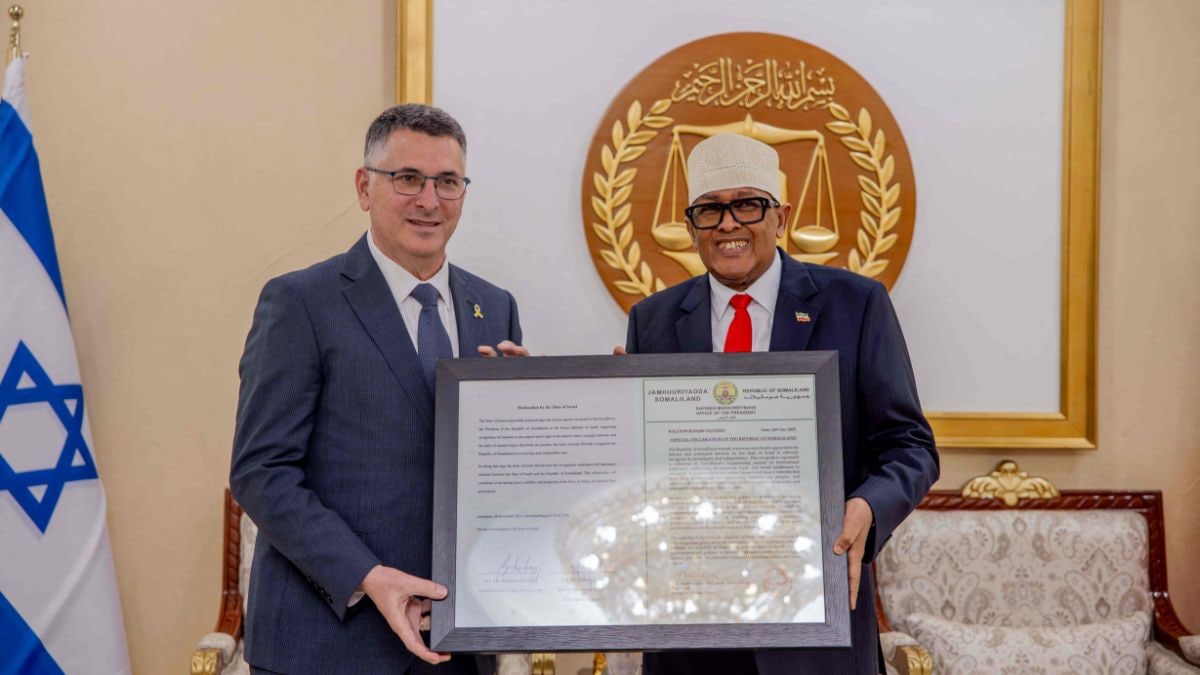
Israeli Foreign Minister Gideon Sa’ar visited Somaliland on January 6, 10 days after his country formally recognised the territory as an independent and sovereign state. “We are determined to vigorously advance relations between Israel and Somaliland,” Sa’ar told Somaliland President Abdirahman Mohamed Abdullahi, who received him in the capital Hargeisa. Sa’ar’s visit marked a significant shift in the geopolitics of the Horn of Africa, formalising a relationship that transformed a long-standing secessionist movement into a global diplomatic flashpoint.
Sa’ar promised that Israel would soon open an embassy in Hargeisa and appoint an ambassador. Calling Somaliland a "fully functioning state" and a "stable democracy", he made a pointed comparison with the Palestinian cause, arguing that, unlike Palestine, Somaliland is not a "virtual state", but an established reality. It showed the dual purpose of the visit: even as it tries to secure a strategic presence in the Red Sea, Israel is also keen to challenge the traditional norms of state recognition.
The key drive behind Israel’s recognition of Somaliland is security concerns in the Red Sea region. For the past couple of years, Jerusalem has been worried about the growing profile and capabilities of the Houthis in Yemen, as they target Israeli interests and disrupt key shipping routes. In Somaliland, situated across the Gulf of Aden from Yemen, it is a critical location for counter-terrorism operations and maritime security. In fact, there were reports that Mossad played a key role in persuading the Netanyahu government to formally establish diplomatic ties with Somaliland, pointing to the deep intelligence cooperation between the two.
Somaliland sees Israel’s recognition as a rare opportunity to gain international legitimacy. Since declaring de facto independence in 1991, it has been waiting for the international community to take note. Hargeisa views Israel as a potential gateway to broader international support, particularly from the United States, as it seeks investment and security guarantees.
Somalia’s response to Sa’ar’s visit has been swift and strong. Mogadishu condemned Sa’ar’s visit as an "unauthorised incursion" and a violation of Somalia’s sovereignty. President Hassan Sheikh Mohamud warned that Israel’s recognition of Somaliland would destabilise an already volatile region. Somalia’s partners like Turkey and Egypt, too, have condemned the Israeli move. Turkey, which has significant economic and military investments in Somalia, sent a deep-sea drilling vessel to Somali waters to show its support. Egypt, meanwhile, sees Somalia as a counterweight to Ethiopia, with which it has a long-standing dispute over the Grand Ethiopian Renaissance Dam. Cairo believes that a united Somalia will help its cause further.
The US, meanwhile, has taken a more nuanced stance. While the state department continues to recognise Somalia’s territorial integrity, several key political figures have welcomed the Israeli move. For instance, Ted Cruz, the Republican senator from Texas and former presidential candidate, said the recognition aligned with American security interests in the region. Somaliland is expecting more US politicians to join Cruz and support its cause.
The role of the United Arab Emirates also appears interesting. It is yet to officially condemn Israel’s move, and in fact, continues to manage the Berbera port in Somaliland, a key strategic asset. It is evident that there is a convergence of interest between Israel and the UAE in the Red Sea. Abu Dhabi may be supporting Somaliland quietly while avoiding drawing attention, as it does not want to provoke the wider Arab world.
Somaliland, meanwhile, is not a homogeneous entity. There are territories and populations in Somaliland that are opposed to formal independence and prefer to stay with Somalia. If more countries start recognising Somaliland’s sovereignty, that could lead to yet another civil war.
A formal recognition of Somaliland by more countries could escalate tensions in the wider Horn of Africa. The Houthis have already warned that Israeli presence in Somaliland would be considered a "military target", which could make it another flashpoint. Moreover, Israel’s recognition of Somaliland has also raised concerns about the displacement of Palestinians, as there are several reports that hint that the territory could be used to host Palestinian refugees. Although Somaliland officials have denied those reports, the rumours continue to circulate.
