



“There are no small teams in this Arab Cup,” said Algerian midfielder Adam Ounas after a 2-0 win against Iraq on December 9 in the 2025 Arab Cup. That may sound like your classic media-trained statement, especially coming from Ounas, who has high-level exposure, having spent almost a decade playing in Europe for the likes of Bordeaux, Napoli, Nice, Cagliari and Lille. But, a week before the Iraq win, Algeria, reigning Arab Cup champions and ranked 35th in the world, was held to a 0-0 draw by 118-ranked Sudan.
Moreover, 34-ranked Egypt had been knocked out from a group consisting of Jordan, the UAE and Kuwait (ranked 66, 67 and 135, respectively) mere hours before Ounas spoke. And, two days ago, Group A had come to a remarkable conclusion with 96-ranked Palestine first and 87-ranked Syria second, ahead of Tunisia (40) and the hosts Qatar (51). Both Egypt and Qatar finished the 2025 Arab Cup winless. So, Ounas was very much warning his teammates not to be complacent.
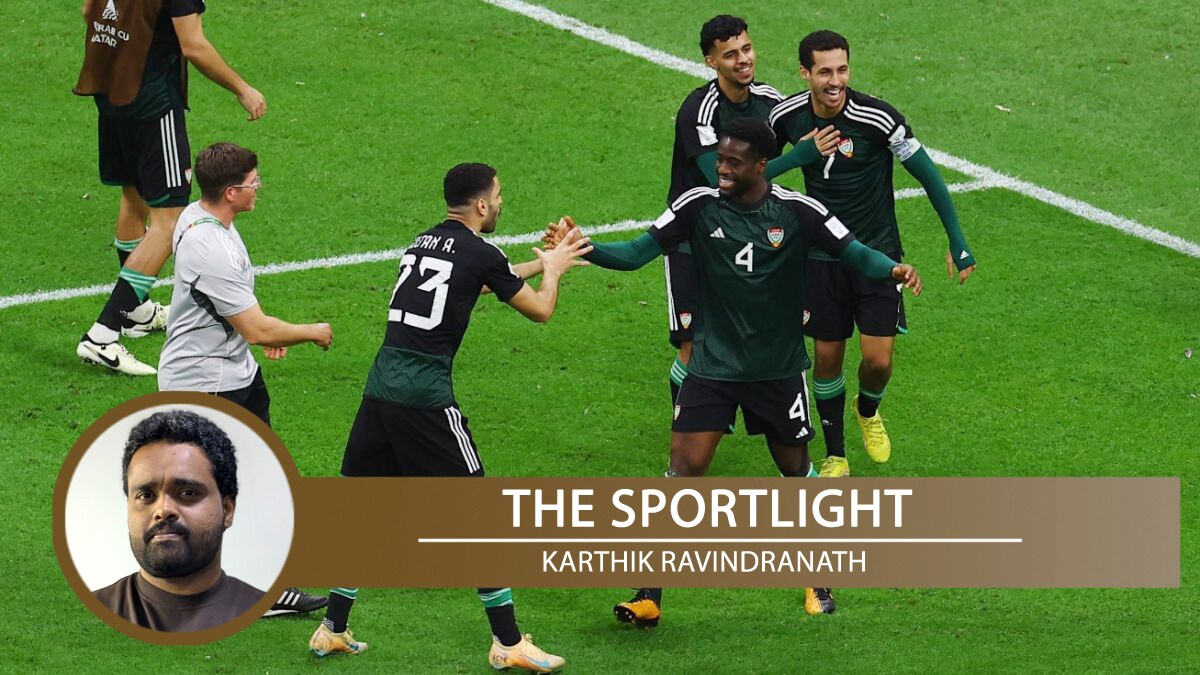
The quarterfinals on December 11 and 12 showed how right he was. Palestine pushed Saudi Arabia all the way before succumbing to a 2-1 defeat after extra time. Morocco—the highest ranked team in the tournament (11)—only beat Syria by a solitary goal. And, Algeria were eliminated on penalties by the UAE. In the semifinals (December 15), big-spending Saudi Arabia will face a tough test against Jordan. However, for the UAE, Morocco is expected to be too much to overcome. But, then again, the Emiratis will go in with no fear, whereas Morocco has everything to lose, especially ahead of hosting the Africa Cup of Nations next week.
So, what exactly is going on in the world of Arab football? Has the dominance of north African teams come to an end? The short answer is no. Firstly, Morocco are likely to end up winning the tournament. Secondly, the stronger teams in the Arab Cup often treat it as a secondary tournament, using a predominantly second-string squad. However, despite this, the results in this edition of the Arab Cup reveal a few significant trends.
For instance, though Egypt did not have its bona fide superstars like Mo Salah and Omar Marmoush, its failure was still surprising and highlighted problems with domestic depth. The domestic players in the Egypt national team, especially those from powerhouse clubs like Al Ahly, are considered vastly superior to the domestic players in Jordan or the UAE. Egypt's squad included stars like Mohamed Magdy Afsha and Mohamed Elneny (formerly of Arsenal). Similarly the Algerian squad featured superstar, albeit ageing ones, like Yacine Brahimi and Islam Slimani. So the fact that north Africa’s ‘best of the rest’ could not beat Jordan and the UAE indicates that the gap in domestic talent development has shrunk significantly.
The results are also a mental and tactical victory for the Asian teams, which no longer seem intimidated by the reputation of north African football. This is a result of strong tactical preparation and confidence that has built slowly through many gritty displays.
As a result the Asian teams have not only the belief, but also the structure necessary to get these results.
In Jordan’s case, the growth has been abundantly clear—they are set to make their World Cup debut in a few months. However, the UAE narrowly missed out on the intercontinental play-offs. Despite this, the UAE’s gains from its investment in youth and technical skill is paying off. The ‘Gulf Model’ seems to be particularly effective in developing attacking talent, like Yahya Al Ghassani. The use of naturalised players like Nicolas Gimenez and Luanzinho have also added a layer of technical finesse.
For the north African teams, while there would be disappointment with the showing at the Arab Cup, they will move on from it quickly as they gear up for bigger fair, like the AFCON. But, for Asian nations, these performances are likely to push them on to greater heights. For them the Arab Cup is a necessary stress test and a key avenue for learning.
