



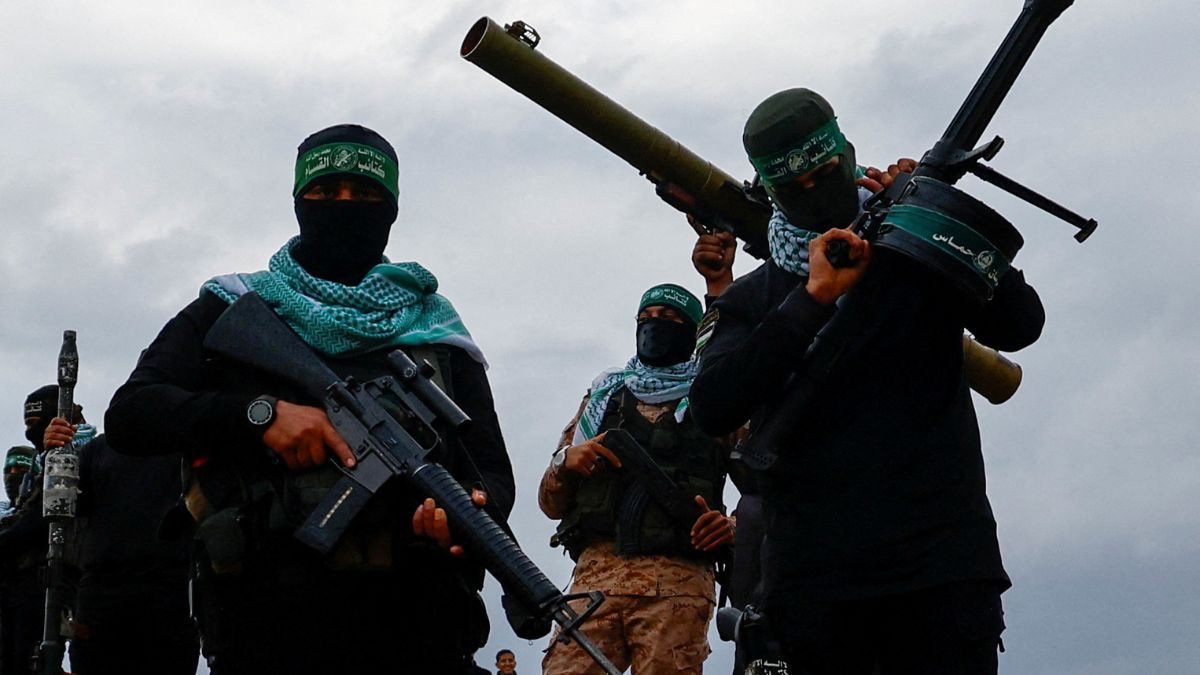
US President Donald Trump imposed a Sunday (October 5) evening deadline for Hamas to accept his 20‑point Gaza peace proposal, issuing a stark warning that failure to comply will unleash “all HELL, like no one has ever seen before” on the militant group.
In a lengthy post on his social media platform, Truth Social, Trump declared that this was the “LAST CHANCE” for Hamas—and that if the agreement was rejected, the consequences would be catastrophic. He asserted that thousands of Hamas fighters were “trapped” and could be neutralised at his command. He also reaffirmed unwavering American support for Israel, pledging to help “finish the job” of eliminating Hamas if the group refuses his terms.
The Trump ultimatum appears to have prompted Hamas to take action, as the group issued a statement late on Friday night saying it was prepared to release all hostages—both living and deceased—if appropriate conditions for an exchange were met. Trump was quick to claim victory on Truth Social, writing that Hamas was ready for a "lasting PEACE". He urged Israeli Prime Minister Benjamin Netanyahu to immediately halt attacks on Gaza to ensure the hostages could be released safely.
Hamas also expressed its willingness to hand over the administration of Gaza to a Palestinian technocratic body based on national consensus and backed by support from the Arab and Islamic world. However, the group remained silent on demands regarding disarmament and relinquishing any future role in Gaza. “President Trump's statements are encouraging, and the movement is ready to begin negotiations immediately to achieve a prisoner exchange, end the war, and secure the withdrawal of the occupation,” said Tahir al-Nounou, media adviser to the head of Hamas's political bureau, in a statement.
The 20‑point plan, jointly unveiled with Netanyahu earlier this week, centres on immediate hostage release, sweeping disarmament and a technocratic interim governance structure for Gaza. Under the proposal, all hostages held by Hamas and the remains of those dead, would be released within 72 hours of agreement, in exchange for hundreds of Gazan detainees. Hamas would be dismantled politically and militarily, while Gaza would enter a transitional phase of stewardship under an international “Board of Peace”, chaired by Trump and possibly involving figures such as former British prime minister Tony Blair. A technocratic Palestinian committee, excluding Hamas representatives, will run the day-to-day administration.
On the security front, the plan calls for a phased Israeli withdrawal, replaced by an “International Stabilisation Force” (ISF) drawn from Arab /Muslim nations. Full humanitarian access would be granted immediately once the deal is accepted.
Though Israel has publicly backed the framework and announced on Saturday that it is preparing to implement the first stage of the plan, Prime Minister Netanyahu maintains that he opposes any solution premised on a Palestinian state—an omission that underscores how the plan seeks only a short‑term stabilisation rather than a lasting political settlement.
It remains to be seen whether Hamas will fully agree to a plan that presents an existential dilemma for it. The plan demands its dissolution, stripping it of both political authority and military capacity. Accepting it would amount to political suicide for the group which has controlled the Gaza strip for nearly two decades. The demand for the immediate release of all hostages removes the group’s primary bargaining leverage. That could be the reason why the group insists on certain conditions being met for the release of the hostages. Hamas wants a long‑term ceasefire and a comprehensive Israeli withdrawal—conditions Netanyahu has already rejected.
Some voices inside Hamas have grown defiant. “Despite the criminal extermination being carried out by this criminal enemy, this resistance will continue to exist until our people achieve their goals and desires,” said Abdel Jabbar Saeed, a Hamas official in Qatar. Meanwhile, Belal Rayan, the son of a long‑dead hardline leader killed by Israel, wrote on X that accepting the Trump plan would amount to “political suicide that will destroy the Palestinian cause”.
Despite Trump’s aggressive ultimatum and Hamas’s apparent willingness to consider the peace plan, it faces serious headwinds. It fails to grapple with the root political conflict: by demanding that Hamas disarm and be expelled from governance, it risks annihilating the group’s legitimacy and base of support. The proposal authorises continued military pressure until compliance, perpetuating the asymmetry between Israel and Gaza rather than resolving it.
Many Palestinians believe that the plan lacks legitimacy, especially because it excludes their own voices, and is dominated by foreign overseers. Not even the Palestinian Authority seems to have a say in running their affairs in the interim. They are also unsettled by the absence of a clear commitment to Palestinian statehood. Netanyahu’s rejection of the two‑state paradigm makes the plan’s long‑term credibility doubtful.
Finally, its implementation presents massive logistical challenges. The notion of an entirely new and untested ISF is fraught with complexity. No existing framework or infrastructure exists to deploy it swiftly and credibly. If the ISF is viewed as an enforcer of Israeli will rather than a neutral peacekeeping body, it could deepen resentment and resistance.
Across the region, reactions to the peace plan have ranged from cautious support to outright scepticism. Saudi Arabia, Qatar, the UAE, Egypt and Turkey have expressed varying degrees of endorsement—mostly symbolic—while many observers interpret their posture as signalling diplomacy rather than firm commitment.
