



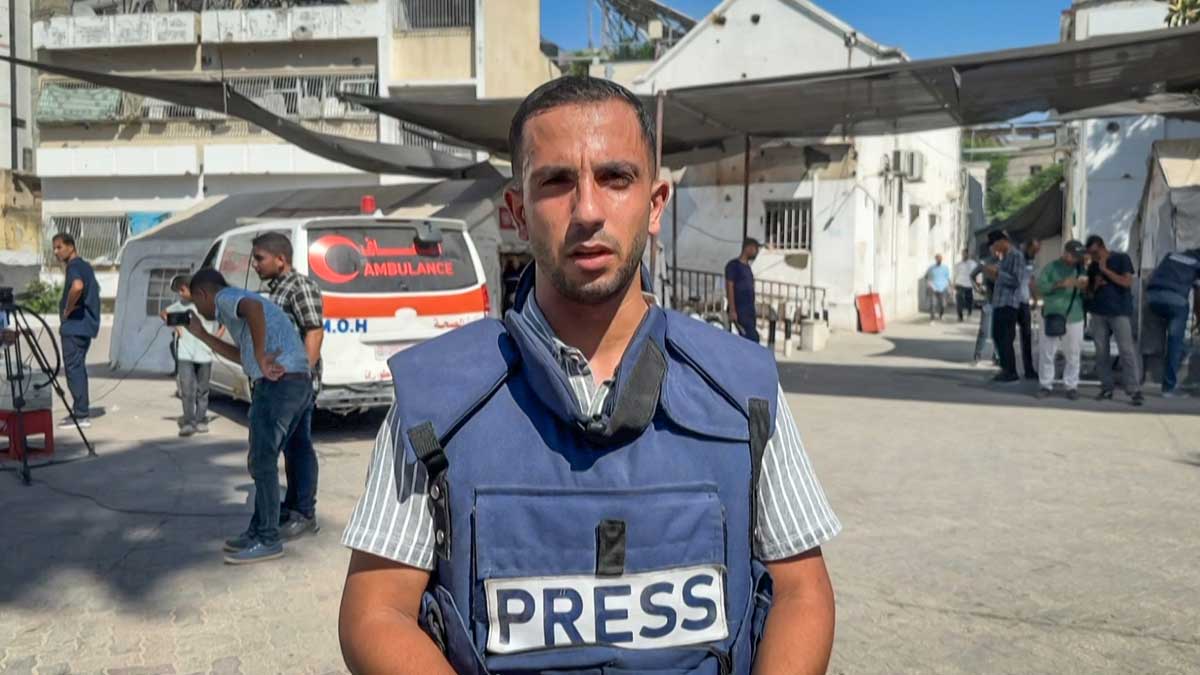
The death of prominent Al Jazeera journalist Anas al-Sharif in an Israeli airstrike on Sunday night has sparked international outrage. Sharif, one of the network’s most recognisable faces in Gaza, was killed along with four colleagues while sheltering in a journalists’ tent outside al-Shifa hospital in Gaza City. The Israel Defense Forces (IDF) immediately took responsibility for the strike, the first time it had done so after a journalist’s death during the conflict. The IDF said Sharif was a Hamas cell leader involved in rocket attacks against Israel, allegations he and Al Jazeera had previously rejected. The IDF also released photographs showing Sharif with former Hamas leader Yahya Sinwar, taken before Hamas’s attack on Israel on October 7, 2023.
The army said documents found in Gaza proved Sharif was a member of Hamas’s East Jabalia Battalion, heading a rocket-launching squad and belonging to the elite Nukhba Force. It claimed these included personnel rosters, training course lists, phone directories, and salary records. Only partial, declassified material has been released, including screenshots of spreadsheets allegedly naming Hamas operatives and a phone directory section. The BBC said it could not independently verify the documents and had seen no evidence linking Sharif to current hostilities or confirming he remained an active Hamas member.
Many pro-Israel commentators on social media praised the strike, while rights groups, governments and international organisations condemned it. Sara Qudah, Middle East and North Africa director at the Committee to Protect Journalists (CPJ), said Israel’s practice of labelling journalists as militants without credible evidence raised serious concerns about its respect for press freedom. Reporters Without Borders described the killings as an “acknowledged murder” by the Israeli army and called for international intervention.
The UN human rights office condemned the targeting of the journalists’ tent as a “grave breach of international humanitarian law” and urged Israel to respect and protect all civilians, including journalists. It called for immediate, safe, and unhindered access to Gaza for the press.
In London, a spokesperson for Prime Minister Keir Starmer said the UK government was gravely concerned by the repeated targeting of journalists in Gaza. They stressed that under international humanitarian law, reporters covering conflicts must be able to work independently and without fear, and Israel must ensure their safety. The Foreign Press Association said it was outraged by what it called the targeted killing, accusing Israel of routinely branding Palestinian journalists as militants without verifiable proof.
Al Jazeera said the strike was a desperate attempt to silence voices ahead of Israel’s planned occupation of Gaza, calling Sharif “one of Gaza’s bravest journalists”. Friends, relatives and colleagues carried the bodies of the dead through Gaza City before burial at Sheikh Radwan cemetery.
Israel has barred foreign journalists from entering Gaza, leaving the task of reporting to Palestinian journalists, many of whom have been killed or displaced. The CPJ has confirmed at least 186 deaths, the highest toll since it began keeping records in 1992. The Watson School of International and Public Affairs’ Costs of War project reported that more journalists have been killed in Gaza than in both world wars, the Vietnam war, the Yugoslav conflicts and the US war in Afghanistan combined.
The strike has strained already complex ties between Israel and Qatar, which funds Al Jazeera and has served as a mediator in ceasefire talks. Qatari Prime Minister and Foreign Minister Sheikh Mohammed bin Abdulrahman al-Thani said the deliberate targeting of journalists revealed crimes beyond imagination and highlighted the inability of international law to stop the tragedy.
Qatar hosts Hamas’s political office and has provided significant financial aid to Gaza with Israel’s knowledge. While playing a central role in mediation, it has increasingly been criticised by right-wing Israeli politicians and commentators. Last week, Yair Netanyahu, son of the Israeli prime minister, accused Qatar of funding a rise in global antisemitism.
Israel’s antagonistic relationship with Al Jazeera has deepened during the war. In 2024 it ordered the network to shut its West Bank operations. While foreign media have been denied entry to Gaza, Al Jazeera has maintained a presence there, broadcasting daily reports on the humanitarian crisis.
The network’s journalists have been targeted before. Last year, Ismail al-Ghoul was killed in an Israeli airstrike along with another reporter. In March, Hussam Shabat also died in a strike. The IDF accused them of being members of Hamas’s armed wing, claims Al Jazeera disputed.
International news agencies including the BBC, Reuters, AP and AFP have warned of deteriorating conditions for Gaza-based journalists, who are struggling to feed themselves and their families. The Israeli government’s refusal to allow foreign media into the territory means these reporters remain the world’s primary source of on-the-ground information from the conflict zone.
Despite the global outcry, the IDF international spokesman, Lieutenant Colonel Nadav Shoshani said the army had current intelligence that Sharif was an active Hamas operative at the time of the strike. He claimed Sharif received salaries from Hamas and from Al Jazeera, which he described as a terrorist supporter. He added that the released documents were only a fraction of the intelligence available.
