



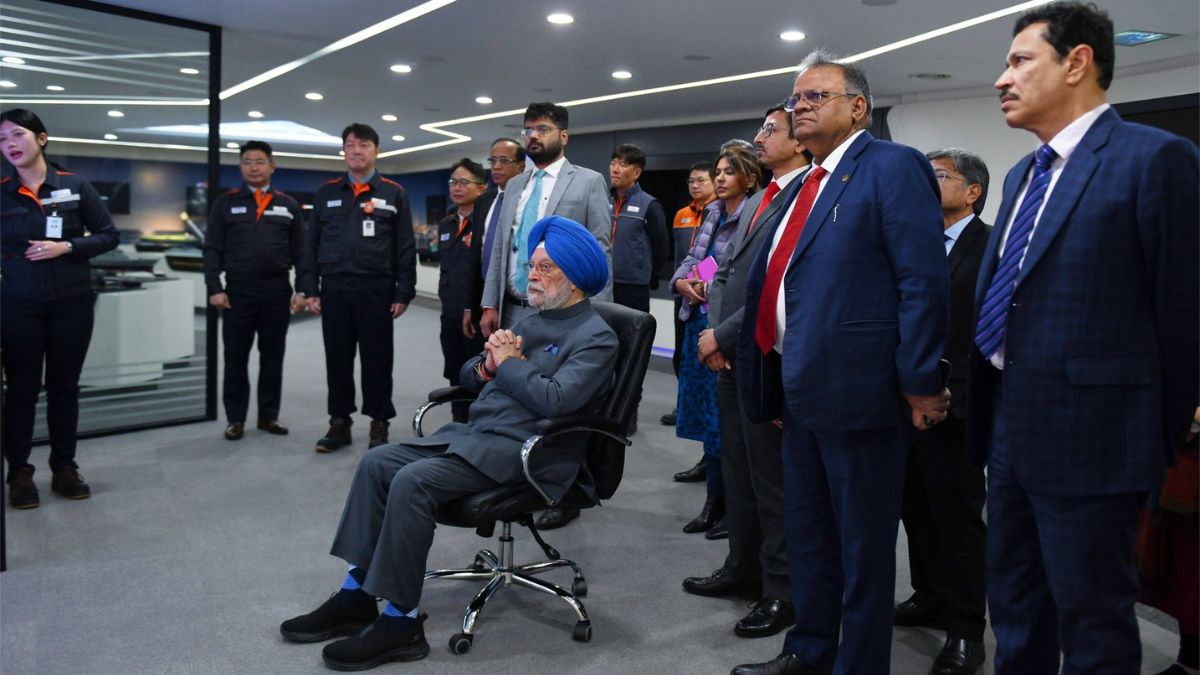
India and South Korea are looking to deepen maritime ties in line with India's Maritime Amrit Kaal 2047.
The onus is on reconciling New Delhi's expanding manufacturing prowess with Seoul's advanced shipbuilding technologies.
Union Minister for Petroleum and Natural Gas Hardeep Singh Puri, who was in South Korea from November 13-15, shared details of his meeting with important Korean shipping leaders in an X post.
"Witnessed the world’s largest shipyard at HD Hyundai Heavy Industries, Ulsan, and held fruitful meetings with Korea’s top shipping leaders," Puri wrote in the post.
He added that the discussions would aid in not only meeting India's growing energy needs, but also support global ship markets.
HD Hyundai Heavy Industries in Ulsan and Hanwha Ocean (a major shipbuilder) in Geoje were the two key companies that stood out among Puri's engagements in South Korea (posted online), and with which India is expected to majorly collaborate in the maritime field.
Over his three-day visit, the energy minister underscored that the strong performance of the Indian economy, combined with the rapid expansion of India’s energy sector, created significant opportunities for collaboration.
He also pointed out that India’s energy PSUs spend approximately $5-8 billion annually on freight, and have an immediate requirement of nearly 59 vessels.
Puri noted that this was because India’s energy imports—valued at more than $150 billion per annum—are entirely seaborne, and yet, only around one-fifth of this cargo is transported on Indian-flagged or Indian-owned ships.
With demand for crude oil, LNG, LPG, and ethane projected to rise sharply and the India's flagship energy major, the Oil and Natural Gas Corporation Limited (ONGC), expected to require nearly 100 offshore service and platform supply vessels by 2034, partnering with global shipbuilding leaders will be essential to expanding domestic capacity, he said.
The energy minister also declared he was confident that vessels built under such collaborative arrangements—or what he called the ‘Make in India for the World' plan—could recover costs within five years as it moved India closer to its goal of becoming a major global maritime hub.
