



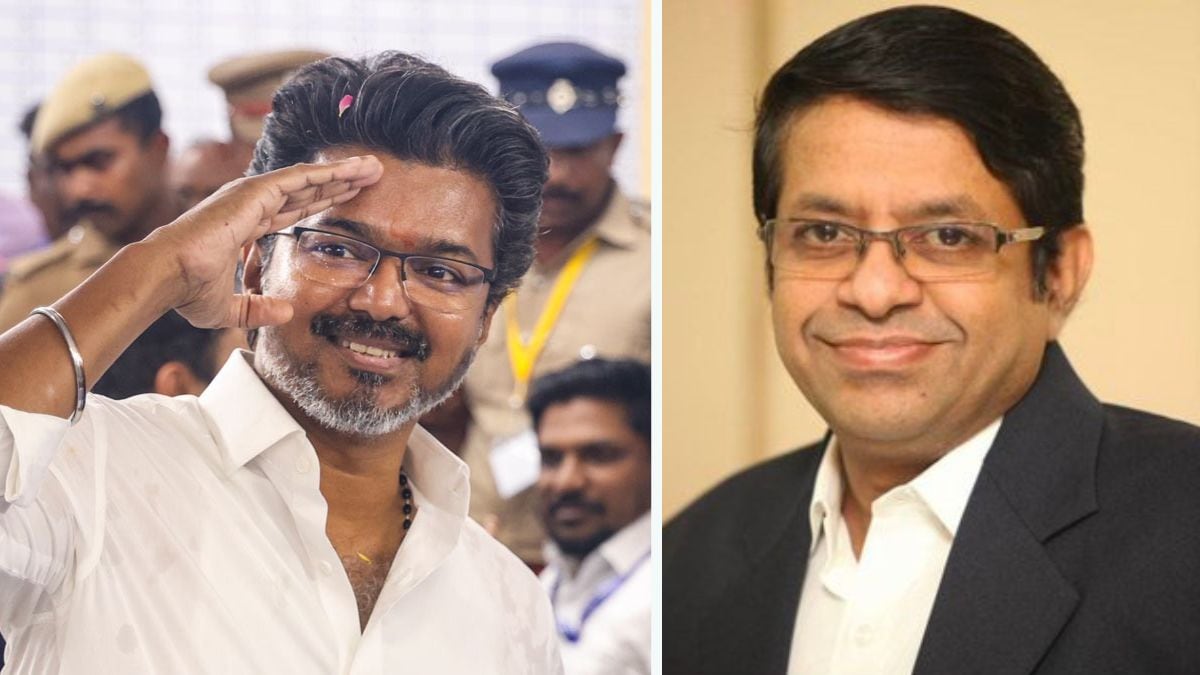
Tamil Nadu Chief Minister C. Joseph Vijay has appointed his personal astrologer, Rickey Radhan Pandit Vettrivel, as the Officer on Special Duty (Political) in the Chief Minister’s Office (CMO), triggering a row. The elevation of Radhan Pandit Vettrivel to a formal state functionary marks a watershed moment in the institutionalisation of spiritual advisory within the Tamil Nadu bureaucracy.
By transitioning from a private occult consultant to the officially designated Officer on Special Duty (OSD) to the chief minister, Vettrivel has effectively bridged the chasm between traditional belief systems and modern administrative machinery. This appointment does not merely suggest a personal preference of Vijay, but signals a structural shift in the 2026 political landscape where astrology and numerological vetting are being embedded into the state’s coordination process.
Within the strategic framework of the Tamilaga Vettri Kazhagam (TVK) victory, Vettrivel is looked at as the chief architect of astrological inevitability. During a period of scepticism regarding Vijay’s ability to dismantle the DMK-AIADMK duopoly, Vettrivel deployed a tsunami narrative, publicly asserting that Vijay’s horoscope possessed a disruptive force that would reshape the state’s political topography. This was not merely rhetoric; it was a prescriptive framework that governed the very formation of the party. Apparently, the TVK’s administrative foundation is built on the premise that planetary alignment is as vital as policy. By successfully predicting the breakthrough when mainstream pollsters remained cautious, Vettrivel leveraged social media momentum to validate his presence in the inner circle, signalling to the bureaucracy that administrative decisions now pass through a spiritual lens.
Who is Radhan Pandit Vettrivel?
Radhan Pandit Vettrivel is no new name in the Tamil Nadu political scenario. Hailing from Erode, his given name is Vetrivel. He was former chief minister Jayalalithaa’s astrologer for many years until 2014, when she was convicted in the Disproportionate Assets case. Vettrivel’s current power is an evolution of a precedent set during his tenure under Jayalalithaa. He entered her orbit in 1998, and embedded himself within the Chief Minister’s Office (CMO) not just as a mentor, but as a spiritual gatekeeper. During this period, he facilitated a form of occult networking, where regional industrialists and political aspirants were reportedly introduced to Jayalalithaa only after their prospects had been astrologically vetted by Vettrivel.
His influence during this period showed its peak on August 9, 2000, when a Government Gazette notification formalised the addition of an extra "A" to Jayalalithaa’s name—previously spelt ‘Jayalalitha’—for numerological favour. Beyond nomenclature, Vettrivel functioned as an undeclared coordinator for the critical districts in the western region, including Erode, Nilgiris, and Coimbatore, for the AIADMK. He wielded significant authority over AIADMK district dynamics, bridging the gap between spiritual consultation and regional industrial management. This proximity to the Poes Garden power centre eventually placed him on a collision course with other influential factions within the administration.
Although he wielded enormous influence within Poes Garden, Vettrivel’s prominence began to decline after 2004, following the entry of Ravanan, a key figure in the V.K. Sasikala family. The clash came out in the open when Vettrivel lodged a police complaint against Ravanan and the Sasikala family. In February 2008, in a written complaint to the Chennai city police commissioner, Vettrivel alleged that Ravanan kidnapped him from Erode and transported him under duress to a bungalow in Chennai. In the complaint, he claimed that he was beaten and forced to sign 10 blank papers and 10 stamped papers.
Vettrivel alleged that his captors attempted to extort ₹7.5 crore in white money, accusing him of hoarding ₹400 crore in black money amassed through his proximity to power. Subsequently, he came under the scrutiny of the Income Tax department, and raids were conducted on his properties, which he described as state-sponsored harassment orchestrated by the Sasikala faction.
Several domestic controversies also surfaced then. Allegations by a woman named Sumathi Sri brought to light a police case in Nambiyur related to the suspicious death of Vettrivel's first wife, Anandi, and his previous career in the printing press industry in Avalpoondurai. To escape the fallout of these scandals and the 2008 abduction, according to sources, Vettrivel fled to Delhi, rebranded himself as Radhan Pandit, and cultivated a new clientele among national leaders before making a strategic return to Tamil Nadu as Vijay's primary advisor.
Now, the formal appointment of Vettrivel as OSD (Political) has ignited a political firestorm regarding the erosion of constitutional secularism. While the government justifies the role as a coordination post, the opposition views it as the state-sanctioned promotion of superstition. The appointment represents a fundamental tension between the chief minister's personal reliance on spiritual vetting and the government's obligation to uphold a scientific temper.
Challenging the administrative necessity of the role, Congress MP Sasikanth Senthil questioned why a practitioner of astrology requires a taxpayer-funded position within the CMO.
CPI(M) state secretary P. Shanmugam said, “This is a violation of the scientific outlook the state is mandated to promote; calling the use of government funds for an astrologer’s salary is unacceptable.”
Legal scholars argue that this appointment contradicts Article 51A(h) of the Indian Constitution, which mandates the development of “scientific temper, humanism and the spirit of inquiry.”
Vettrivel’s journey from an Erode printing press to the Chief Minister’s Office represents a unique—and almost forensic—case study in how spiritual influence can be converted into administrative power. His evolution indicates that, in the new era of Tamil Nadu politics, the traditional boundaries of secular administration are being reshaped to accommodate the dictates of the occult.
