



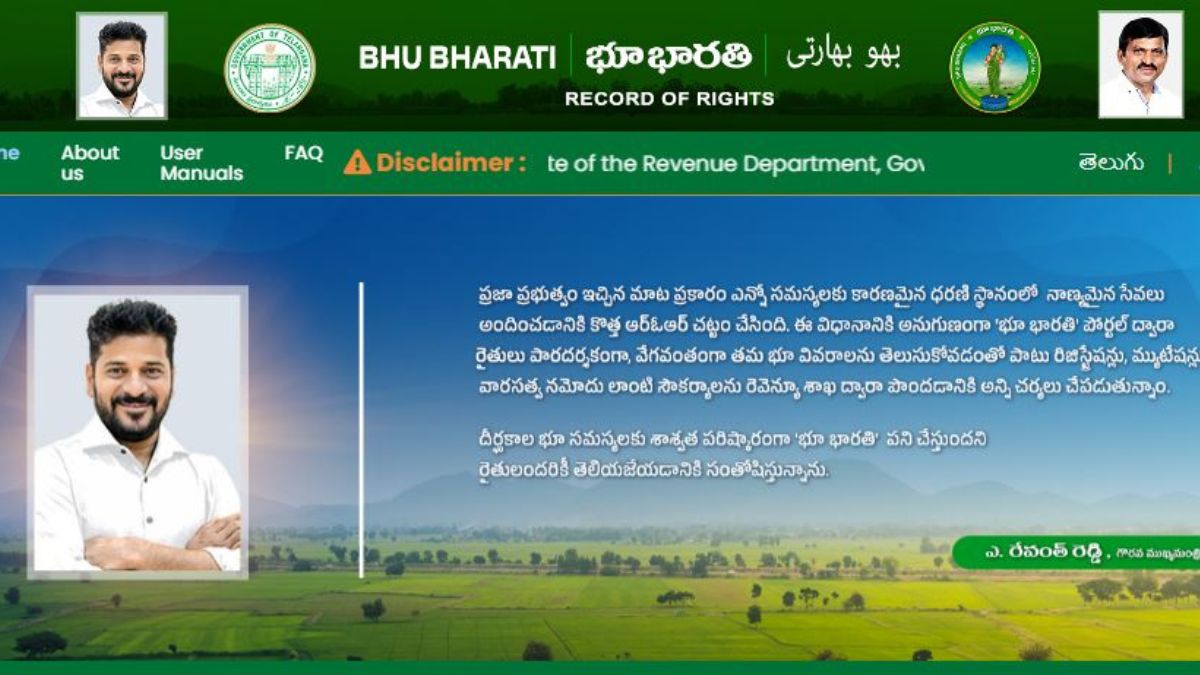
The Telangana government issued the first 'Bhudhaar card', a land ownership document carrying a unique 14-digit identification number along with a land map, on April 21 to a farmer in Khammam district.
The card was issued to Bhagam Kishan Rao of Muthapuram village as part of an advanced pilot project being implemented in five mandals of the state. The card was designed on the lines of the Aadhaar card and is intended to provide a clear ownership record of land.
State revenue minister Ponguleti Srinivas Reddy said the government has made it mandatory to submit a land survey map during registration to reduce future litigation over ownership. The Bhu Bharati portal integrates the Revenue, Survey, and Registration departments to streamline registrations and make them largely dispute-free.
The minister said that the Congress government was trying to clear the mess created by the previous Bharat Rashtra Samiti government with its Dharani portal.
The Dharani land management system was introduced by the then Chief Minister K. Chandrasekhar Rao in October 2020. Though he assured that the integrated system would improve transparency and efficiency, critics say the outcome was exactly the opposite.
The portal was allegedly misused by officials and influential individuals. The land records would alter overnight, and victims could go nowhere except civil courts. Mismanagement of Dharani has created a distressful condition for many land owners.
The controversies surrounding Dharani were cited as one of the factors in the BRS’s defeat in the 2023 Assembly elections. Congress, then the Opposition party, promised to rectify this by abolishing Dharani and introducing a better land management system. Eventually, the Revanth Reddy government passed the Telangana Bhu Bharati (Record of Rights in Land) Act, 2024, in December, and launched the Bhu Bharati portal on April 14, 2025.
The new portal reduced the number of application modules from 33 to six, making the process simpler for farmers with limited technical know-how. The new law also decentralises grievance redressal by allowing people to approach local revenue officials such as the tahsildar or revenue divisional officer, a provision largely absent in the earlier system, and many disputes ended up in civil courts.
The portal was initially piloted in four mandals, focusing on core services such as RoR records, passbooks, and encumbrance certificates. After assessment and improvement, the government launched an integrated version of the system on April 2, 2026.
This advanced version integrates the related departments and is being implemented in five mandals: Kusumanchi (Khammam), Aswaraopeta (Bhadradri Kothagudem), Amangal (Ranga Reddy), Vatpally (Sangareddy), and Kosgi (Narayanpet). Following the pilot’s success, the portal is expected to be rolled out across the remaining mandals of Telangana in phases.
However, Bhu Bharati is not entirely problem-free. Within months of its launch, a Rs 52 crore payment scam rattled the system. Fraudsters allegedly used hacking tools to manipulate data packets during online transactions, remitting as little as one per cent of the actual fee while issuing full receipts to unsuspecting farmers. The government moved quickly and tightend payment gateways and mandated Aadhaar-based eKYC for all transactions — but the episode exposed vulnerabilities in the portal.
Though the portal has faced teething problems, Chief Minister A. Revanth Reddy has not dismissed the criticism and has instead sought to address the issues. This marks a departure from the previous BRS government, when then Chief Minister K. Chandrasekhar Rao was often criticised for not acknowledging problems in the system.
