



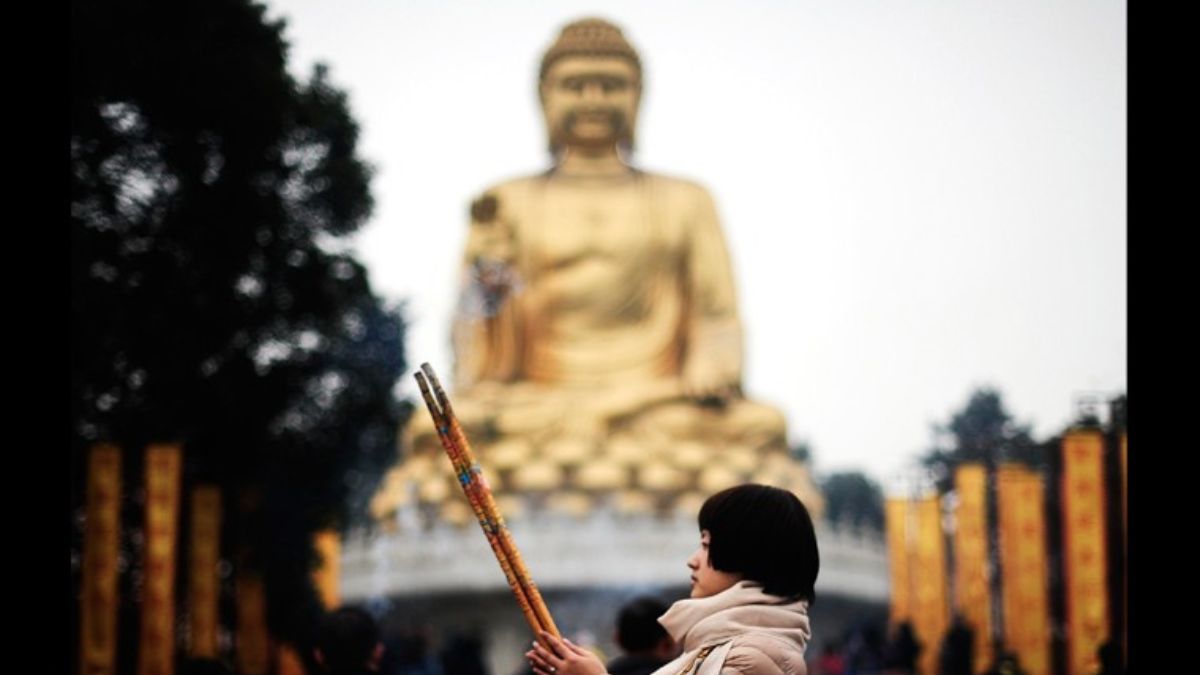
One notable initiative that combines domestic development with foreign relations was when the Finance Minister, Smt. Nirmala Sitharaman, announced during the 2026 budget presentation in Parliament to improve the Buddhist Circuits in the Northeastern region of India, which includes Arunachal Pradesh, Sikkim, Assam, Manipur, Mizoram, and Tripura. The announcement was made with the objective of not only promoting the Buddhist heritage of the nation but also capitalising on the civilizational ties between India and the SAARC and ASEAN nations of South and Southeast Asia. From a foreign relations perspective, this is a big step forward for India.
A Cultural Initiative with Strategic Depth: The Buddhist Circuit project seeks to preserve monasteries and religious sites while establishing pilgrimage interpretation centers and upgrading tourism infrastructure.
While it can be seen as a project for the development of heritage and tourism infrastructure, it also contains aspects of cultural diplomacy. Buddhism is a shared civilisational heritage in Asia.
The project, which concentrates on Buddhist sites in the Northeast region that have historically connected India and Southeast Asia, reiterates India’s position as a protector of cultural heritage. The fact that the announcement has come at a time when the region is witnessing increased geopolitical tensions and the emphasis on shared civilisational values by India is a non-confrontational and inclusive approach to diplomacy.
The Northeast region of India has always been a crucial cultural and civilisational bridge between South Asia and Southeast Asia, thanks to its Himalayan passes, Brahmaputra Valley river systems, and trade routes. This has enabled not only the exchange of economic goods but also the exchange of the religious, artistic, and monastic traditions of the Northeast region.
Buddhism has developed considerably in Arunachal Pradesh with Mahayana and Vajrayana influences, which are related to Tibet and Bhutan. The Tawang Monastery is particularly noteworthy as a place of Buddhist learning, representing historical links between India and the area beyond the Himalayas. The local tribes, such as the Monpa and Sherdukpen, represent the assimilation of Buddhist ideals with native beliefs, exemplified by the presence of many temples and meditation sites.
Sikkim, which has developed into a central place for the Nyingma and Kagyu schools of Tibetan Buddhism since the seventeenth century, has important monasteries such as Rumtek and Pemayangtse, which are critical to the very existence of religion and art, with roots deeply embedded in the legacy of Guru Padmasambhava, who is said to have introduced Vajrayana Buddhism. The sacred geography of Guru Padmasambhava establishes a link between Sikkim, Bhutan, Arunachal Pradesh, and Tibet, transcending political boundaries.
Assam provides a lesser-known but significant context for the spread of Buddhism, as archaeological evidence reveals the presence of Buddhist art and architecture of ancient Kamarupa. The testimony of the Chinese traveler Xuanzang also establishes the historical presence of Buddhist scholarship in Assam, where the Brahmaputra Valley facilitated the movement of monks and traders, influencing as far as Myanmar and Southeast Asia.
Manipur and Tripura display evidence of Buddhist cultural interactions, indicating the influence of Theravada as well as Mahayana Buddhism, especially in the border areas of Myanmar. Archaeological evidence in Tripura reveals the presence of a larger cultural context, including Bengal and Assam. It is important to understand the role of the legendary figure of Guru Padmasambhava, known as the 'Second Buddha' of Vajrayana Buddhism, which created a vast spiritual network connecting the Northeast to Tibet, Bhutan, Nepal, and the larger trans-Asian Buddhist world.
The Act East Policy and the 'Rising Northeast' are centered on improving connectivity, trade, tourism, and cultural exchanges in the Northeast region of India. This policy framework promotes infrastructure development that supports heritage tourism, especially under the Buddhist Circuit Scheme.
The policy emphasises the importance of Buddhism in civilizational heritage that originated in India, which aligns with the aspirations of the government. The engagement with Buddhist heritage has had a positive effect on India’s relations with the SAARC countries, especially Nepal, Sri Lanka, and Bhutan.
The collaborative approach in the development of the Buddhist Circuit in the India-Nepal region demonstrates shared heritage, which expands the pilgrimage route to cover both Northeast and other regions, encouraging tourism cooperation and goodwill among the SAARC countries.
Additionally, the efforts by India are well received in ASEAN countries such as Thailand, Myanmar, and Vietnam, which have a rich Buddhist heritage. The development of Buddhist heritage sites in the Northeast region of India aims to make the cultural heritage more accessible, making India an important hub for Buddhist pilgrims and a partner in heritage development.
Soft Power and Strategic Messaging: The Buddhist Circuit project plan increases India’s soft power by using cultural stories that resonate with its foreign policy of peace, compassion, and coexistence. This is different from hard power policies, which use more overt tactics to shape international opinion.
Other projects, like the display of Buddhist relics and the development of Nalanda as a learning center, have already proven the success of using cultural aspects in foreign policy. The addition of the Buddhist Circuit project to the 2026 Budget shows that there is a desire to place cultural stories at the forefront of India’s foreign policy.
The project is also expected to have economic benefits for the Northeastern states, which will help tourism, employment, and small businesses. Improved infrastructure is expected to raise the standard of living for the people, and improved transportation will make trade easier and help people-to-people ties with other countries, thus integrating the Northeast region more fully into the global economy.
The Buddha Relic Expositions hold a very important place in India’s Buddhist diplomacy, and they are fully supported by the Ministry of Culture and also the International Buddhist Confederation. In recent times, exhibitions of Lord Buddha’s sacred relics have been organised in Sri Lanka, Thailand, Mongolia, and Vietnam, and millions of followers have shown interest. These exhibitions are not just for showcasing religious artifacts, and they help build trust and goodwill at the grassroots level.
The Ministry of Culture supports these exhibitions to provide scholarly authenticity and also to ensure proper conservation. The IBC provides a platform for uniting Buddhist monastic communities, scholars, and followers. In Northeast India, conferences and exhibitions organized by the IBC have helped to integrate Buddhist traditions with the larger Buddhist world and have emphasised the importance of Northeast India for India’s civilizational and diplomatic endeavors.
A Civilizational Heritage Corridor for Peace focuses on the Buddhist Circuit project’s ability to promote peace and cooperation in a region that has always been tense. The project’s focus on civilizational heritage instead of national heritage helps to ensure that a common identity is developed among various groups. This not only ensures peace but also offers a regional approach that is modeled on the Indian concept of a civilizational heritage corridor that stretches from the Gangetic plains to Southeast Asia.
The Union Budget 2026 announcement on the development of the Buddhist Circuit in India’s Northeast region reflects a strategic approach to civilizational diplomacy that can strengthen India’s international diplomacy.
This includes the development of monasteries and pilgrimage centers in various Northeastern states. This approach repositions the Northeast region as a key civilizational bridge between South Asia and Southeast Asia in line with India’s international diplomacy on showcasing sacred Buddha relics. Additionally, as India partners with Nepal on these Buddhist circuits, the larger vision reflects historical, spiritual, and cultural values while strengthening economic growth. This intertwining of infrastructure development and spirituality reflects India’s commitment to international cooperation, peace, and understanding while incorporating the Northeast into its Act East Policy.
Therefore, the Buddhist heritage in Northeast India assumes significance beyond the regional and national levels because it constitutes an integral part of Asian civilisation history. The Buddhist monasteries, pilgrimage centers, archaeological sites, and cultural traditions in Northeast India suggest a strong history of cultural interactions and mutual influences.
The Buddhist Circuit proposal assumes significance as a significant move in the conservation of this heritage while reinforcing India’s historical role as a bridge between various cultures in Asia through shared Buddhist values. By incorporating this proposal in the Northeastern region of India, the government attempts to revive and reinforce the region as a bridge between civilisations, which could potentially attract Buddhist travelers from SAARC and ASEAN countries and transform the region into a spiritual tourism hub and a cultural dialogue platform in consonance with India’s larger vision for peace and understanding in Asia by leveraging Buddhism as a soft power tool that appeals to Buddhist nations in Asia.
(Authored Prof Arvind Kumar Singh, Professor, Buddhist Studies, Dr. B. R. Ambedkar Chair for Buddhist Studies (ICCR), Lumbini Buddhist University & Gautam Buddha University)
The opinions expressed in this article are those of the author and do not purport to reflect the opinions or views of THE WEEK.
