



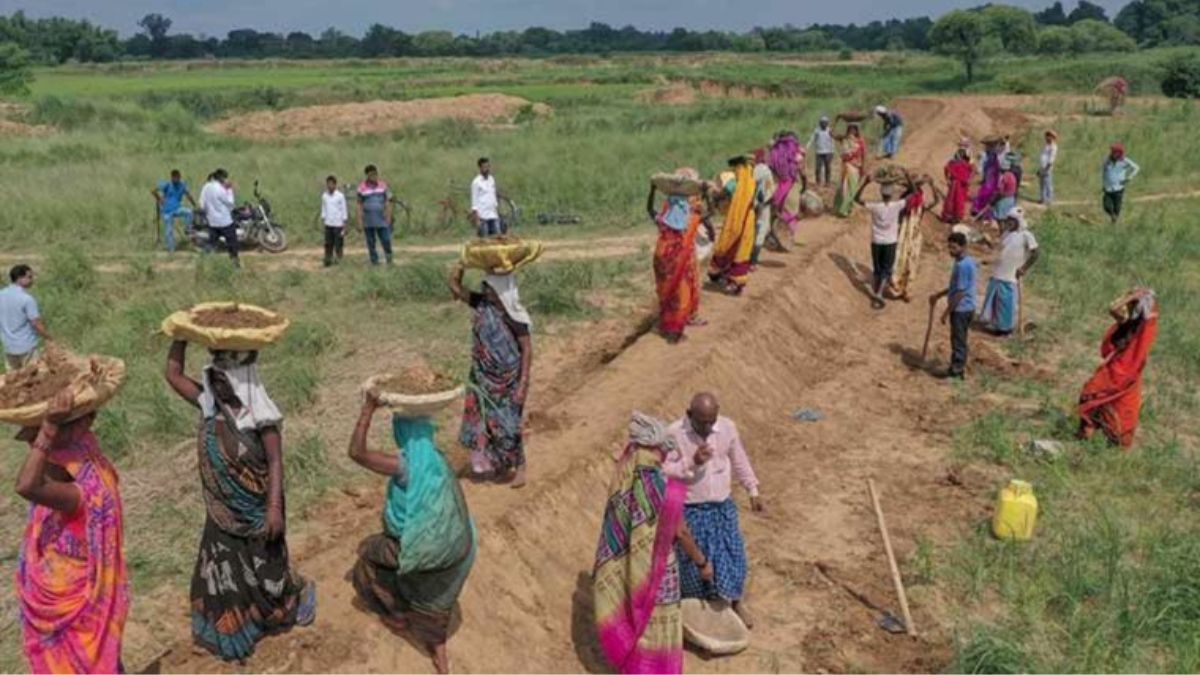
The Modi government is set to replace the United Progressive Alliance’s (UPA) flagship rights-based rural employment law, the Mahatma Gandhi National Rural Employment Guarantee Act (MNREGA), with a new statute that rebrands and restructures the programme as the Viksit Bharat - Guarantee for Rozgar and Ajeevika Mission (Gramin) Act, 2025.
The move marks both a change in nomenclature and philosophy.
While MNREGA was framed in 2005 as a legal right to employment to address rural distress, the new law positions rural employment as part of a development and infrastructure strategy aligned with the government’s Viksit Bharat 2047 vision.
The government has branded the new framework as VB-G RAM G, a compressed formulation of 'Guarantee for Rozgar and Ajeevika Mission (Gramin)'.
In political and administrative circles, it is already being referred to as the “RAM G” law. The abbreviation also carries an evident cultural resonance as it syncs with Lord Ram.
In 2015, while attacking Congress in the Lok Sabha, Prime Minister Narendra Modi had said that the scheme would continue, but as a “living monument to the failures of Congress”. Ten years later, the scheme is being rebranded.
It reflects the Modi government’s broader pattern of renaming legacy schemes associated with earlier dispensations. The Opposition is already attacking the government, saying it is erasing the name of Mahatma Gandhi.
Big change
The big change is that the new law guarantees 125 days of wage employment per rural household, up from the 100 days provided under MNREGA.
MNREGA was designed as an open-ended, demand-driven programme, allowing households to seek work at any time, with the state legally bound to provide employment or pay unemployment allowance.
Over time, it became one of the world’s largest public works programmes but also faced persistent criticism over leakages, weak asset quality and poor monitoring.
The VB-G RAM G Bill retains the legal guarantee of employment but reorients the programme away from scattered welfare works towards the creation of durable rural infrastructure. Works under the new law are limited to four priority areas: water security, core rural infrastructure, livelihood-related infrastructure, and climate mitigation works.
All assets created will be digitally mapped and integrated into a national infrastructure database, allowing village-level works to be aligned with broader planning frameworks such as PM Gati-Shakti, as per officials.
While expanding the employment guarantee to 125 days, the government has also tightened operational design. Gram Panchayats are now required to prepare Viksit Gram Panchayat Plans, mapping works spatially in advance, rather than responding only to daily demand for employment.
Officials argue that this shift improves predictability, reduces duplication, and ensures that public spending results in assets with lasting economic value.
The government also maintains that this does not dilute the guarantee, as the unemployment allowance remains mandatory if work is not provided.
The government has cited repeated instances of misappropriation and weak compliance under MNREGA to justify the overhaul. Monitoring exercises in recent years flagged non-existent works, machine use in labour-intensive projects, and widespread manipulation of attendance records. In 2024-25, reported misappropriation across states amounted to Rs 193.67 crore.
Impact on farmers and labour markets
One of the key changes here allows states to notify up to 60 days in a year during peak sowing and harvesting periods when public works under the scheme are paused. The government says this is intended to prevent labour shortages in agriculture and curb wage inflation that raises cultivation costs.
Labourers, the Centre argues, will still receive 125 days of work over the remaining period and benefit from higher seasonal farm wages during agricultural peaks.
The new Act formally converts the programme into a centrally sponsored scheme, with a 60:40 cost-sharing ratio between the Centre and states, while retaining higher central support for north-eastern and Himalayan states and full funding for Union Territories without legislatures.
