



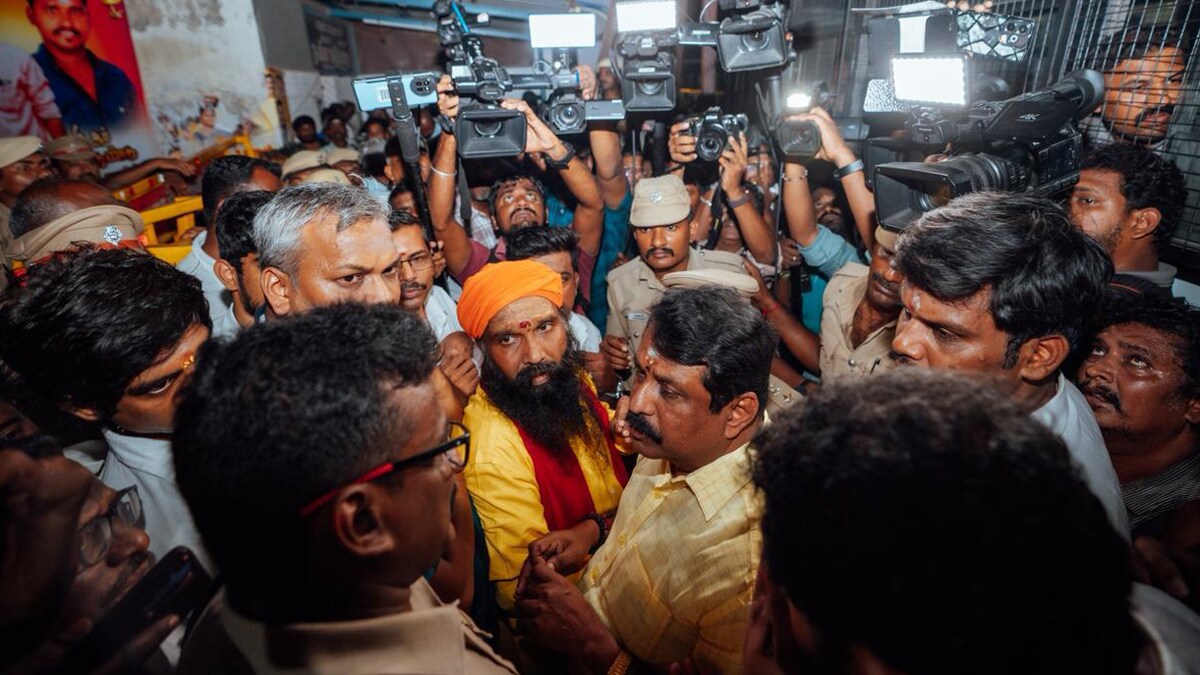
Hours after the Madras High Court declined to stay an order of a single judge bench, allowing the lighting of the traditional Karthigai Deepam oil lamp on a stone pillar on the Thiruparankundram hill housing the Lord Subramanya Swamy temple, the Tamil Nadu government has chosen to challenge the order in the Supreme Court.
A bench led by Justice G. Jayachandran and Justice K.K. Ramakrishnan declined to interfere with the order passed by a bench led by Justice G.R. Swaminathan, who issued an order to light the lamp on the stone pillar on the hilltop. “By lighting the lamp on the Deepathoon, which is meant for that purpose, the structure of the Dargah is not in any way affected, and the Dargah is located at a safe distance of not less than 50 meters away from the stone pillar," the judge had said in the order.
On December 1, Justice Swaminathan allowed a writ petition filed by Rama Ravikumar, one of the leaders of a Hindu outfit, who sought directions to the state government for appropriate arrangements to light the karthigai deepam on the ‘Dheepa thoon’ or the stone pillar on the hill. Swaminathan had ordered the government to make arrangements to light the oil lamp on the Dheepa thoon.
But the state government refused to carry out Swaminathan’s directive. Instead, the lamp was lit on the usual Utchi Pilaiyar temple. While arrangements were made to light the ceremonial lamp on the Dheepa thoon on the hill top, at the last moment the plan was changed, which led the Hindutva outfits and leaders of the BJP to stage a protest in front of the Thiruparankundram hill - a religious site long contested by the Hindu temple authorities and the nearby muslim Dargah.
The Thiruparankundram hill temple and the adjoining dargah
In Tamil Nadu, there are six abodes of Lord Muruga, and the first of the six abodes is Thiruparankundram, a small town in Madurai. The others include Palani, Thiruthani, Thiruchendur, Swamimalai and Pazhamuthircholai. And Karthigai Deepam, one of the auspicious festivals which falls in November-December, is celebrated with religious fervour in all these abodes and the lord Shiva shrines across Tamil Nadu. An oil lamp is usually lit in these abodes.
Thiurparankundram, located in Madurai, is one of the most celebrated shrines where the temple and a dargah coexist for centuries. The hill is home to Subramanya Swamy temple, Kasi Viswanathar temple and Sikander Badusha dargah. The Hindu and Muslim communities have been living in harmony at Thiruparankundram for centuries and members from both the communities own shops around the hill temple. “We are living in harmony. We are like brothers and uncles. But now we are being looked at with hatred. Things began changing only from this February,” says Amjad Basha, who runs a fancy store on the foothills of Thiruparankundram.
According to historical data, though the dargah came up only in the 17th century, the temple existed even before that, and there have never been any disputes. The Muslims carried out their prayers and religious rituals while the Hindus also walked atop the hill and offered prayers to Lord Muruga. While there was an ownership debate in 1923, it was settled then by the subordinate judge of Madurai, during the British era itself. The ruling then said that the whole hill belonged to the temple, except for a part of the cultivated land and the site of the mosque.
And since then, the temple and the mosque coexisted without any dispute. But in February this year, as the Hindutva outfits in Tamil Nadu stepped in, the issue was raked up. It came up all of a sudden when there were voices from the Muslim community to call the hillock as ‘Sikander Malai’.
Simultaneously, a row broke out when photographs of people allegedly consuming meat at the hilltop surfaced on social media. A huge confrontation broke out between DMK-led alliance’s Ramanathapuram MP Nawaz Kani and the then BJP state president K. Annamalai. Staunch followers and devotees of Lord Muruga raised objections to this, while the BJP and the rightwing organisations launched protests. One of the BJP leaders, H. Raja, even called Thiruparankundram the “Ayodhya of the south.”
While the issue died down, the BJP was not willing to settle. Months later, the BJP organised the Lord Muruga conference in Madurai, with Home Minister Amit Shah as the chief guest. He accused the DMK of supporting a section that was for renaming the hillock. He also called for support from the Hindu devotees.
Later, the Madurai bench of the Madras High Court pronounced an order prohibiting the ritual of animal sacrifice at the Sikander Badusha dargah. This order was the fallout of an objection raised by the Hindu outfits to the animal sacrifice carried out at the dargah.
The controversy and the deep row
The current row over lighting the lamp came up after Rama Ravikumar, a Hindu activist, who is also running a party, moved the Madurai bench of the Madras High Court seeking direction to the government to make arrangements to light the oil lamp on a sacred pillar atop the hillock on the day of karthigai deepam festival. Justice Swaminathan passed an order allowing Ravikumar’s petition which led to the chaos and the confusion in the peacefully celebrated festival.
“The petitioner in this case Rama Ravikumar is running a party. He has filed the petition in the garb of a devotee. He has no business to do this. How many times had he participated in the karthigai deepam festivals? There are six abodes of lord Muruga. If he is so particular about lighting lamps in sacred abodes, he should have done this in all the abodes. Thiruparankundram was chosen because there is a dargah here. He is backed by the BJP, RSS and the Hindutva goons. What has politics got to do with religion? That is the USP of BJP. They were successful in North India and they want to replicate the same formula here, which the DMK will not allow,” says advocate and DMK spokesperson Annadurai Saravanan.
However, the protest by the BJP and the Hindu outfits, the refusal by the government and the slew of petitions and appeals in the court have only led to a shakeup in the long-standing peace and harmony in Tamil Nadu.
