



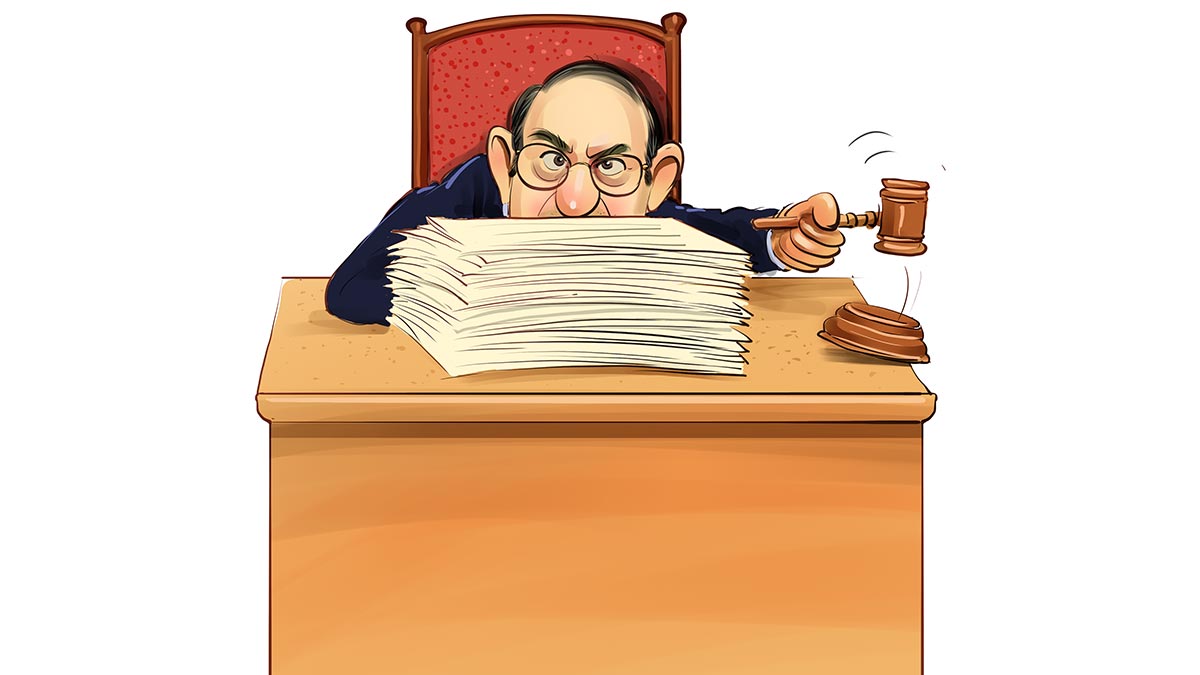
The depiction of a criminal trial in a movie is often a distortion of what really happens in a court of law. Although the unsuspecting viewer watches the courtroom scenes in a movie intently, he seldom realises that the scenes are grossly exaggerated and do not play out in the same way in a courtroom. “So what?” One might ask, “It’s only a movie, and what’s the worth of a movie if it does not provide some excitement based on an exaggerated version of reality?”
There really is no straightforward answer to that question, but one must know what really happens in a court of law, for we simply cannot afford to have the efficacy of the criminal justice system in our country measured based on the extent to which it conforms to a movie-goer’s expectation! Yet, sadly, this is what happens in our country today, thanks to the dissemination of false narratives through the media.
Our criminal justice system is founded on the principle that ‘no innocent person should be punished even if a hundred guilty persons walk free for want of proof of their misdemeanours.’ So rigid is our adherence to the said principle that our laws require the State prosecution wing to prove its case against an accused ‘beyond all reasonable doubt’ before a court can convict the accused and sentence him.

The threshold for conviction is fairly high, and it has often been asked whether in our country, where the investigating and forensic agencies do not have access to state-of-the-art crime detection technologies, setting such a high threshold is reasonable and practical. Ought we to reduce the threshold level to secure a conviction to “a balance of probabilities” as is the burden cast on litigants to prove facts in civil cases? The jury is still out on the said question, but let's take a closer look at what actually happens in a criminal trial.
A criminal investigation begins with the furnishing of a “First Information” as to the commission of a crime by a person having knowledge of such facts as constitute a cognisable offence. A cognisable offence is one which is listed out as such in our criminal statutes, and which enables a police officer to arrest an offender without a formal warrant from a magistrate, subject to the production of the arrested person before a judicial magistrate within twenty-four hours of his arrest. On receipt of such information, the officer in charge of a police station must reduce the information received by him into writing and register a crime which must then be investigated by a police officer designated for the purpose. A complainant has also the option of setting the criminal law in motion by approaching the jurisdictional magistrate directly with his complaint, in which event the magistrate, on being satisfied that the complaint alleges the commission of an offence, directs the investigating officer to investigate the complaint and submit a report to him.
The investigation of a crime by a police officer is invariably carried out within a judicial maze of procedural safeguards that are designed to prevent the extraction of incriminating material against an accused through unfair and unlawful means. Accordingly, the statements recorded by the investigating authorities from various witnesses can only be used to contradict the same witnesses when they enter the witness box in a court to give their primary evidence before a judge at the trial of the case. As for the accused, any confession that he makes to the police officials when he is in judicial custody cannot be used against him as evidence in a court of law because the Indian Law of Evidence, originally gifted to us by our erstwhile colonial masters, still does not believe that there can be ‘gentlemen among policemen’ or that an accused would voluntarily, and of his own free will, make a confession before a policeman. A confession to be valid and acceptable as such in evidence, must be made before a judicial magistrate who, in turn, has to satisfy himself that the confession is being made without any threat or coercion, and voluntarily by the accused person acting on his own free will. Collection of further evidence against the accused person, based on a confession made by him while in judicial custody, is also subject to scrutiny by the court to see whether the discovery of new facts based on portions of the confession statement given by the accused would render that portion alone, which leads to the discovery of new facts, admissible in evidence. Thus, while the world watches televised images of an accused being taken by the police to a crime scene or other place from where a ‘seemingly incriminating’ object such as a weapon or other material is ‘unearthed’ or ‘discovered’, the legal community alone realises that none of that is real and reliable ‘evidence’ that can be used against an accused in a court of law!
As for the trial proceedings, a heavy burden of proof is placed on the prosecution to prove through cogent and reliable evidence that the accused is guilty, beyond all reasonable doubt, of the offences charged against him. Towards this end, the eyewitnesses cited must measure up to the standard of ‘sterling witnesses,’ whose testimony in court must withstand the gruelling cross-examination unleashed on them by defence lawyers. In the absence of any such direct evidence, the prosecution must rely on circumstantial evidence that satisfies the test of “established chain of proved circumstances pointing unequivocally to the guilt of the accused and admitting of no other hypothesis than the guilt of the accused.” It is only after the prosecution has discharged the above burden cast upon it that the accused person is called upon to adduce evidence that he might have, to explain the incriminating circumstances proved against him and to show his innocence. The trial court is also conferred with ample powers to discharge or acquit the accused at any stage of the proceedings, if it finds that there is no material evidence let in by the prosecution to convict the accused. In reality, therefore, the accused in a criminal court occupies a ‘privileged’ position where he can simply pick holes in the prosecution case to demonstrate that the evidence adduced against him does not meet the standard of proof of ‘beyond all reasonable doubt.’ In a country where technology-aided criminal investigation is still at a nascent stage, an accused can quite easily play ‘hard to get’!
And then there are the infrastructural woes that plague our justice system: dilapidated court buildings, over-crowded prisons, low judge-population ratio, pressurised and inadequately sensitised investigating agencies et al. It is common knowledge that the financial allocation for the judiciary in any budget – whether by the Union government or the State government – is always minimal.
While the Union government allocates roughly 0.1% of the total budget for law and justice, the State budgets for the justice system (including police, judiciary and prisons) average about 4.3% of their total budget. All this in a democratic republic where governance is by the rule of law! The allocation per capita for the judiciary, specifically, is even lower. A recent report puts the figure showing the average amount spent per person per year on the justice system at Rs 389/- in 2024–25. It comes as no surprise, therefore, that our forensic laboratories, that are grossly under-staffed and lack suitable equipment, struggle to submit timely reports to overburdened criminal courts that need those reports to complete pending trials.
This then is the harsh reality of our criminal justice system, and it is essential that our citizenry take note of it. The State executive needs to loosen its purse strings to make available much-needed funds to augment judicial and administrative infrastructure so that the justice system is liberated from its present predicament and duly equipped to deliver effective and high-quality justice. The black robes worn by the legal fraternity, and public faith in the judicial institution, are what sustains the judiciary in our country.
Unreasonable public expectation, flowing from ignorance of government funding policies and media-driven misinformation, has the potential to erode that public faith and that cannot be good for “We, the people of India.”
A.K. Jayasankaran Nambiar is a judge of the Kerala High Court.
The opinions expressed in this article are those of the author and do not purport to reflect the opinions or views of THE WEEK.
