



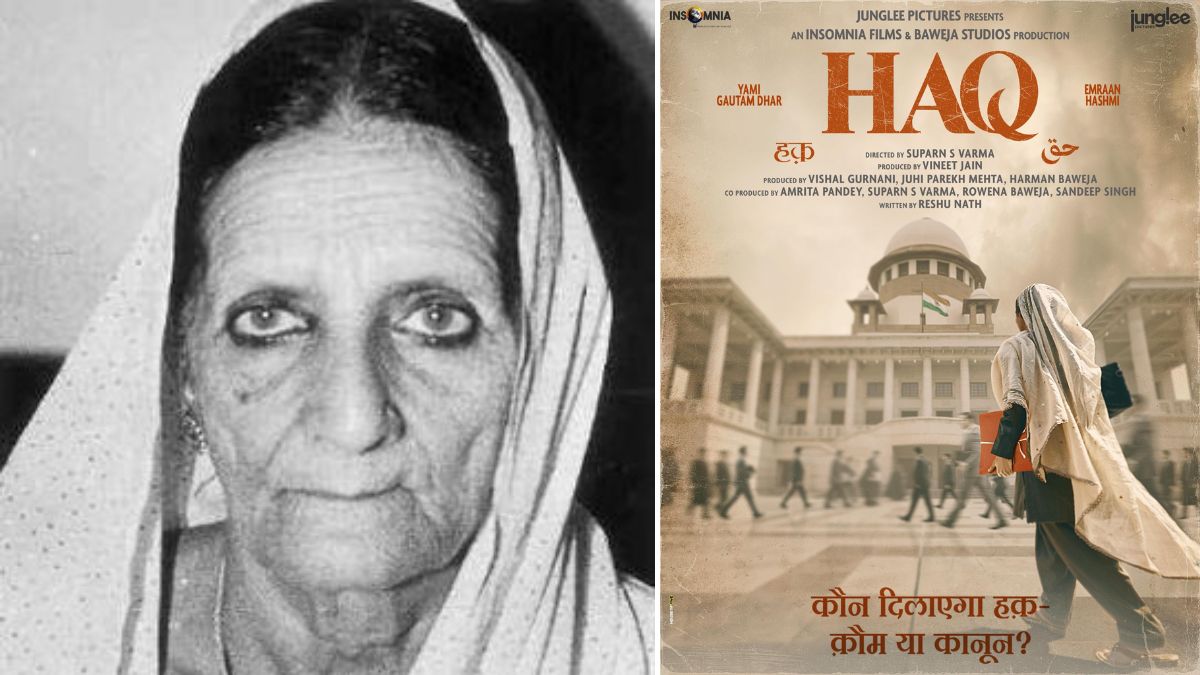
In 1978, a frail 62-year-old woman from Indore named Shah Bano Begum walked into a courtroom not as a lawyer or an activist, but as a divorced mother of five, seeking something heartbreakingly simple, the right to live with dignity. What began as her personal fight for maintenance against her husband would, over the next few years, shake the foundations of Indian law and politics, and still echo four decades later now, through a new Bollywood film, titled Haq.
The woman who challenged the system
Shah Bano had married Mohammad Ahmed Khan, a prosperous lawyer in Indore, in 1932. For decades, she lived as a homemaker, raising their five children. But when she crossed 60, her husband took a younger wife and, eventually, divorced her using the triple talaq.
Abandoned and without means to support herself, Shah Bano turned to Section 125 of the Code of Criminal Procedure (CrPC), a secular provision that mandates a husband to provide maintenance to his wife if she cannot maintain herself.
It was an unusual move. Muslim women, at that time, were expected to seek relief under Muslim personal law, which limits maintenance to the short iddat period roughly three months after divorce. But Shah Bano’s lawyers argued that Section 125 applied to all women, irrespective of religion.
Her husband contended that his obligation ended after paying maintenance for the iddat period, as per Islamic law. The legal battle that followed went all the way to the Supreme Court of India, setting the stage for one of the most significant judgments in India’s constitutional history.
1985 verdict: Law above religion
In 1985, a five-judge Constitution Bench of the Supreme Court, headed by the then Chief Justice Y.V. Chandrachud, ruled in Shah Bano’s favour. The court held that a divorced Muslim woman is entitled to maintenance under Section 125 of CrPC if she is unable to maintain herself.
Justice Chandrachud stated in his judgment, “Section 125 was enacted in order to provide a quick and summary remedy to a class of persons who are unable to maintain themselves. What difference would it then make as to what is the religion professed by the neglected wife, child or parent? Neglect by a person of sufficient means to maintain these and the inability of these persons to maintain themselves are the objective criteria which determine the applicability of section 125. Such provisions, which are essentially of a prophylactic nature, cut across the barriers of religion. The liability imposed by section 125 to maintain close relatives who are indigent is founded upon the individual’s obligation to society to prevent vagrancy and destitution. That is the moral edict of the law and morality cannot be clubbed with religion."
The ruling made it clear that secular law takes precedence when it comes to basic rights and social justice. The Court even remarked that a uniform civil code would help promote national integration, a line that would fuel political debate for decades.
For Shah Bano, the judgment was vindication — a rare victory for an elderly woman who had the courage to stand up against patriarchy and orthodoxy. But for Indian politics, it was a storm waiting to break.
The political backlash
The judgment sparked outrage among conservative sections of the Muslim community, who saw it as an encroachment upon their personal laws. Religious leaders organised protests, claiming the ruling undermined Islamic principles.
Caught in the political crossfire, Prime Minister Rajiv Gandhi, faced mounting pressure from clerics and community leaders. In a controversial move, his government passed the Muslim Women (Protection of Rights on Divorce) Act, 1986, effectively overturning the Supreme Court’s ruling and restricting a husband’s obligation to the iddat period.
The Act was widely criticised as a political compromise that sacrificed gender justice at the altar of vote-bank politics. Women’s rights groups saw it as a betrayal of Shah Bano’s struggle and a setback for equality.
Despite that, the case became a landmark a reference point in every debate on gender justice, secularism, and the Uniform Civil Code. It forced India to confront uncomfortable questions: Should religious laws override constitutional rights? And how far should the State go in balancing faith and gender equality?
Cinema reopens the debate
Now, 40 years after the judgment, the story of Shah Bano finds a new life on screen. Suparn S. Varma’s upcoming film, Haq, starring Yami Gautam and Emraan Hashmi, revisits the emotional and legal complexities of the case through a fictional lens.
The film, slated for release on November 7, 2025, tells the story of Shazia Bano, a woman abandoned by her husband who seeks justice in court. The narrative closely parallels Shah Bano’s real-life ordeal, her struggle against societal stigma, her faith in the Constitution, and her quiet courage.
But Haq has already stirred fresh controversy. Shah Bano’s daughter, Siddiqua Begum Khan, has approached the Madhya Pradesh High Court seeking a stay on the film’s release. She alleges that the film uses her mother’s story without the family’s consent and distorts key facts. The court has reserved it's verdict.
