



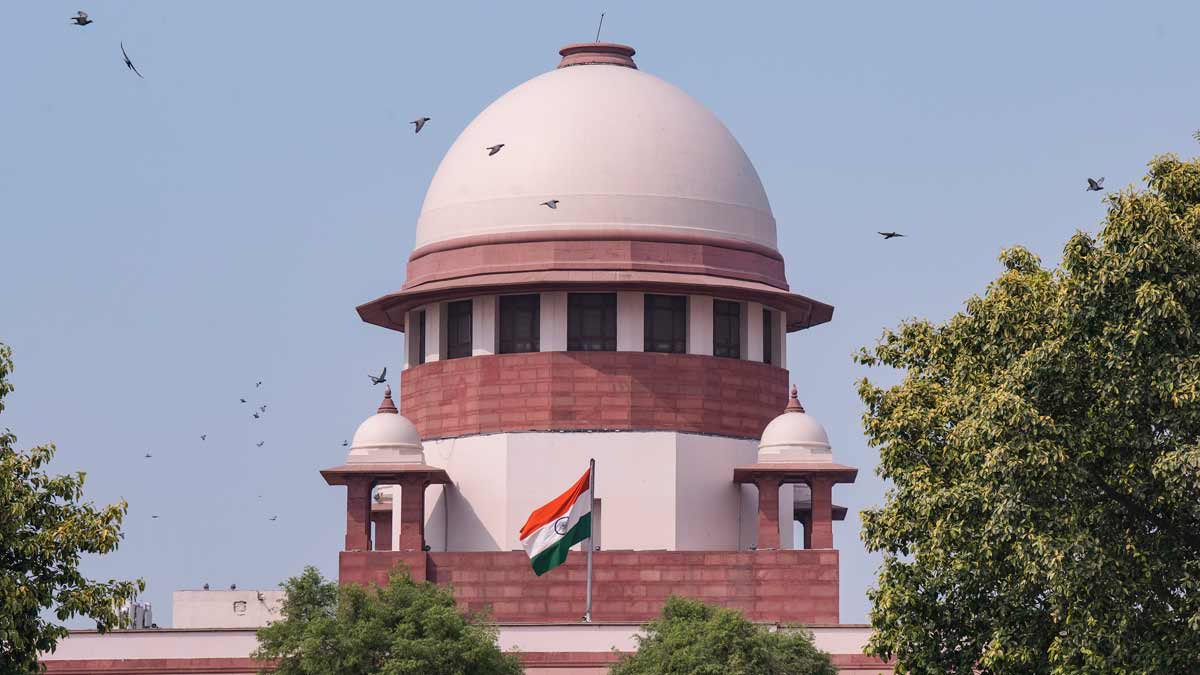
The Supreme Court attained its sanctioned strength of 34 judges on Friday with the swearing-in of Bombay High Court Chief Justice Alok Aradhe and Patna High Court Chief Justice Vipul Manubhai Pancholi. Their elevation comes against the backdrop of a widening row over collegium resolutions, and the choices have once again sharpened debates about seniority, supersession, and the institutional practice of fixing the line of succession for the Chief Justice of India (CJI).
While both Justices Aradhe and Pancholi are respected jurists with long stints in the High Courts, it is Justice Pancholi’s elevation that has triggered the most conversation in legal and political circles. By virtue of his seniority at the time, he will be in line to take over as the CJI in October 2031 after Justice Joymalya Bagchi’s retirement. This outcome was not automatic; it was shaped by the collegium’s choice to elevate him now, and in the process, to bypass other High Court judges who were senior in terms of appointment.
Supersession in the service of succession
The Indian judiciary has traditionally guarded seniority as the primary basis for appointments to the Supreme Court. However, in practice, the collegium has often departed from this norm, citing factors such as merit, regional representation, and diversity. Critics argue that these departures sometimes serve a narrower purpose to secure a predictable line of succession for the post of Chief Justice of India.
Justice Pancholi’s case illustrates this dynamic. Several senior High Court judges, including those from Kerala, Delhi, and Karnataka, had a stronger claim by age or tenure. Yet, by elevating him now, the collegium has effectively ensured his place in the CJI’s chair six years down the line. The decision, while technically defensible, is seen by many as a conscious exercise in shaping the institution’s future leadership rather than responding solely to the needs of the present.
Politics of the CJI’s Office
The CJI is not merely the first among equals. The office commands immense influence over case allocations, constitution of benches, and the administrative machinery of the court. The CJI also presides over the collegium itself, thereby shaping the future composition of the higher judiciary. It is this concentration of power that makes succession battles so charged.
Historically, governments have also shown keen interest in who gets to be the CJI. The Emergency era saw the infamous supersession of judges in 1973 when Justice A N Ray was appointed CJI over three seniors, triggering a crisis of confidence in judicial independence. Although such direct political interventions have since diminished, the collegium’s own decisions have produced similar debates, albeit within a closed circle of judges rather than at the behest of the executive.
In this sense, the elevation of Justice Pancholi can be read as part of a long tradition where the judiciary itself seeks to insulate, and at times manipulate, the line of succession. The collegium may well have factored in his reputation, administrative ability, and projected tenure, but the broader impact is unmistakable; the next decade of judicial leadership is already being charted out.
Costs of supersession
The downside of such choices is the alienation of senior judges who find themselves overlooked. Several High Court judges who were not considered may feel slighted, particularly when they see their prospects of elevation permanently closed.
Further, supersession chips away at the judiciary’s claim of transparency. The collegium does not issue detailed reasons for preferring one candidate over another, leaving space for speculation. In an era where judicial accountability is under sharper public scrutiny, unexplained departures from convention risk undermining credibility.
Bigger picture
At a practical level, the immediate impact of today’s appointments is that the Supreme Court reaches its full strength of 34 judges, easing a crushing backlog of over 80,000 cases. Both Justices Aradhe and Pancholi bring valuable regional perspectives. Justice Aradhe has served in Madhya Pradesh and Jammu & Kashmir before leading the Bombay High Court, while Justice Pancholi has significant experience in Gujarat and Bihar.
But the larger significance lies in how these choices recalibrate the court’s future. With Justice Pancholi’s succession virtually secured, the judiciary has sketched its leadership trajectory for 2031. This has implications not only for the court’s internal dynamics but also for its interface with the executive, Parliament, and the federal structure of the country.
Collegium’s choices stir nepotism allegations
The debate over succession has coincided with another controversy that threatens to dent the collegium’s credibility. Recently, the Supreme Court Collegium recommended 14 lawyers for elevation as judges of the Bombay High Court. Among them is Raj Damodar Wakode, who is related to CJI B.R. Gavai identified as the son of the CJI’s cousin and therefore considered his nephew.
Although Justice Gavai’s brother, Dr. Rajendra Gavai, clarified that Wakode should be regarded as a distant relative, the optics have been troubling. Critics argue that such selections risk reinforcing perceptions of nepotism in judicial appointments, especially when the system already faces charges of opacity and favouritism.
Yet, the episode underlines the larger disquiet over how appointments are made and who ultimately gets to decide the future shape of the judiciary. Coming at a time when senior judges are being superseded to secure a line of succession for the Chief Justice’s office, the controversy has added fuel to the demand for a more transparent, institutionalised mechanism.
The Supreme Court may have achieved full strength in numbers today, but the debate over the principles governing those numbers is far from settled.
