



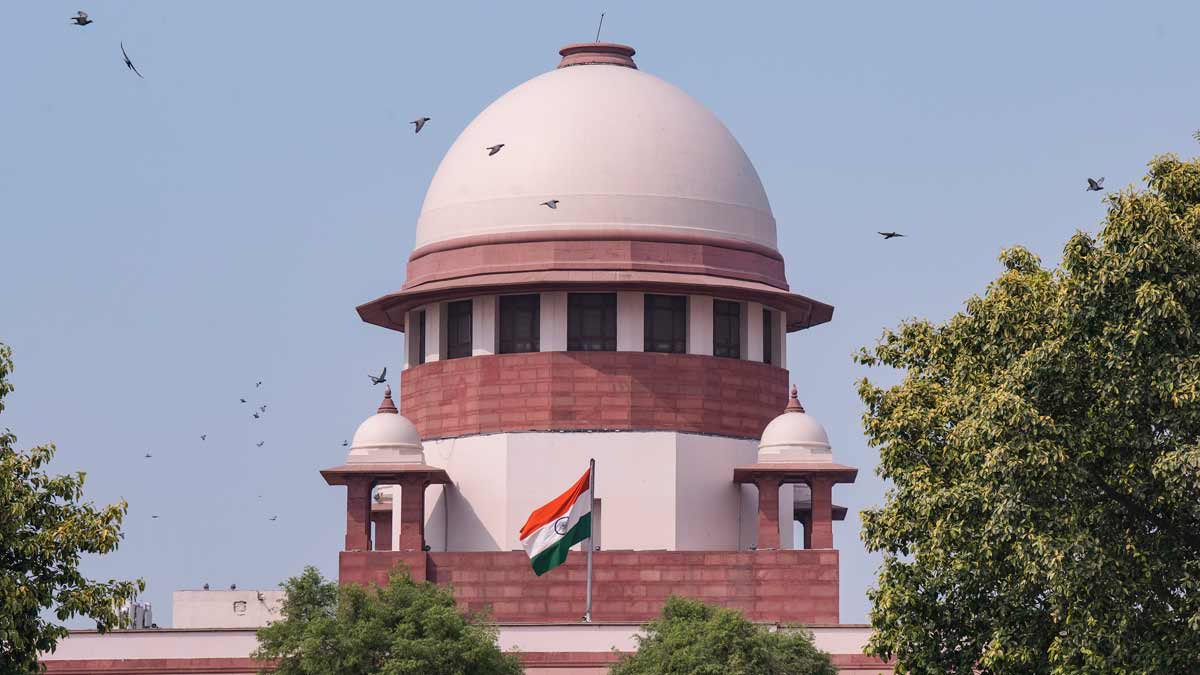
The Supreme Court, on Thursday, resumed its hearing on the Presidential Reference concerning the powers of Governors under Articles 200 and 201 of the Constitution. The core question before the five-judge bench led by Chief Justice of India B.R. Gavai is whether governors can indefinitely sit on bills passed by duly elected state legislatures, and if so, whether such inaction is subject to judicial review.
At the heart of the debate lies the tension between the Union’s interpretation, presented by Solicitor General Tushar Mehta, and the counterarguments advanced by senior advocate Abhishek Manu Singhvi on behalf of the state of Tamil Nadu. The courtroom exchanges underscored the delicate balance of India’s federal structure, the limits of gubernatorial authority, and the broader implications for democratic accountability.
Centre’s Position: Immunity and discretion for governors
Solicitor General Mehta defended the wide latitude of gubernatorial powers. He argued that under Article 361, governors enjoy complete immunity, and their actions, whether granting assent, withholding it, or reserving Bills for Presidential consideration, cannot be subjected to judicial scrutiny. Citing the B.P. Singhal judgment, he emphasised that governors are not agents of the Union or political parties but constitutional authorities who represent the President.
Mehta contended that judicially imposed time limits on governors to act on Bills would upset the constitutional scheme. “The governor may, in his wisdom, think it fit to wait for a year to defuse a tense political situation,” he told the bench, warning against judicial overreach into what he described as inherently political considerations.
He also raised a broader constitutional point: a state government, as a constitutional entity, cannot claim fundamental rights under Article 32. Only citizens can do so. Thus, Tamil Nadu’s challenge itself, according to Mehta, was misconceived.
Tamil Nadu’s stand: Governors are titular heads, not parallel executives
Singhvi, countering the Centre, painted different picture of the constitutional role of governors. He argued forcefully that the governor is not a super chief minister nor the last word in law-making. Quoting Dr B.R. Ambedkar and the Punchhi Commission report, Singhvi reminded the court that governors were envisaged as facilitators, friends, philosophers, and guides and not power centres capable of stalling the democratic will.
“The governor cannot overrule the ministry. He is part of the legislative process but not part of the legislation,” Singhvi said. Returning or reserving Bills for Presidential assent, he explained, are options to be exercised only in exceptional circumstances, not as a weapon to obstruct governance.
He stressed that Article 163 does not confer a general discretionary power on governors, and their independence is limited to rare, explicitly enumerated situations. Any attempt to read wider discretion into the Constitution, he warned, would create chaos.
Chief Justice Gavai pressed the Centre on whether the judiciary should sit idle while governors make elected legislatures defunct by holding Bills indefinitely. “Is the Supreme Court to suspend its role as custodian of the Constitution?” he asked.
CJI underscored that the Constituent Assembly debates themselves suggested governors should act within six weeks on Bills presented to them. Allowing open-ended inaction, the bench indicated, risks undermining both democracy and federalism.
When Mehta argued that governors do not represent the Union of India but only the President, the CJI was quick to interject, “The government’s executive authority vests in the President. How can you say the governor does not represent the government of India?”
Constitutional stakes
The proceedings highlight a recurring constitutional friction: governors, often seen as appointees of the Union, sitting in judgment over Bills passed by state legislatures where opposition parties rule.
The broader stakes are high. If the Supreme Court affirms wide immunity and discretion for governors, state legislatures could find their law-making function hostage to gubernatorial inaction. On the other hand, if the court curtails these powers, it would significantly strengthen state autonomy and legislative sovereignty.
The hearing remained inconclusive and will continue on September 2.
