



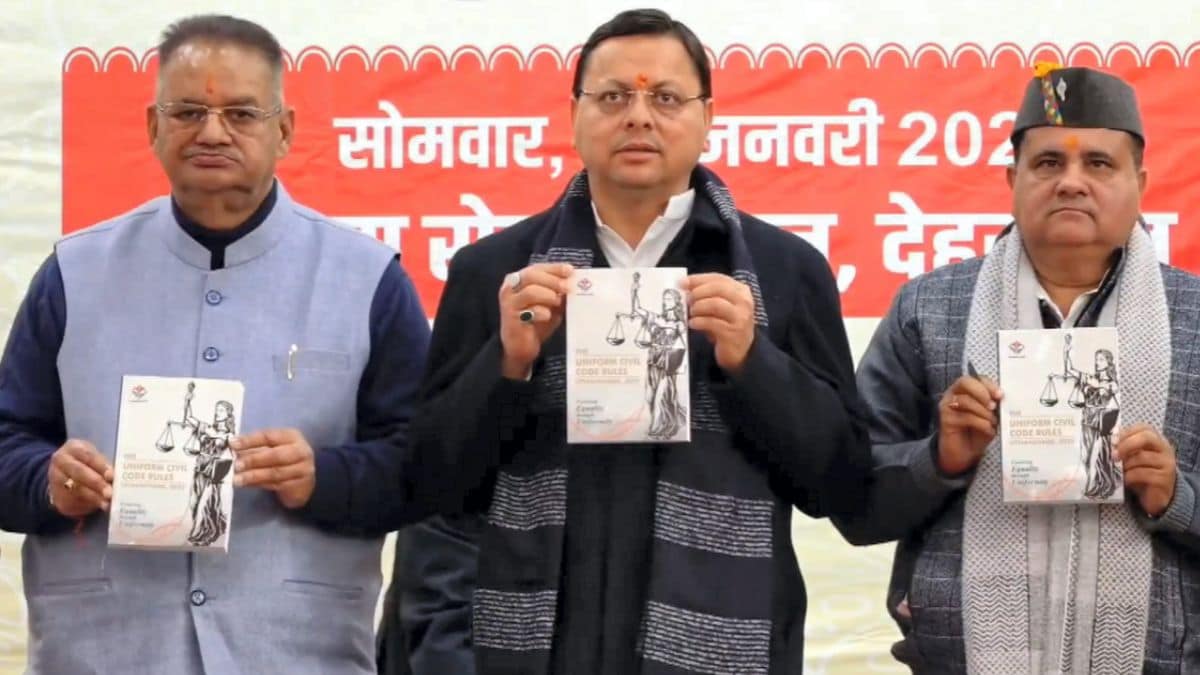
Through an amendment introduced in the Uttarakhand Vidhan Sabha on Tuesday, the state’s Uniform Civil Code (UCC), first enacted in 2024, will be significantly changed to address procedural challenges, modernise penalty provisions, and make the law more comprehensive and enforceable.
One of the most notable shifts in the amendment bill is the extension of critical procedural time limits. Various provisions relating to registration of marriages, divorce procedures, and appeals formerly required actions within six months from an event. The amendment now uniformly increases these periods to one year. This change comes from practical learning from the implementation phase, recognising that many administrative processes and appeals require additional time to be effectively completed by officials and citizens. The change aims to reduce procedural bottlenecks and ensure smoother law enforcement.
The amendments update crucial legal references from the erstwhile Code of Criminal Procedure, 1973 and related penal codes to Bharatiya Nagarik Suraksha Sanhita, 2023. This alignment will harmonise the state law with national-level legal reforms; secondly, it brings penalty clauses in line with modern, unified legal standards that offer clearer definitions and enforceability frameworks.
The amendment replaces the old penalties such as imprisonment ‘up to three months or fine up to ₹25,000’ with language delegating the assessment and enforcement to the provisions of the updated BNS.
A significant addition in the amendment is the introduction of an appeal mechanism for penalties imposed on Sub-Registrars—the officials responsible for marriage and civil event registrations. Section 19A empowers penalised Sub-Registrars to file appeals within 30 days before a competent appellate authority notified by the state government. This provision promotes accountability while protecting officials’ rights, thereby improving governance transparency.
Additionally, power to cancel registrations related to marriage, divorce, or succession has been explicitly vested in the Registrar General, streamlining procedural clarity.
The amendment introduces strict penalties for cases of identity misrepresentation, fraud, and coercion in matrimonial contexts. A new provision allows annulment or penalty if either party to a marriage has provided false information about their identity at the time of solemnisation.
Further, clauses have been introduced to punish ‘persistent violations’ of live-in relationships and cases where individuals enter into subsequent marriages without legally dissolving previous ones.
The bill specifically criminalises coercion and fraud to obtain consent for marriage, prescribing imprisonment up to seven years and fines. Concealment of serious criminal convictions or marital status also attracts heavy penalties.
The bill elaborates on legal and administrative procedures concerning live-in relationships, which are increasingly prevalent. Registrars will now issue certificates terminating live-in relationships in prescribed formats, giving legal recognition to their dissolution. The law punishes individuals who form new live-in relationships while their previous marriages or relationships remain legally unresolved, unless the missing partner has been absent for over seven years.
This legal emphasis both protects individuals’ rights and discourages social abuse of live-in arrangements, introducing clear consequences for violations.
To make the discipline associated with violations truly effective, the amendment includes clauses on recovery mechanisms for penalties similar to recovery of land revenue arrears. This provision ensures monetary penalties imposed under the UCC can be collected efficiently, bolstering the code’s enforcement.
The Uniform Civil Code (Amendment) Bill, 2025 by updating timelines, updating penalties, introducing accountability measures, and clamping down on fraudulent and illegal matrimonial behaviours, the state has reaffirmed its commitment to create a civil code that upholds fairness, equality, and the rule of law.
Chief Minister Pushkar Singh Dhami said that these changes are driven by practical experience and stakeholder engagement, striving to make the Uniform Civil Code “more practical, equitable, and effective” in protecting diverse social interests and enabling smoother legal processes.
