


Pink sandstone pillars and arches, submerged under layers of moss and grime at the temple workshop in Ayodhya, are slowly re-emerging from their ravages as construction of the Ram Mandir gets closer.
Sandstone is a popular choice for temple construction because of its uniform grain size, durability and resistance to acidic and alkaline solutions. The one used at the Ram Janmabhoomi Nyas Karyashala is from Bansi Paharpur in Rajasthan. It is also called ‘balua patthar’ as in its naturally occurring form, it is the colour of sand. The Rashtrapati Bhawan in Delhi and the Buddhist stupas at Sarnath are just two prominent examples of its use.
The contract for the cleaning of the pillars which have faced years of rain and sun has been given to Clean and Cure, a New Delhi-based company that specializes in cleaning heritage monuments. Many other bidders were in the fray for the job, which is a mammoth one.
Sandeep Garg, Chairman of Clean and Cure says that his company is breaking the stranglehold of American, Italian, German and Australian firms which sell cleaning material at exorbitant prices. “We have developed 100 per cent indigenous, eco-friendly, mild chemicals that do not harm the stone in any way. We do not sell the product but work on contracts. Our aim is to bring the cost of cleaning and restoration to lesser than would take to whitewash a building,” Garg says.
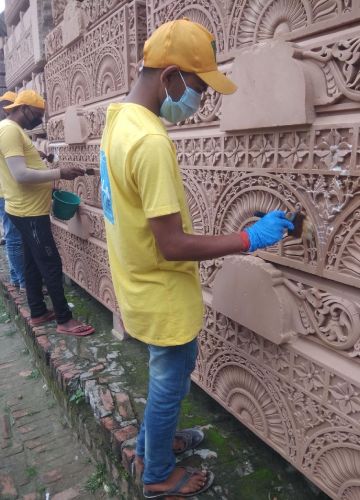 Cleaning operations at the Ram Janmabhoomi Nyas Karyashala | Sourced Image
At the workshop the cleaning operations are overseen by Sanjay Jadia, a regional manager with the company.
Jadia explains that the cleaning is done by a controlled pressure jet of water which removes most of the moss and algae that have settled on the pillars. This also washes away the rust which results from the naturally occurring iron in the stone (the temple itself will not use any iron). After that the in-house solution of 23 chemicals is used to gently scrap away dirt which remains lodged in crevices. A penetrating sealing compound is then brushed over the stone to protect it from water seepage. While the process will keep the pillars as good as new for anywhere between seven to 25 years, actual results will vary on the footfall and usage.
“Our cleaning solution is just a degree harder than water. We do not need protective equipment to handle it,” Jadia says.
For any visitor to Ayodhya, a stop at the workshop is a must. It is here that thousands of bricks donated by kar sewaks from across the country lie with the sandstone carvings.
The workshop began buzzing with activity in 1992. But after five years of intense work, as the title suit crawled through the court, the initial din of machines and tools grew quieter. Yet, the stream of visitors never stopped with many touching the bricks and pillars to their foreheads, as though paying obeisance at the temple itself.
Garg says this is not just any other job for his company. “We look at all our work as contribution to the Swachh Bharat Mission. But this is even more special as it is Ram ka kaam (the work of Ram)”.
