



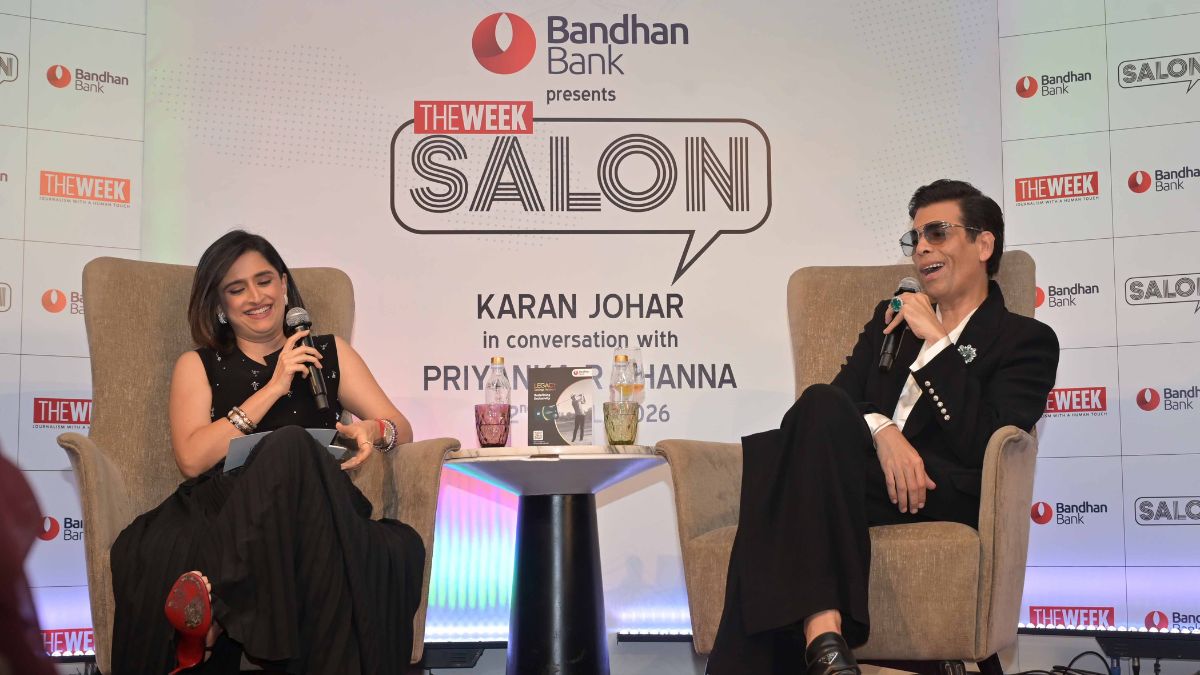
At THE WEEK Salon, sponsored by Bandhan Bank on Wednesday evening, filmmaker Karan Johar, who produced "Raazi" and "Gunjan Saxena", discusses the prevailing male-hero-centric narrative in Bollywood and the industry's glorification of toxic masculinity.
As a filmmaker who made his mark with movies such as "Kuch Kuch Hota Hai" and "Kabhi Khushi Kabhi Gum", Karan now connects the pattern by which Bollywood recycles male-gaze-driven films. Having changed his style from the past, he’s now crafting films with strong women protagonists, as in "Raazi" and "Gunjan Saxena: The Kargil Girl".
He sharply critiques the films in Bollywood for being hyper-masculine and says, “cinema has now gone big alpha–massive testosterone, hyper alpha energy.”
Arguing that Bollywood cinema narratives are recurrent and how all of them are crafted from a man’s point of view, he laughs as he says, "If one film works in a certain zone, there will be 10 more. So you will see 10 more high octave testosterone movies where men are just walking in slow motion for no reason and going nowhere in particular, but they will be walking in that way, and they'll all have beards and they will all smoke. Apparently, that's what women like to watch, is what the men think."
Explaining his unconventional thought process behind
"Rocky Aur Rani Kii Prem Kahaani", he mentions the backlash he faced in changing the narrative. Johar says, "When I made Rocky Aur Rani, and I made a man do a classical dance, I had a whole barrage of so-called mainstream audiences who said, 'How can you depict a man like that?’”
Talking to Priyanka Khanna, he further says that the stories he believes in also have to be crafted and not just specific narratives made for a particular audience, "If I'm going to really, really only focus my attention on a certain audience and not really have a certain sense of conviction in my own DNA, then why am I here? I have to tell the stories that I also believe in. I'm a born feminist, I will always tell a feminist story because I was raised by a strong woman and women around me, including you. So I will always, always, always tell stories that I personally believe in as well."
