



World War II began with Germany and Soviet Russia as friends. Though they weren’t going to aid each other in their wars, the Molotov-Ribbonism Pact of August 23, 1939, assured each other that neither would attack the other, leaving Adolf Hitler and Joseph Stalin pursue their own other conquests.
However, Hitler had plans to attack Soviet Russia, and secretly mobilised 3.8 million soldiers, 6,867 armoured vehicles, 3,795 tanks, 7,000 to 23,000 artillery pieces, 17,000 mortars, and about 700,000 horses. It was the largest invasion force ever assembled in history!
Codenamed Barbarous, the operation opened on June 22, 1941,with German forces pushing into Russia on three fronts—one army group towards Leningrad (now St Petersburg), another into Ukraine and from there to the Black Sea region, and a third towards Moscow. The material targets were the farms and mines of Ukraine and Belorussian, oil fields in the Caucasus, and of course the cities of Leningrad and Moscow with their dreaming spires, and the political aim to Germanise European Russia.
The Russians, cosy in the thought that their German friends would never cheat, were caught unawares. City after city fell to the blitzkrieg Germans, and the Nazis literally massacred the troops or enslaved the citizens in millions. It was then that the Russian brass came up with a stratagem. They realised that the German army, expecting a quick victory before the onset of winter, would not have brought the clothing or equipment needed to survive the harsh Russian winter. If the Russians could keep the invader engaged till them, nature would take care of the rest.
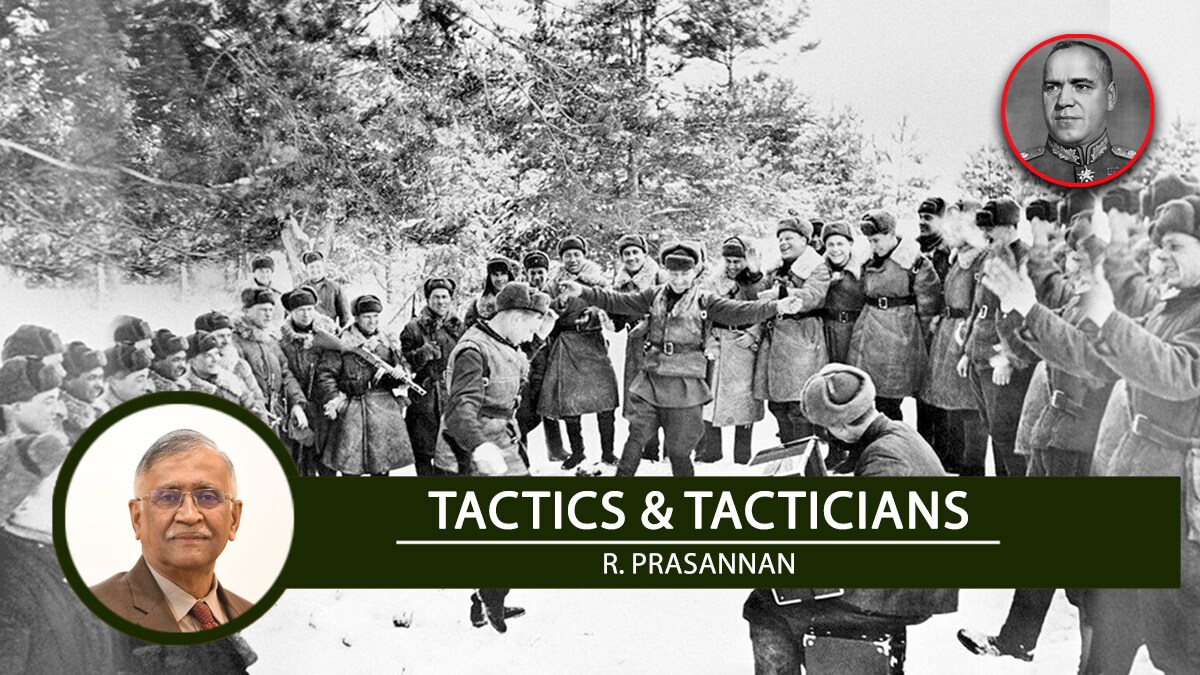
Russian General Georgy Zhukov ordered his army to retreat from most fronts. It was not a simple retreat; they were ordered to destroy everything in their path—all bridges, buildings, railway lines, and farmlands—by bombing or setting them on fire. The thought was that the enemy must not be able to use any of these.
In Stalingrad and Leningrad, the citizenry fought alongside the army. The Germans besieged both cities. Near Moscow, 600,000 Russian soldiers tried to hold back the German army. But the German army crushed them as well. By then, it was October, and the snowfall had begun. But Zhukov did not act. Let's wait for December - he decided.
By December, the entire Russian landscape was covered in heavy snow. German soldiers began to freeze to death without winter clothing. Tanks became immobile as their engines froze. Vehicle wheels got stuck in the snow and mud. As the Russians say, General Snow and General Mud did the rest.
On December 6, General Zhukov launched a massive counter-attack with an army of more than one hundred divisions. The survivors in the German army began to retreat. That retreat turned into a limping rout all the way back into Germany, with the Russians at their heels. It ended in Berlin, marking a sweet revenge for the Russians. The insult of invasion that had nearly been inflicted on Moscow was avenged.
The whole campaign, starting with the opening of Barbarossa till the fall of Berlin, lasted about three years and cost millions of lives.
