



In the 25th edition of the Pentagon’s assessment of China’s military trajectory, the US Department of Defence stated that Pakistan had ordered 36 J-10 fighter aircraft from China in two separate orders, at least 20 of which had been delivered.
Officially known in defence circles as the China Military Power Report (CMPR), it was submitted by the Secretary of Defence to the U.S. Congress under legal requirements. “Annual Report to Congress: Military and Security Developments Involving the People’s Republic of China for 2025” was released in the last week of December 2025. The latest edition claimed that China was working on a project to make the People’s Liberation Army (PLA) a “world class” military by 2049 and had already made significant progress in this regard.
The Pakistan Air Force (PAF) was expected to receive the remaining fighter aircraft before the end of that year, fully completing Pakistan’s first J-10C fleet structure, it added. Apart from the sale of J-10C fighter jets, Pakistan was mentioned a total of seven times across four topics in the report. The report mentioned Islamabad while commenting on the PLA's ambitions to have global military bases as well as the activities of the China-led International Lunar Research Station (ILRS). Earlier reports had said that China, which was the dominant supplier of military hardware to Pakistan—supplying nearly 81 per cent of Pakistan’s total arms imports between 2020 and 2024—would continue to be so, with some media reports claiming that Islamabad had even shown interest in China's sixth-generation fighter jets which were under development.
ALSO READ | Chinese weapons, fighter jets will continue to dominate Pakistan's arsenal: Expert
Here were all mentions of Pakistan in the US report that labelled the PLA as "a key component of China’s ambition to displace the United States as the world’s most powerful nation."
1. Sino-Pak aircraft deals. What the report said:
Fixed-Wing Aircraft. China offers three combat aircraft for export, including the fifth generation FC-31 and the fourth generation J-10C multirole combat aircrafts, and the China-Pakistan co-produced JF-17 light combat aircraft. In addition to manned aircraft, China has supplied strike-capable Caihong and Wing Loong UAVs to Algeria, Egypt, Ethiopia, Indonesia, Iraq, Morocco, Myanmar, Pakistan, Serbia, and the UAE.
In a further table included in the report regarding J-10C sales, it is stated that as of May 2025:, Beijing has delivered 20 units to Pakistan as part of two previous orders totalling 36 since 2020. It is their only J-10C export to date, it claimed.
2. Pakistan was among the potential buyers of Chinese naval vessels. What the report said:
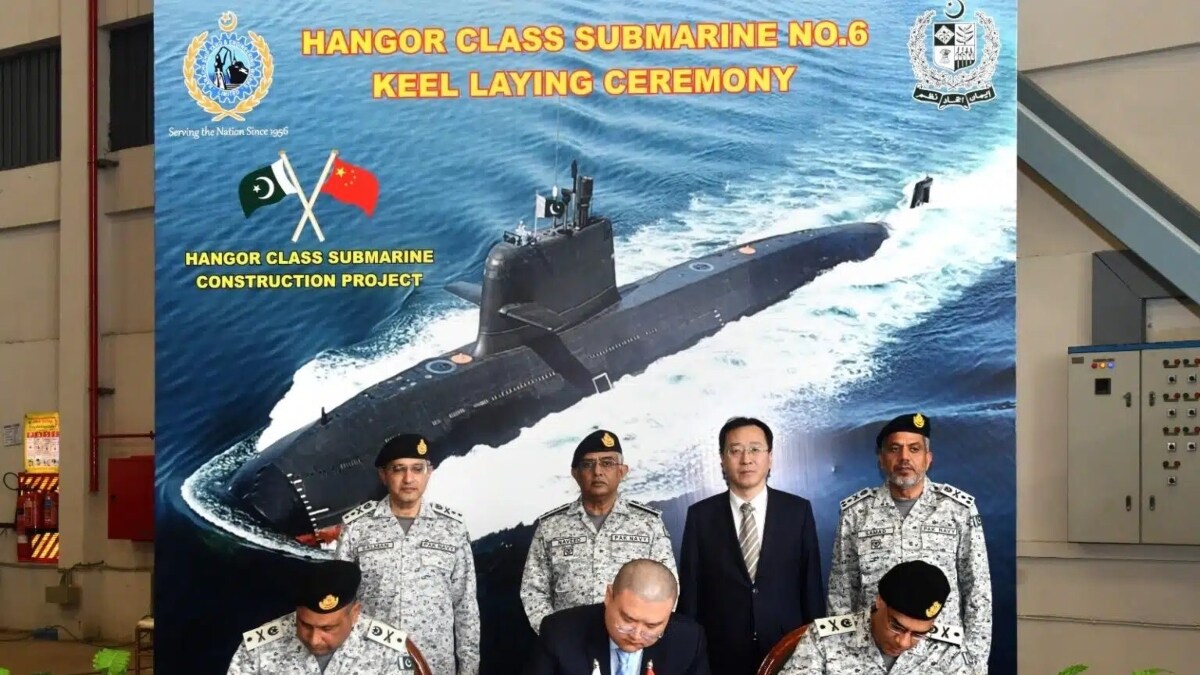
Naval Combatants. During the next five years, China probably will grow its naval export market, adding to a customer base that currently includes Bangladesh, Malaysia, Pakistan, and Thailand. In 2017 and 2018, China sold two frigates to Bangladesh and four to Pakistan, respectively.
3. China wanted bases and had identified places where it wished to establish them. A staunch ally of the communist regime, Pakistan and Bangladesh featured in the list. What the report said:
China seeks to establish sites as part of a global logistics and basing network to allow the PLA to project and sustain military power at greater distances. China’s leaders probably accept varied levels of access to meet the PLA’s overseas military logistics needs– including bases with garrisoned forces, host-nation shared facilities, exclusive PLA logistics facilities collocated with commercial infrastructure, or ad-hoc access to commercial infrastructure abroad. The purpose and operations performed at each facility are likely to be determined based on host-nation agreements and each China has likely also considered basing in Angola, Bangladesh, Burma, Cuba, Equatorial Guinea, Indonesia, Kenya, Mozambique, Namibia, Nigeria, Pakistan, Papua New Guinea, Seychelles, Solomon Islands, Sri Lanka, Tajikistan, Thailand, Tanzania, United Arab Emirates, and Vanuatu. The PLA is probably most interested in military access along the sea lines of communication in the Malacca Strait, the Strait of Hormuz, and other areas in Africa and the Middle East.
CLICK TO READ THE REPORT IN FULL HERE
4. Space Cooperation: Throughout 2024, China increased its space cooperation outreach worldwide, probably to boost its image as a collaborative space power while undermining U.S. global leadership, particularly with developing nations. As of December 2024, China has signed nearly 200 intergovernmental space cooperation agreements with more than 50 countries and international organizations, covering fields including earth observation, deep space exploration, satellite development, lunar exploration, and manned spaceflight. In 2024, Senegal became the latest country to join the China-led International Lunar Research Station (ILRS), and entities from the United Arab Emirates, Switzerland, Panama, Serbia, Pakistan, South Africa, and Indonesia signed agreements on ILRS cooperation.
(Note: The seven mentions were not given in the order of appearance in the original report.)
