



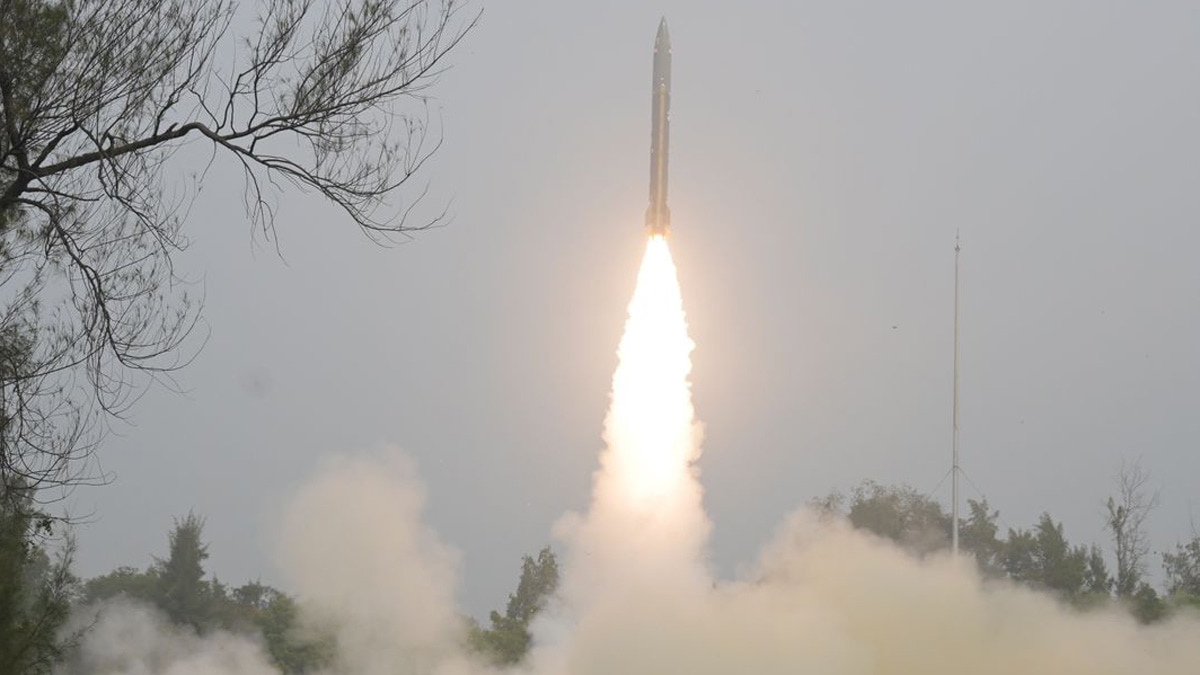
The successful launch of two Pralay missiles marks a quiet but consequential shift in India’s approach to conventional deterrence. The December 31, 2025, salvo launch of two missiles from the same launcher off Odisha proves India can now deliver pre-emptive, proactive, precision punishment deep into enemy territory. It marks a new strategic culture reset of denial and domination beyond strategic restraint or reactive disposition. This development could mark the next step for India’s Rocket Force.
Pralay is a short-range surface-to-surface missile designed as a theatre-level operational strike system for the Indian Army rather than a strategic deterrent. It uses a two-stage solid propellant motor with a manoeuvrable re-entry vehicle, allowing controlled flight and high precision against time-sensitive targets. With a range of about 150 to 500 kilometres and speeds up to around Mach 1.6, it follows a quasi-ballistic, low altitude trajectory that complicates detection and interception. Road mobile launch from an 8x8 BEML Tatra transporter gives it rapid deployment and survivability, while indigenous guidance and avionics enable mid-course correction and penetration of enemy air defences.
Salvo launch shifts doctrine
This was not a technology demonstration designed for optics. It was a user evaluation trial conducted to operational specifications, with the Indian Army present as a stakeholder. That distinction matters. It signals movement from development to doctrine.
Targets like command posts, airfields, radars, logistics and C5ISR nodes across borders now face rapid strikes from deep secure launch pads, with minimal risk and maximum survivability. Salvo firing is not about symbolism. It is about the ability to generate volume, conduct follow-on strikes, and sustain dominance against time-sensitive and high-value targets. In deterrence terms, reliability under stress matters more than headline specifications. Solid fuel propulsion enables high readiness and rapid launch, while road mobility enhances survivability and reduces vulnerability to preemption.
Pakistan’s arsenal in perspective
Pakistan fields a sizeable inventory of ballistic and cruise missiles, including the Shaheen‑III medium‑range ballistic missile with an estimated reach of about 2,750 km and systems such as Ghauri and Babur. Yet many of these weapons, particularly older liquid‑fuelled designs like Ghauri, lag in readiness, mobility, and precision compared to India’s emerging solid‑fuel, precision‑guided arsenal, making them more suitable for psychological deterrence than fine‑grained escalation control.
Pralay, by contrast, offers India a high‑accuracy, conventional strike capability that can impose costs on military infrastructure without inviting immediate nuclear retaliation, thereby tilting the qualitative balance in India’s favour at the conventional level.
Pakistan’s force buys psychological weight and table seats, but lacks Pralay-style precision for controlled punishment, tipping the quality balance to India. Babur adds deniability, yet Pralay counters dispersed threats better with its speed and reach.
China’s overmatch and India’s reply
China’s People’s Liberation Army Rocket Force fields missiles across all ranges, from systems like the DF‑21 and DF‑26, both capable of nuclear or conventional roles, to longer‑range missiles such as the DF‑27 that can reach 5,000–8,000 km and also carry hypersonic glide vehicles. It shapes seas and skies far out, blending conventional and nuclear roles.
India seeks no parity count, but Pralay closes tactical strike gaps that others exploit. Paired with BrahMos and hypersonic missiles, it pushes back numerically, hardening northern fronts against surveillance and rapid mobilisations. Quasi-ballistic paths complicate interception; precision hits high-value targets despite asymmetry. This is India’s biggest deterrence against China.
Why Pralay matters for deterrence
Let’s cut the fluff on deterrence theory. Credible deterrence isn’t silence. It’s certainty of cost, quickness of punishment, and fog-proof signals. Pralay contributes to all three.
- Certainty of cost: Adversaries must now assume that high-value strike assets can be hit conventionally with precision within hours, not days. That alters strategic incentives during crisis escalation.
- Quick punishment: Solid fuel + mobile launcher = response in minutes. That compresses decision timelines for all actors.
- Communication without chaos: Conventional precision weapons offer leaders calibrated pain options that avoid crossing nuclear thresholds.
India’s missile doctrine has historically been defensive and nuclear-centric. Pralay and its kin are steps toward a posture that can deter without irrational escalation, signal resolve without losing control. That’s the high-end challenge of modern deterrence.
Redefining conventional deterrence
For over two decades, India’s deterrence debate has been framed by nuclear thresholds even though actual crises from Kargil to Balakot and Galwan to Op Sindoor have remained below that line. India accumulated air-delivered precision capability and nuclear-armed ballistic systems, but left a grey zone between punitive air strikes and nuclear signalling. Pralay plugs precisely this gap by offering conventional, theatre depth, high precision strikes against time-sensitive, high value targets.
Targets that were earlier difficult to engage without air campaigns or prolonged artillery exchanges can now be engaged with reduced risks from deep within Indian territory. Command nodes, logistics hubs, airfields, and high-value force concentrations across the Western and Northern fronts fall within its envelope, making limited war, salami slicing, and coercive probing cost-prohibitive and less predictable for the initiator.
Salvo as strategic signalling
The choice to fire two missiles in rapid succession from the same launcher was itself a message. Salvo firing demonstrates that the system is robust under operational tempo, can support saturation attacks, and is designed for follow-on strikes rather than one-off symbolism. Deterrence rests not on possession but on perceived reliability under pressure; a tested salvo suggests confidence that batteries can generate volume, survive counterfire, and keep shooting when the fog of war is thickest.
Pralay’s solid fuel design allows rapid command to launch timelines reportedly as low as about a minute, while road mobile launchers carrying multiple missiles increase survivability and complicate enemy targeting. In practice, this means that targets which earlier demanded complex, politically risky air campaigns or prolonged artillery duels can now be threatened or neutralised within minutes, tightening the feedback loop between political decision and military effect.
Indigenous edge and user focus
Born from DRDO’s Research Centre Imarat with Bharat Dynamics and Bharat Electronics Limited as partners, Pralay proves ecosystem maturity across propulsion, guidance, and warheads. The Indian Army and Air Force input in trials ensures operational fit, not lab fancy.
Indigenisation means no foreign strings in crises. Sustainable production keeps deterrence alive through upgrades and wars. Resilience from solid fuel and mobility builds second strike faith at conventional levels, cooling pre-emption urges.
Operational discipline ahead
Pralay’s warheads suit varied targets, but success demands doctrine: joint ISR fusion, clear employment rules, and salvo planning. Tailored right, it punishes without chaos; botched, it muddies signals. Testing patterns show services grasp this.
From a regional view, Pralay reshapes fronts. West: counters proxy denial. North: complicates tech-heavy defences. Silent deterrence works when foes pause probes, knowing costs are certain and steep.
Doctrinal transformation: Need for a Rocket Force
India’s missile and rocket capability is strong but still dispersed across services and structured largely for deterrence instead of dedicated precision strike dominance. The Agni series strengthens nuclear deterrence. Prithvi and short-range systems give limited tactical reach. Prahar, Pralay, BrahMos, Smerch and Pinaka add credible punch. However, China already fields layered rocket and missile strike grids with high-density launcher deployment. India needs speed, massed fire, time-sensitive targeting and seamless command authority to counter this reality.
This is why the country needs Indian Rocket Force. A dedicated missile and rocket command would unify doctrine, training, ISR integration, targeting workflows and escalation management. It would enable pre-emptive denial, counter force options, battlefield paralysis strikes, and long-range conventional deterrence. It would free the Indian Air Force from overdependence on strike roles and give ground forces overwhelming fire support without crossing nuclear thresholds. It would also improve war preparedness along both fronts and signal strategic maturity.
Strategic culture reset
For much of the past, restraint was misread as hesitancy. Pralay helps recalibrate that perception. It strengthens the link between political intent and military execution, offering proportional responses that are firm yet controlled. In doing so, it marks a subtle but important evolution in India’s strategic culture, from denial alone to a balanced approach that integrates denial with credible conventional punishment.
Future conflicts in the region are likely to remain ambiguous, competitive, and below the nuclear threshold. In that space, control over timelines, targets, and escalation dynamics is decisive. India must optimise precision rockets and missiles to decide tempo, dominance, and outcomes. India cannot afford a fragmented capability. An Indian Rocket Force is no luxury. It is a strategic necessity.
(The opinions expressed in this article are those of the author and do not purport to reflect the opinions or views of THE WEEK)
