



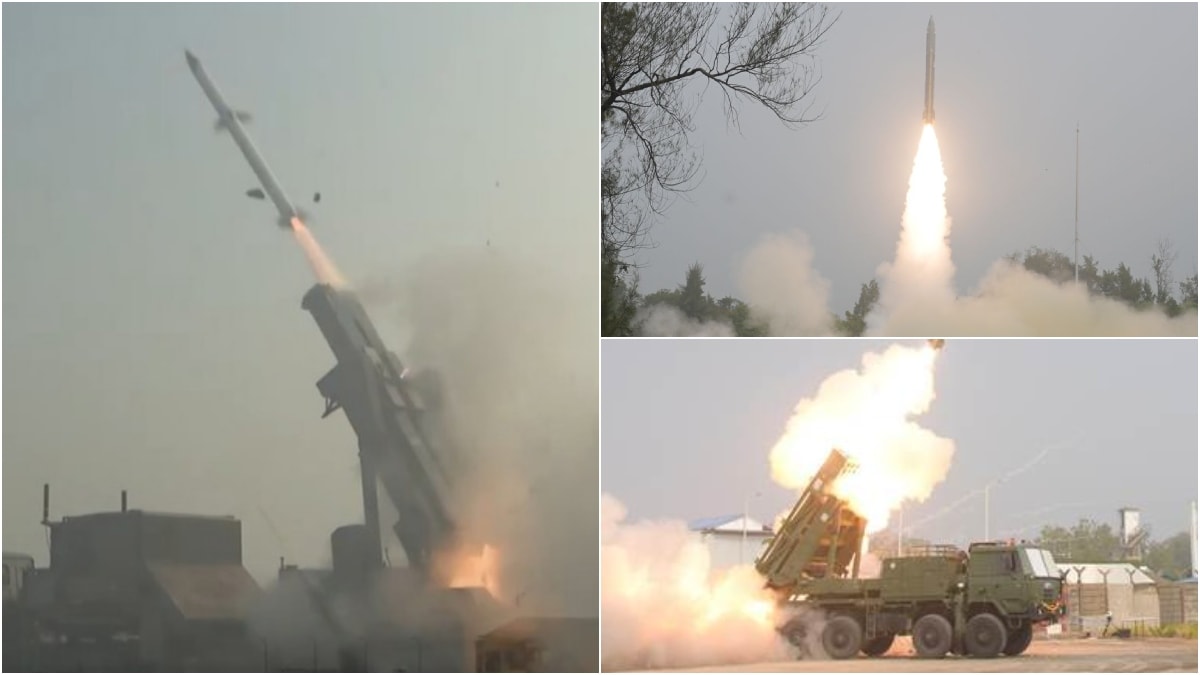
The last few days of 2025 had been quite eventful for the Indian defence establishment, as four major tests that are key to its strategic posture and defence self-reliance were carried out in just nine days.
First came the user evaluation trials of the next-generation Akash missile system on December 23. Akash-NG is a new-generation surface-to-air missile meant to intercept high-maneuvering, low Radar Cross Section (RCS) aerial threats. It has been developed with better deployability compared to other similar systems, with a canisterized launcher and a much smaller ground system footprint.
The system, according to the Defence Research and Development Organisation (DRDO), demonstrated high precision against various aerial threats, including high-speed, low-altitude targets and long-range, high-altitude targets during the user evaluation trials.
During the trials, the missiles successfully intercepted aerial targets at different ranges and altitudes, "including the near-boundary, low-altitude and long-range, high-altitude scenarios," the DRDO said.
The successful user evaluation trials will eventually lead to the induction of the missile system into the armed forces, marking a major boost to the air defence capabilities of the country.
While there has been no official communication yet, on the same day, another test of the nuclear-capable K-4 submarine-launched ballistic missile (SLBM) was successfully carried out from INS Arighaat in the Bay of Bengal.
Powered by solid rocket propellant in a two-stage design, K-4, which is derived from Agni-III, carries a warhead of up to 2–2.5 tonnes and has a range of 3,000–3,500 km.
K-4 is expected to be inducted into the nuclear arsenal of India soon.
A few days later, on December 29, the maiden flight test of the Pinaka long-range guided rocket was conducted at the Integrated Test Range at Chandipur in Odisha.
Designed by the Armament Research and Development Establishment, a lab of the DRDO, in association with the High Energy Materials Research Laboratory and with support from the Defence Research and Development Laboratory and Research Centre Imarat, the rocket has been termed a "game changer" by the defence ministry.
It was launched from the in-service Pinaka launcher, demonstrating its versatility and showcasing the launch capability for Pinaka variants of different ranges. During the flight test, the rocket achieved its maximum range of 120 km, executing all planned in-flight maneuvers with high accuracy and striking the target with much precision.
On the last day of the year 2025, another important milestone was achieved as two Pralay missiles were test-fired in quick succession, establishing the reliability of the missile.
The indigenously developed Pralay is a short-range surface-to-surface missile with a payload capacity of 500–1,000 kg, capable of carrying multiple conventional warheads. It has a range of 150 to 500 km.
The flight test was carried out as part of user evaluation trials. Both missiles followed their intended trajectories and successfully met all flight objectives, as confirmed by tracking sensors, the defence ministry stated.
The successful completion of the salvo launch of the Pralay missile will pave the way for its induction into the armed forces.
The aforementioned tests fast-track the induction of these systems into the Indian Army, Navy, and Air Force, leading to enhanced border defence and maritime security. These tests mark major steps in defence self-reliance and in the country's strategic posture, as they showcase the precision strike capabilities, sea-based nuclear deterrence, and layered air defence of the country's armed forces.
The tests, at least that of the K-4, appeared to have triggered Pakistan as a Pak-based think tank, Islamabad Policy Institute (IPI), claimed that from a Pakistani perspective, the SLBM test is "less a defensive milestone and more a red flag for regional and global stability." The test has further complicated South Asia’s fragile nuclear balance, IPI argued. "Such developments cannot be ignored as routine or purely technical milestones. Tests of this nature go beyond incremental capability upgrades and carry wider strategic consequences," it further said.
