



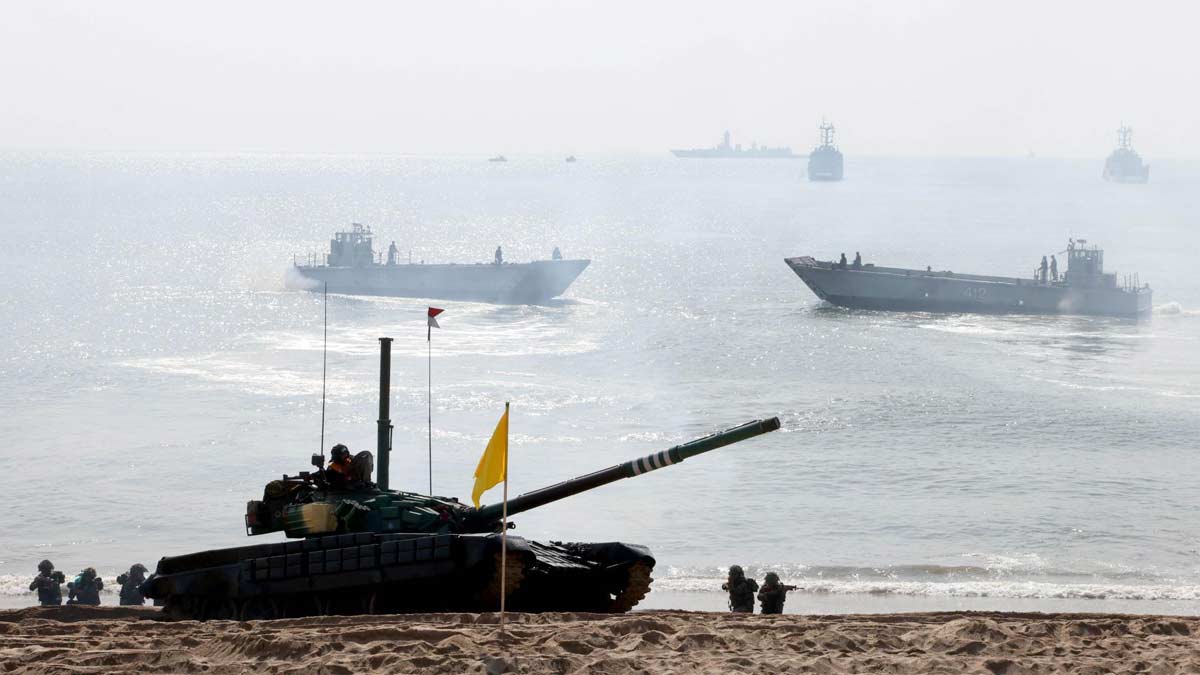
The joint operational readiness and multi-domain warfighting capabilities of the Indian armed forces have been effectively showcased during the Tri-Services Exercise 'Trishul', which concluded recently.
The exercise validated critical integrated combat procedures and strengthened interoperability across the Indian Navy, the Army, and the Air Force, a statement from the defence ministry read.
The major focus of the exercise was to enhance synergy between the armed forces and validate and synchronise multi-domain integrated operational procedures across the three services, enabling joint effect-based operations. Key objectives included enhancing interoperability of platforms and infrastructure, strengthening network integration across the services, and advancing jointness in operations.
According to the defence ministry, the exercise achieved its core objectives of enhancing synergy between the three services, refining network integration, validating joint Intelligence, Surveillance and Reconnaissance, electronic warfare, and cyber warfare plans, and advancing effect-based operations through fully synchronised multi-domain actions.
The exercise showcased improved interoperability of platforms, infrastructure and command structures across the services. Joint Intelligence, Surveillance and Reconnaissance procedures were validated, while electronic warfare and cyber warfare frameworks were tested in realistic combat settings.
ALSO READ: What is the US heavy bomber B-1B Lancer doing in India?
Trishul further showcased the effective deployment of indigenous systems in line Aatmanirbhar Bharat, besides fine-tuning tactics and techniques tailored to address emerging threats and the shifting character of modern warfare.
Conducted in early November 2025 with the Indian Navy as the lead service, the wargame brought together the Western Naval Command, the Southern Command of the Indian Army, and the South Western Air Command of the Indian Air Force as the primary formations.
The large-scale drill spanned creek and desert sectors in Rajasthan and Gujarat, extended into the maritime domain, and included amphibious operations in the North Arabian sea.
The exercise has set new benchmarks in jointness and interoperability and "we go back much stronger out of it," top Indian military commanders said on Thursday.
Air Marshal Nagesh Kapoor, Air Officer Commanding-in-Chief, South Western Air Command, said, "Our aim was to refine our protocols and procedures, and field new technology. So, it was not a fall-out of Operation Sindoor, and there was no strategic messaging (in it)."
Lt Gen Dhiraj Seth, General Officer Commanding-in-Chief, Southern Command, said. "During Exercise Trishul, the kind of jointness, integration and interoperability we have established is a new symbol. It has been very effective, and we have set a new benchmark."
