



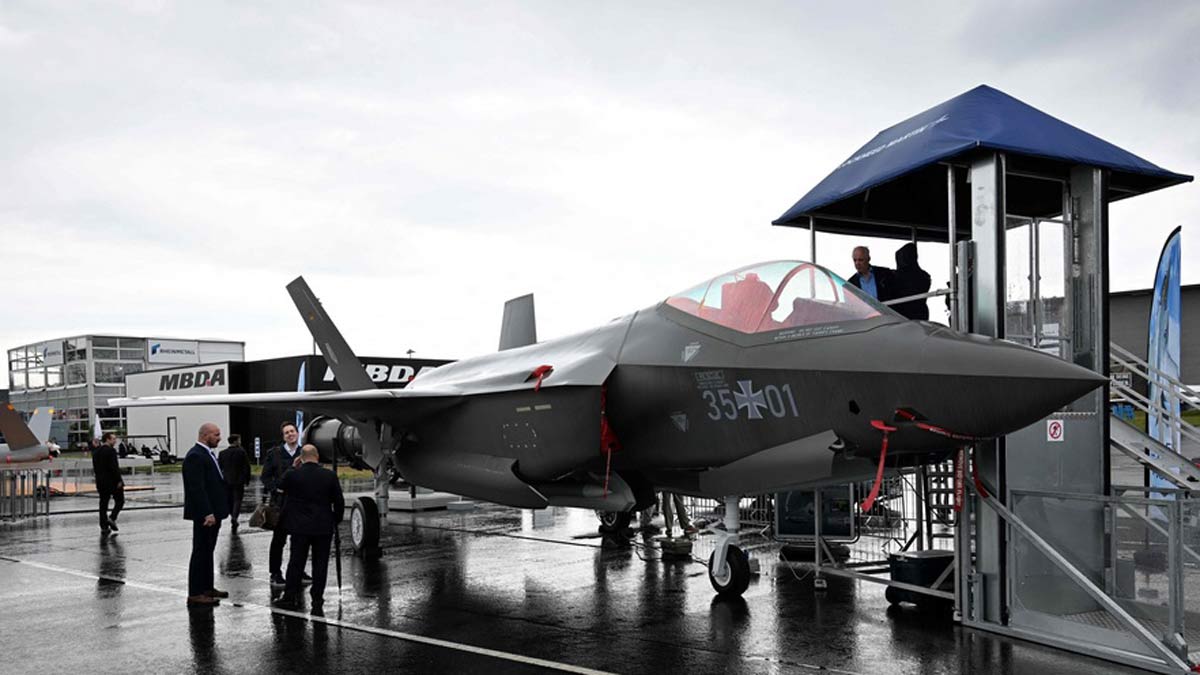
Amid the ongoing trade tensions between the United States and Canada and US President Donald Trump's threat to make Canada the 51st state, Canada is said to be reviewing its plan to purchase the fifth-generation F-35 fighter jet of American defence major Lockheed Martin to replace the aging fleet of CF-18 Hornets of the Royal Canadian Air Force.
While the C$19 billion ($13.2 billion) contract to procure 88 F-35 fighter jets, announced two years ago, hasn't been cancelled yet, Canada's Prime Minister Mark Carney asked Defence Minister Bill Blair to review the purchase order to see if there are any other options.
Canadian defence ministry press secretary Laurent de Casanove said the PM asked the defence minister “to determine if the F-35 contract, as it stands, is the best investment for Canada, and if there are other options that could better meet Canada’s needs."
“To be clear, the F-35 contract has not been canceled, but we need to do our homework given the changing environment and make sure that the contract in its current form is in the best interests of Canadians and the Canadian Armed Forces,” he added.
So, what are Canada's options?
A close contender for the warplane deal with Canada was Saab AB and the company's Gripen fighter jet was seen as a possible alternative for F-35. Saab JAS 39 Gripen is a single-engine multi-role fighter aircraft known for its agility and advanced avionics. Equipped with state-of-the-art technology, it is capable of performing a wide range of air-to-air, air-to-surface and reconnaissance missions. Given the strong bilateral relations that Canada and Sweden enjoy, and the fact that Gripen fighter jets came a close second in the deal make it a possible option for Canada.
Besides, there are indications that Blair was referring to the Swedish firm's proposal when he said, "The prime minister has asked me to go and examine those things and have discussions with other sources, particularly where there may be opportunities to assemble those fighter jets in Canada."
The 4.5th-generation ((or 4.5+ if one is to go by the latest version) twin-engine, multi-role fighter aircraft Dassault Rafale with its "outstanding load-carrying capability and its advanced mission system" could be another possible option that Canada can consider to replace the CF-18 Hornet jets. The combat-proven Rafale, already being exported to seven countries, including India, is being billed as an "omnirole" fighter because of its ability to perform several actions—air-to-ground strikes, air-to-air attacks and interceptions during the same sortie—at the same time.
There is also the option to replace CF-18 Hornets with the Boeing F/A-18 Super Hornet, which according to the company can perform “virtually every mission in the tactical spectrum, including air superiority, day/night strike with precision-guided weapons, fighter escort, close air support, suppression of enemy air defences, maritime strike, reconnaissance, forward air control and tanker missions.” The transition from CF-18 Hornets to F/A-18 Super Hornet would also be easier, according to defence website armyrecognition.
There is also Eurofighter Typhoon, developed by a consortium of European companies, including Airbus, BAE Systems, and Leonardo, and known for its advanced avionics, exceptional maneuverability, and versatility in both air-to-air and air-to-surface missions. Its sensors give the pilot an unparalleled situational awareness, seamlessly integrating data and updating the battle space picture for actionable intelligence, according to the company.
Meanwhile, Lockheed Martin had said the company values its strong history with Canada's air force and the “questions about Canada’s procurement of the F-35 are best addressed by the Canadian and US governments.”
