



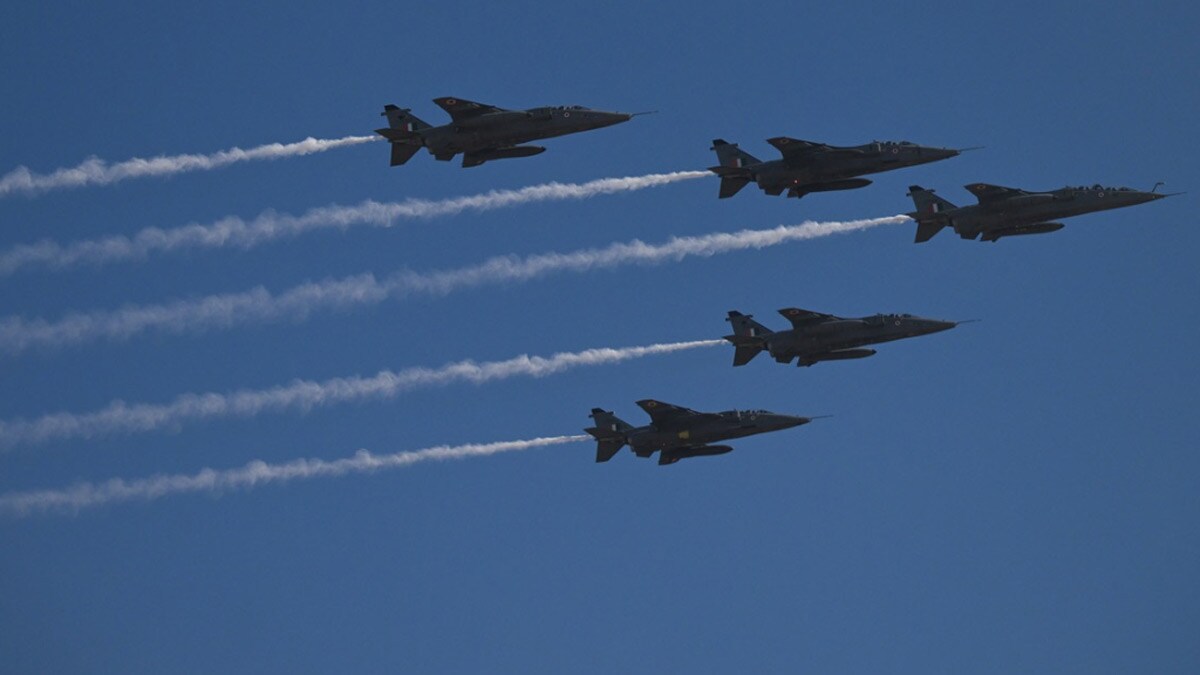
These are interesting times we live in. One, major conflicts are ensuing across the world, including the ones in Ukraine and the Israeli-Palestinian conflagration, that have in them the potential to escalate into another one of Great Wars.
Second, with traditional power balances shifting and a strategic ‘rebalancing’ taking place after the end of the Cold War, a process of realignment has set in, giving impetus to the buttressing of military strength by most major nations of the world.
Third is the mind-boggling speed of development and proliferation of cutting-edge military technology that has yielded new and deadlier weapons, platforms and systems.
In this backdrop, Aero India 2025 may have a defined narrative—India wants a larger pie of the military market to sell its products, seeks greater collaboration with foreign Original Equipment Manufacturers with more favourable transfer-of-technology terms, and yet build up its indigenous capability to make military products.
Being held in the IT city of Bengaluru, for five days from Monday, all roads will lead to the Yelahanka Air Force Station where the 15th edition of the biannual show is being hosted.
A government flagship air show, touted to be Asia's biggest, it is being organised by the Defence Exhibition Organisation, under the aegis of the Ministry of Defence’s Department of Defence Production.
Besides providing a platform for the display of military and technology prowess in the aerospace sector by the powers that be, it aims to productively engage governments and the military-industrial complex in Business-to-Government (B2G) and Business-to-Business (B2B) interactions.
Just to give an idea, in the show’s 14th edition in 2023, more than 250 B2B partnerships were finalised with a total value of more than Rs 75,000 crore.
But it is also an event where strategic and military alliances firm up and get showcased.
While Russian weaponry comprises the dominant chunk of the Indian Air Force (IAF) arsenal including the Sukhoi series fighters and MiGS, the Americans have been trying to wean off India from the Russian sourcing and replace it with their own or with Western assets. Meanwhile, the Indian military effort has been more focused on ‘Atmanirbharta’—indigenisation of its weapons and platforms.
In the regional context, the strategic and military developments in the South Asian geography have added another dimension to India’s security preparedness.
With China fielding fifth-generation stealth fighter aircraft like the J-20 aka ‘Mighty Dragon’ in significant numbers and deployed in air bases very close to the Indian border, the security balance in the region is shifting very fast. The speedy development of the sixth-generation J-36 is being acknowledged as an effort by China to claim global leadership in cutting-edge aerospace weaponry.
What would also worry the Indian leadership is the Chinese proactive help to Pakistan to ramp up the latter’s air force by providing and collaborating on fighter aircraft development and manufacturing.
This is happening at a time when the IAF is desperately in need of new fighter squadrons to ramp up its air combat capability. The IAF fields only about 31 fighter squadrons as against the mandated 42 squadrons that would be needed in case of a two-war front scenario.
Moreover, against the ‘Mighty Dragon’, the IAF’s most modern and frontline platform is the 4.5 generation Rafale fighter from the French Dassault stable. A fifth-generation fighter aircraft in the IAF fleet would definitely somewhat erode Chinese supremacy in the skies.
In that context, it is pertinent to raise the question if the US would offer the cutting-edge F-35 fighter to India under favourable financial considerations. It would be definitely in their interest to do so as the US looks at India as being on the frontline to counter the growing Chinese military and economic might.
It was during Aero India 2023 that the F-35 first landed on Indian soil. Later, two F-35 aircraft stood by on the tarmac for a static display even as two B-1 bombers flew past underlining their long -range operational capability. Another platform put on display were the two B-1 strategic bombers that flew about 15,000 km from the United States Air Force (USAF) base at South Dakota and then to Guam before flying over Bengaluru.
In August 2020, the US deployed B-1 bombers along with about 200 airmen amid escalating tensions between India and China over the border dispute along the Line of Actual Control in eastern Ladakh.
With the US likely to fly in its F-35s to Aero India, Russia is not very far behind with a likely Aero India debut by the fifth-generation stealth multirole fighter Sukhoi-57. The Russians claim the superiority of the Su-57 over the F-35 in terms of its supersonic cruising speed, on-board arsenal, and stealth prowess.
But what would be a main factor for India while deciding whether to go in for foreign fighter aircraft or not is the reported progress in India’s Advanced Medium Combat Aircraft (AMCA) programme. The main stumbling block for the AMCA programme is the lack of an aero engine. While there have been ongoing talks with the General Electric F414 engines, it is an issue that is yet to be resolved. There is a possibility that Bengaluru’s Aero India may yield answers to that among many more.
