



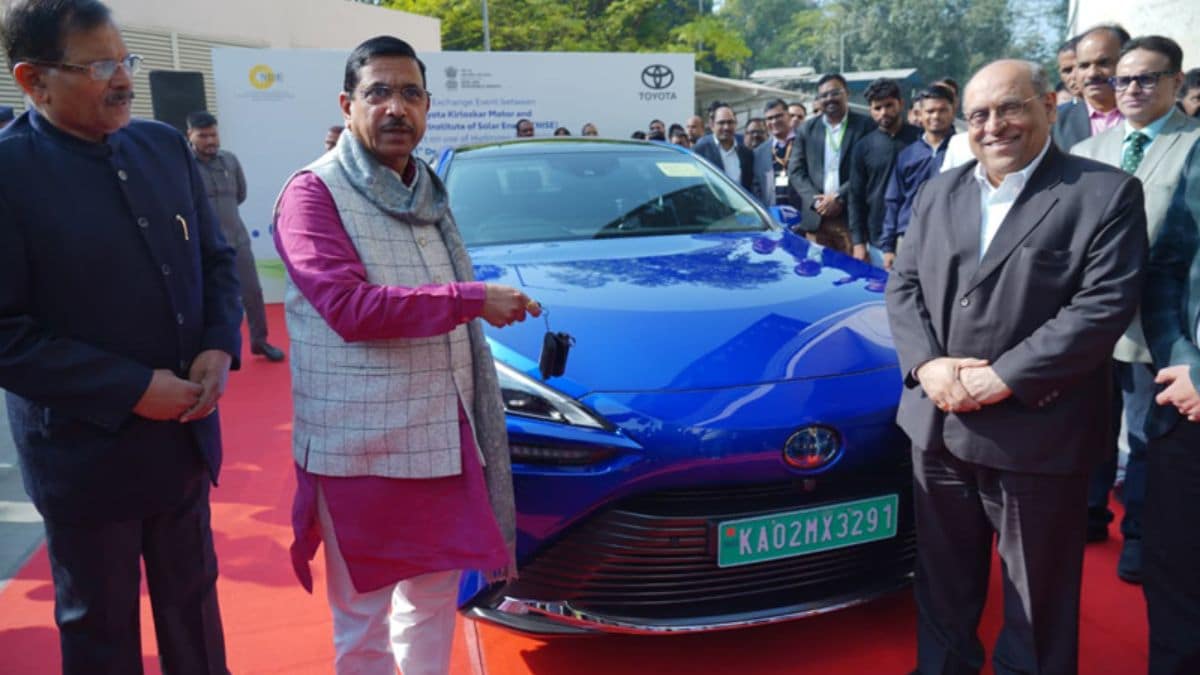
It was a short drive which spelt a giant leap for the transport sector’s hydrogen dreams. Or at least the global debate over Battery EVs operating on lithium versus Fuel cells operating on Hydrogen.
Union minister for new and renewable energy Prahlad Joshi launched a pilot project last week in Delhi for the National Institute of Solar Energy to test a new fuel cell electric vehicle or FCEV under real-world Indian conditions.
WATCH: Pralhad Joshi drives Toyota Mirai to Parliament
An FCEV, in other words, is one that uses compressed hydrogen, which combines with oxygen to power an electric motor for propulsion, as compared to the present set of electric vehicles, which run on charged batteries, primarily of lithium-ion make.
But the minister did not stop at just the formal event. He drove the car all the way to Parliament, which is presently in session.
“The ride was incredibly smooth, silent and comfortable and with zero emissions,” the minister remarked, “This vehicle demonstrates the transformative potential of hydrogen mobility in shaping India’s clean future.”
While the electric battery vs hydrogen vs other technologies like sodium-ion has been debated about for some time, what is interesting is the competitive hues it has taken—not just down to rival technologies and companies, but whole nations.
Aap chronology samajhiye. After the Second World War, transportation depended on the internal combustion engine, dominated by American companies like Ford and General Motors. The Europeans, too, had a share in the pie, particularly German brands like the Volkswagen group, which had a plethora of premium brands ranging from Porsche, BMW, Bentley and Audi.
But Japan was the dark horse by the time it was the eighties and nineties, its vehicles racing to the top of the sales charts even in markets like the US, with its highly evolved market scenario and deeply insular consumers. Toyota soon became the world’s largest-selling motor car brand, while Suzuki’s Indian partnership, Maruti Suzuki, made it a heavyweight. Others like Honda, Mitsubishi, Nissan all became cars people vied for all over the world, with Brand Japan becoming numero uno in the auto sector in general, and especially in passenger cars.
Then, disaster struck with the advent of electric vehicle technology. Japanese brands perhaps did not take the new technology too seriously at first, or perhaps it was China’s runaway success in EV battery technology, straddling the ecosystem right from lithium refining to battery technology to the final products. Today, 8 out of the top-selling EV cars are from China.
The Japanese strategy through all this has been two-fold: one, hybrid, where we use a mix of petrol and electric or natural gas, should be the way forward at least during the transition phase. Secondly, electricity as a clean energy depends not just on its use, but also on ensuring that the source of electricity used to charge the batteries actually comes from clean sources and not from coal, as is the case primarily, for example, in India. A petrol that follows emission norms and is less polluting would do equally well.
And the third, and most crucial, has been Japan’s clambering onto other future technologies, primarily Hydrogen fuel cells for now, though others like sodium ion, etc., are not anathema to them, which has made detractors wonder whether it’s a case of being miffed at the Chinese march in EV that is the real reason.
Any which way, while hydrogen technology is years away from becoming commonplace. “Hydrogen fuel cell-based technology will have applications in certain areas of mobility, but I think it is a few years out for large-scale commercial applications,” argues Himanshu Aggarwal, investor & strategy of Zenergize, a power electronics company.
Industry-wide, the focus is presently intensely on lithium battery EVs. “Battery electric mobility is currently the most viable pathway to decarbonise transport, driven by superior energy efficiency, declining battery costs and faster infra rollouts,” said Piyush Goyal, co-founder & CEO of Volks Energie, “Hydrogen fuel cells remain constrained by the cost and availability of green hydrogen.”
The more curious thing right now is which of the options other major markets will hitch a ride on. India is officially technology or medium-agnostic, though recent government moves to cut down on the incentives for EVs, even while raising them for hybrid models (at least in some states), may hint at something else. Not to forget, the talking up of hydrogen as a promising technology, with minister Joshi’s hydrogen ride is only one example. It does make one wonder whether India is also following the Japanese playbook when it comes to dealing with a strategic rival like China.
