



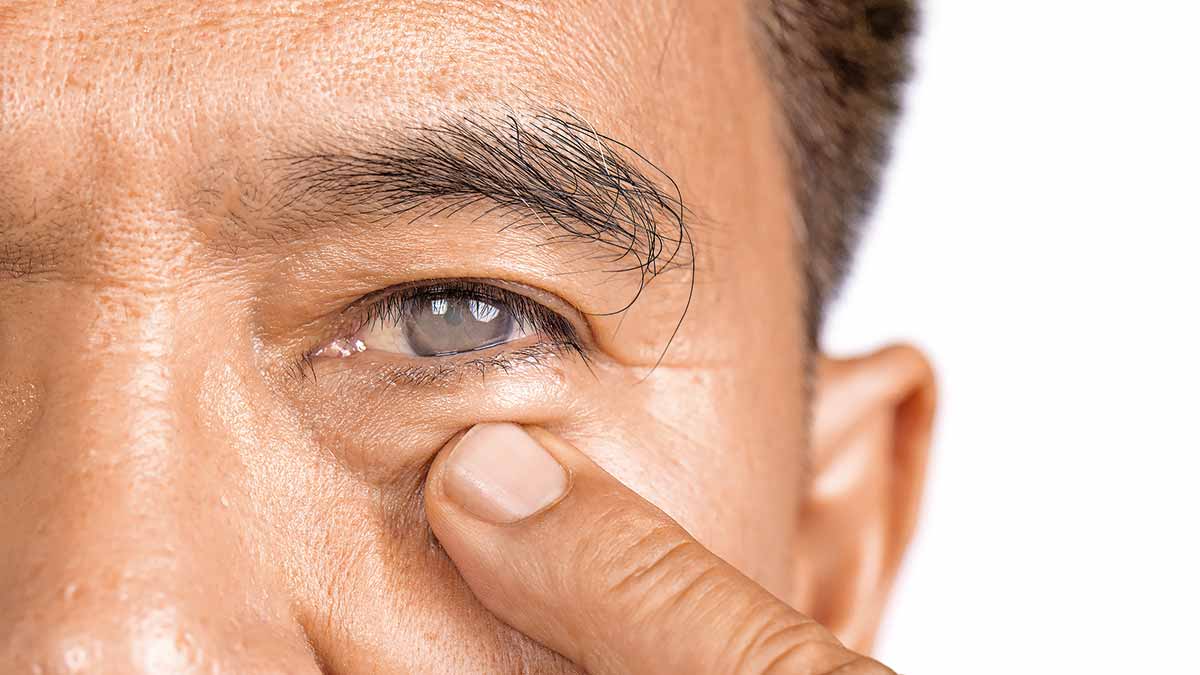
Deepali R., a Mumbai homemaker, thought menopause was her only worry as she approached her late 40s. Little did she know that she would soon join her septuagenarian uncle in wearing post-cataract surgery spectacles. She experienced persistent haziness in vision, but thought it was stress-related and ignored it. “It was a jolt,” she says. “I hadn’t even greyed fully. But thankfully, my vision has been revitalised.”
Cataract, the gradual clouding of the eye’s lens, has always been a part of the ageing process. But today, people in their 40s are signing up for surgery. “Previously, the approach to cataract surgery was to delay it till blindness set in or until there was a sudden dramatic depletion in vision,” says Mumbai ophthalmologist Dr Himanshu Mehta. “Cataract never happens suddenly. Technology, too, wasn’t developed back then.”
EMERGING AWARENESS
Mehta believes people today, especially professionals, feel a more pressing need for excellent vision. Earlier, elderly members of a household who didn’t need to read or see much ignored the symptoms. “A 50-year-old corporate guy facing vision problems might find it a hindrance at the workplace, not being able to clearly read presentations,” he says. “‘I can’t see’ is no excuse.”
Delhi-based perfumer Mukul Gundhi, 54, believes that along with a sound nose, a good pair of eyes is a non-negotiable to his livelihood. He couldn’t afford gradually depleting vision while handling daily customers, reading online orders and maintaining accounts at his heritage perfumery. Following successful cataract surgeries for both eyes, he now enjoys an improved quality of life.
“The cataract concept has changed over the years,” says Delhi ophthalmologist Dr Rajib Mukherjee, who operated on Gundhi. “In the 1980s and 1990s, people waited until the cataract completely matured, which could take decades. That era was devoid of computer and phone screens. Today’s visual demands are far greater. Can you sacrifice identifying things on your phone? Today, we don’t look at mature cataracts, but rather at lifestyles.”
EARLY INDICATIONS
“More than even screens, early diabetes causes early cataract,” says Dr Ronnie Jacob George, senior ophthalmologist at Chennai’s Sankara Nethralaya. “The number of young Indians with diabetes has sadly increased over the years.”
Fluctuating blood sugar level causes imbalances in the intraocular (in the eyeball) fluid, leading to swelling of the lens. “When the concentration of sugar increases, the lens tends to absorb water and swells,” says George. “The lens is clear due to the proteins being arranged in a particular way. In this case, the protein arrangement is changed and vision becomes hazy.”
Uncontrolled blood sugar, extensive exposure to ultraviolet radiation, smoking and tobacco consumption of any kind, he says, affect eye health. “Farmers, for instance, are known to suffer from early cataract due to continuous UV exposure,” he says. “That’s why wearing sunglasses is essential. Airline pilots always do, considering intense UV exposure at high altitudes.”
Although cataract and ageing are directly connected, many babies are born with the condition, too. “If the mother suffers from infections like rubella during the second trimester, the child can be born with cataract,” says Mehta. While his oldest cataract patient was 108, his youngest was just two.
FROM ‘SODA GLASSES’ TO SAFE AND SMOOTH
“At the outset, the term ‘surgery’ gave me jitters,” says Gundhi. “However, after the first eye’s cataract was smoothly removed, I was completely fearless for the second.” The post-operative pain, he says, was like a needle-prick during a blood test.
With technical advancements, cataract surgery is no longer painful, cumbersome and stressful. “Earlier, sandbags were placed on either side of the head [to restrict movement] while the patient lied down,” says Mehta. “There was risk of infection. Many lost eyes. There was no lens replacement, but instead ‘soda glasses’ (thick lenses) with convex lenses of a whopping +30 power. With those, everything looked magnified. While crossing the street, one experienced a ‘jack in the box’ phenomenon (an optical illusion). A car would appear, then disappear only to suddenly reappear, causing confusion and often accidents.”
Today, with evolved technology, things look brighter. “Modern techniques include phacoemulsification surgery that began in the 1990s,” says Mehta. “It involves a ‘phaco machine’ which, through a tiny ultrasonic needle, breaks the cataract at a high speed and suctions it out. No stitches are involved.”
Laser surgeries, however, are the most advanced and near-painless, he says, especially FLACS (Femtosecond laser-Assisted Cataract Surgery). “Even when we perform a laser surgery, the fragments are finally removed by the phaco machine. The robot makes it more precise and perfect. Laser is a safe procedure and hence consistently repeatable,” he says.
Comparatively, phacoemulsification without femtosecond laser (a precise infrared laser) is more affordable and not many Indian centres are equipped with the latter. “Less than 5 per cent of patients choose femtolaser. For them, an iPhone is more important than the eye,” says Mehta with a chuckle.
PRICELESS PRECISION
“Cataract is the most frequently performed surgery globally,” says George. “Around 40 years ago, surgeries involved opening the eye to remove the cataract and lens replacement wasn’t common. Today, sophisticated procedures are performed with high-end technology. Eye drops have replaced injections and stitches. Incisions are as minute as 2.2mm.”
There are also highly precise algorithms to estimate the patient’s lens power. “Error rates have decreased,” he adds. “Along with providing the power your eye needs, we can also correct your spectacle errors, even cylindrical ones, to enable you to be as spectacle-independent as possible.”
The most commonly implanted artificial lenses during cataract surgery include monofocal (allows you to see only at one particular distance), multifocal (vision at multiple distances), toric (to correct astigmatism) and extended depth of focus (continuous range of vision).
SURGERY AND RECOVERY
At the outset, the pre-operative ‘workup’, Mukherjee explains, involves examining the health of the eye structure. “The eye is shaped like a globe. We have to observe it from front to back,” he says. “If, for instance, the patient has a weak cornea, the surgical plan would be designed accordingly, to make it safer.”
The second step, he says, is lens selection based on the patient’s lifestyle and the outcome the lens offers.
Cataract surgeries usually take between 10 and 30 minutes, depending on how complicated the case is. The anaesthesia administered can either be local or ‘topical’, an advanced method that involves just eye drops. An echocardiogram and a series of blood tests are ordered before surgery.
“Today, immediately post-surgery, the patient is ambulatory (can walk),” he says. “I encourage them to enjoy life with their renewed vision.”
For safety, a pad is placed on the patient’s eye for a couple of hours after surgery. Many ophthalmologists recommend post-operative clear spectacles to avoid infections; some don’t.
“Many misleading advertisements promise an immediate return to office following surgery,” says Mukherjee. “We have to consider patient safety and long-term outcomes.” After surgery, medication includes eye drops for at least six to eight weeks. The patient has to keep water from entering the eye for about five days.
“Recovery has many indicators, like the patient’s mobility and reasonably improved vision from the first day after surgery,” he says. “They can go out after a few days of being home-bound.”
Bilateral cataract surgery (operating on both eyes together) is often practised abroad. “Our situation in India is different,” says Mukherjee. “Patient safety is prioritised. It pays to leave a gap of around a week between the surgeries.”
Mehta recommends a simple, regular home test—cup each eye (even with spectacles on) to test the vision of the other. “Cataract is a once in a lifetime surgery,” he says. “Once removed, it never recurs."
