


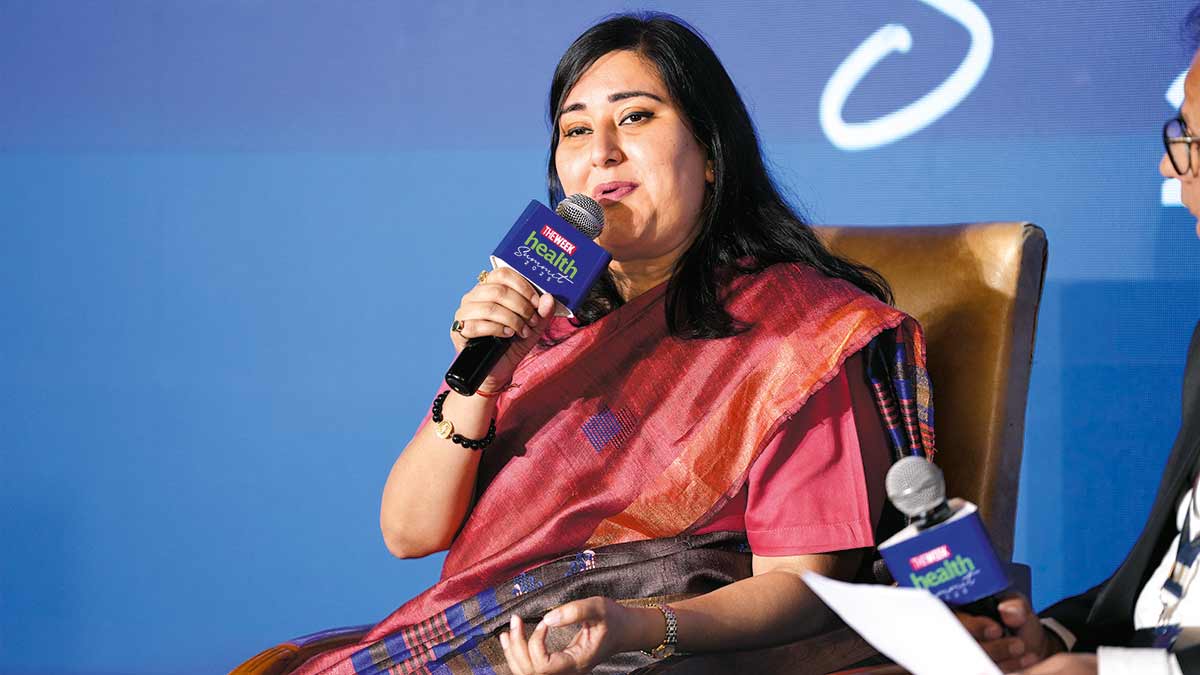
Health is wealth, they say. Lok Sabha MP Bansuri Swaraj concurs, as did her mother, Sushma Swaraj, who was the health minister under prime minister A.B. Vajpayee. “She was the one who knew that to have a Samriddha Bharat (prosperous India), we need to have a Swastha Bharat (healthy India),” Bansuri Swaraj told Senior Assistant Editor Pratul Sharma. In a freewheeling chat, she shared her dream for the health of India. Excerpts:
Pratul Sharma/ Let me begin with the central theme of this session. What is your dream for the health of India?
Bansuri Swaraj/ My dream for India is actually twofold. The first is to have access and inclusivity in our health system for everybody, because they craft and create the socio-economic background. To ensure that, we are leveraging technology to ensure that access to health care becomes modern and effective.
Today, 60 per cent of our population is below the age of 35. A harsh reality will be that in 30 years, this huge resource of youth will grow old. So, my second dream is: I want my country to have a robust geriatric care system. To ensure that we need to have very strong policy-driven decisions to have the infrastructure on ground to equip us to deal with that. But we also need to run a formidable awareness campaign where we sensitise people that health is not something to be taken lightly. Your mind, your body are building blocks for a developed nation.
Sharma/ What kind of initiatives are needed to ensure better care of our ageing population?
Swaraj/ I am very proud to say that the Modi administration is already thinking about it. There are certain initiatives like the one headed by [AIIMS director] Dr M. Srinivas, where he is leveraging technology to integrate various Delhi hospitals to ensure bed availability. You don't have to go running from pillar to post, you can see it on one application.
The Modi administration has ensured that there is a threefold approach to everything. The first is financial health. Ayushman Bharat is one of the largest health insurance schemes in the world—Rs5 lakh annual cover is given to the beneficiaries, especially the economically weaker section. And then the prime minister went ahead and expanded its ambit by involving every citizen who is above the age of 70.
The second approach is that there is a major push by the government, not only in building infrastructure, but also increasing awareness. Before PM Modi, having an international day of yoga was unheard of. Today, you know that yoga is not only a sign of our soft diplomacy, it is also ensuring that you are not neglecting your mental health.
The third thing is that he is also leveraging our ancient medicine, like having the Ministry of Ayush. And finally, the push for indigenous medicine. I think the Jan Aushadi Kendra is a huge step in this.
So I think this kind of holistic approach... is going to ensure that India is going to be a leader on the global map when it comes to health sector.
Sharma/ Your mother Sushma Swaraj served as health minister during the Vajpayee regime. Did her experience also shape your understanding of not just the public but also the health sector?
Swaraj/ Certainly. Because I can tell you that out of all the ministries that she was a part of, I think the health ministry is the one that gave her the maximum amount of job satisfaction. She was definitely one of the driving forces in ensuring that instead of having just one AIIMS, we should expand the number of AIIMS. She was the one who knew that to have a ‘Samriddha Bharat’ (prosperous India), we need to have a ‘Swastha Bharat’ (healthy India). She worked arduously to ensure that there was a lot of work done for women's health, especially for menstrual hygiene. When I got elected, one of the first CSR initiatives that we took up was to establish a sanitary pad manufacturing and distribution unit in one of the largest seva bastis in my constituency.
Sharma/ Are there sufficient initiatives for women’s health?
Swaraj/ I think women's health is one of the most important aspects of nation building. Because women are the fulcrum on which the entire family unit is engaged. It is an arduous task to take women, especially mothers, to the doctor, right? We all understand that.
The latest initiative by the prime minister was the 15-day campaign—Swasth Nari, Sashakt Parivar. That was a trailblazing approach, because it ensured that women across strata could go to their nearest Arogya Mandir or government hospital and get screened free of cost. For the economically weaker sections, even the medicines were given free.
Sharma/ How do you ensure that even areas beyond metros get access to health care?
Swaraj/ There are initiatives like the Pradhan Mantri Dialysis Programme. There are 1,674 centres in the country. Over 11,757 machines have been installed. About 342.25 lakh dialysis sessions have already been conducted, which means that patients have actually saved over Rs16,000 crore. This seems like a very simple initiative, but renal failure is something which is very rampant in the country. Dialysis is the need of the hour because it takes years for people on the transplant list to get a viable donor. My mother suffered from renal failure. So I can say this from personal experience—it is a disease which causes discomfort not just to the patient; the entire family suffers with the patient.
Also when we come to cancer care, 19 cancer institutes have been approved at the state level. Similarly, when we talk about tertiary cancer care, 20 projects have been approved, amounting to Rs120 crore. Another thing that the Modi government is doing is leveraging technology. Telemedicine is a revolutionary step. It is ensuring health care access to rural India. Similarly, we have seen how technology can be leveraged to ensure that we make up for the lack of infrastructure.
