


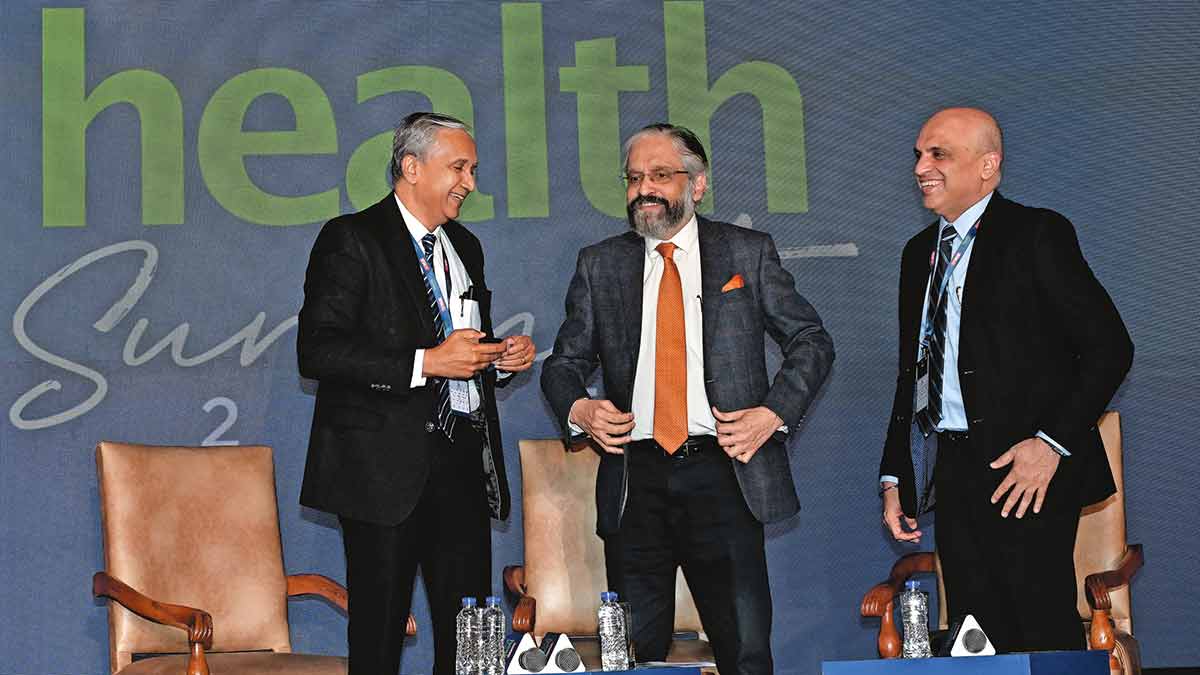
Three doctors, three different specialities but one common concern—the rise in non-communicable diseases in India. In an enlightening conversation, Dr Vikram Mathews, director, CMC, Vellore, Dr Ambrish Mithal, chairman and head of endocrinology and diabetes at Max Healthcare, Saket, and Dr Santosh Shetty, CEO & executive director, Kokilaben Dhirubhai Ambani Hospital, Mumbai, talked about the contributing factors behind the increasing burden of NCDs and how to bend that curve. Excerpts:
Dr Vikram Mathews/ More than 40 million deaths every year worldwide are due to non-communicable diseases. Forty-three per cent of adults are overweight and 16 per cent are obese globally. And in India, the proportion of deaths due to NCDs increased from 38 per cent in the 1990s to 62 per cent by 2016 and continues to rise.
The ICMR data suggests that diabetes is about 11.4 per cent and we know that there are hotspots where the incidence is far, far higher. And pre-diabetes is almost 50.3 per cent and hypertension about 35.5 per cent. Overweight/obesity is almost 44 per cent in males and 41 per cent in females. So we are a country which has both extreme spectrums—under-nutrition on one end and overweight, obesity on the other, and both are killers. So, in this context, where do you see the trajectory of India with respect to obesity, diabetes and hypertension?
Dr Ambrish Mithal/ I think the trajectory is quite obvious. When I entered endocrinology, it was the mid-80s, obesity was not considered a major problem in India at that time. And diabetes wasn't a very glamorous disease, it was just one of those things.
The whole epidemic of non-communicable diseases, the sharp rise in diabetes and obesity, started in the early 1990s and it actually runs parallel with the economic growth of the country. That has been seen across the world, not just in India. And the spurt is nowhere near peaking yet. At the moment, even studies done in 2019 versus those in 2023 show a substantial increase.
Mathews/ Dr Shetty, are you seeing any patterns in your hospital?

Dr Santosh Shetty/ What we are seeing in our hospital, and which I am sure is representative of most tertiary care hospitals, is an uptick in the patients coming in with these non-communicable diseases and their various complications.
While life expectancy has gone up from 36 to 70-72 years, that comes with the burden of non-communicable diseases. And what we are seeing is a significant increase in cardiac, cancer, obesity, diabetes cases and their complications. And we see younger patients coming in.
Mathews/ We have a lot of outreach programmes in the tribal community. In the tribal hamlets and population, it is really shocking to see a spurt in young people with hypertension and stroke. So at 40 years of age, you have these people who don’t fit in the normal kind of body morphology having these kind of illnesses. You want to comment on this?
Mithal/ The last point is really important, because we are certainly seeing changes in the rural areas as well. The fundamental thing that we need to understand is excess body fat is driving the epidemic of pandemics. Obesity is the mother of all modern non-communicable diseases. It increases diabetes, blood pressure, heart disease, fatty liver, many kinds of cancer, different kinds of arthritis and so on.
So the important point here is that it is obesity that has risen in India dramatically. We treat blood pressure, diabetes, fatty liver, but the genesis of everything is excess body fat.
And the other important point which is relevant to what you were saying about rural areas and tribal populations is that Indians develop metabolic complications at a lower body weight. A BMI of 25 or more is considered obese in India, which is just considered overweight in the west. Within that, below that 25 BMI, there is a huge number of Indians who are what is called metabolically unhealthy, although they are non-obese. That is because they have visceral fat deposit.
Mathews/ We often tend to take western parameters and impose it on our population. And that may not actually be true, whether it is haemoglobin, blood sugar or BMI. We need good, large respondents-based studies for our population to define what is our normal.
Dr Shetty, in terms of economic impact, where do you think this is going?
Shetty/ It has a significant economic impact. If you look at any of these conditions, these are chronic conditions that affect multiple organs, and warrant multiple visits to hospitals, both outpatient as well as inpatient and critical care.
I don't think our country can afford a situation where we have such a huge burden of NCDs. We really need to intervene to make sure that there is a lot more focus on prevention, awareness, early detection so that we don't get to a point where patients end up with complications.
Earlier we used to talk of family history as a big component. While it is important, now we are seeing so many patients with no family history still coming in with diabetes and cardiovascular disease. Now it is an effect of nutrition, lifestyle and various other factors which I think are contributing significantly. And all of us as a society need to intervene to make sure that we reduce this burden because the economic impact of this can be massive.
Mathews/ The World Economic Forum estimates a cumulative loss of $47 trillion to the global economy worldwide between 2011 and 2030 because of these conditions.
Obesity in children is also a major problem. How do you look at childhood obesity?
Mithal/ Actually, it starts even earlier, it starts in-utero. There are compelling studies from Pune which tell us about the impact of maternal nutrition, both under-nutrition and over-nutrition on the foetus and the programming of the foetus. That's one part. Even maternal health determines long term non-communicable disease in the offspring.
But childhood obesity definitely is a major contributor, and it leads to adolescent obesity, adult obesity and leads to diabetes and blood pressure. When we talk of prevention, childhood obesity will be our biggest target and it is something that will also determine habits. So I think this is important, the choice of healthy food in school and college, healthy meals, not quick-fix meals or not something that kids want often.
Mathews/ We need to bend that curve. How do we go forward?
Shetty/ We have to look at prevention, awareness and early intervention. And it has to start very early on, from childhood in terms of good nutrition at home, healthy food in schools, more physical activity. Incentivise them to stay healthy. A lot more focus should be on physical activity in schools. Very few schools have the kind of playgrounds that are needed.
Just like obesity is a multifactorial disease, it needs a multi-pronged approach, with families, individuals, government all coming together.
Mithal/ All procedures are often covered under insurance. But OPD treatment to prevent those complications is often not covered. This is something I have not been able to crack.
If people had subsidised OPD treatment—I am not talking of government setups; they have it—you would prevent so many complications and there would be economic gain, too.
Now, on the individual level, we tend to still play the blame game.
There is a lot more than that. Family is exceedingly important. On Diwali, Christmas and New Year, if you have tons of sweets coming into the house, how do you expect the one guy who is overweight not to have it or the one person who is diabetic not to have it? So what I am saying is that there is individual, then there is family, then it is society as a whole.
And of course, authorities are very important in this because we have to make healthy food more accessible and less expensive than unhealthy food.
Mathews/ I think the government has to come up with policies to tax food that is not healthy. Health is more than just diet. It is also about our environment. There have to be policies with respect to pollution. There has to be a will to push these agendas forward.
Also, it is primary health care that has to come to the forefront. If you don't measure, you don't manage. Unless there is mandatory screening of the population, there is no way that you are going to manage this. And we can only hope that we will correct it before it goes out of control.
