



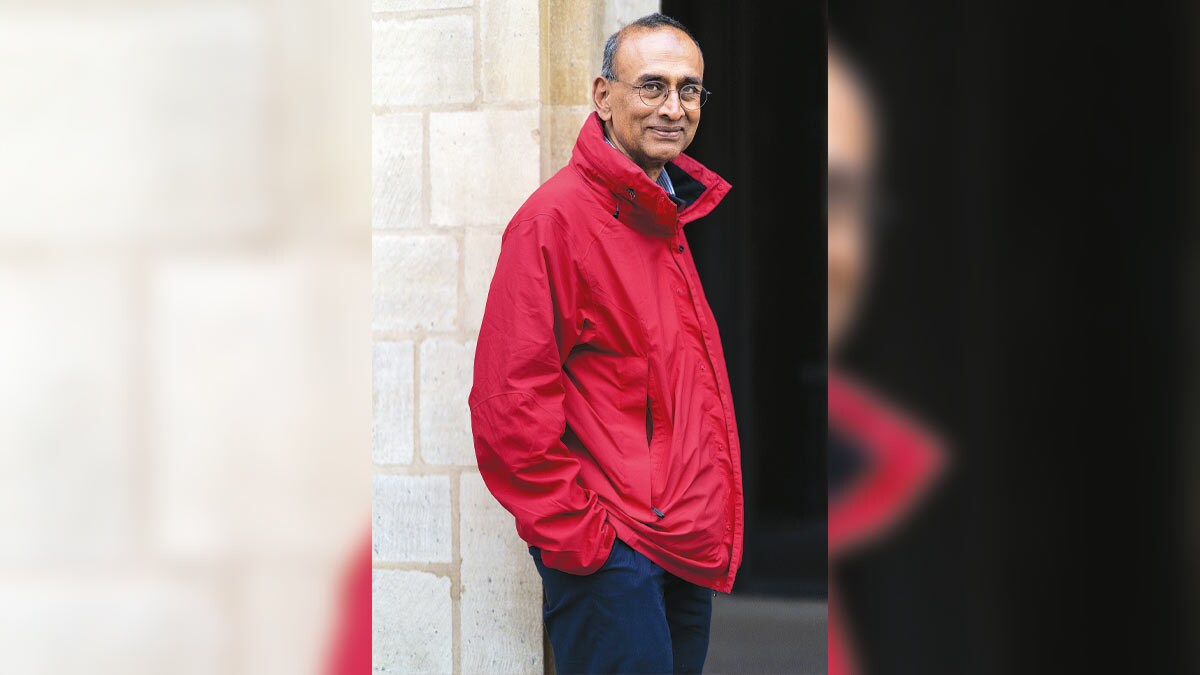
Interview/ Venki Ramakrishnan, Structural biologist
It is amazing to think to what lengths people go to avoid death, right from the Egyptian pharaoh Tutankhamun, whose elaborate tomb was simply a passage to take him to a blissful afterlife, to present-day tech moguls like Bryan Johnson, who spends $2 million a year on his anti-ageing regimen, which includes blood transfusions and taking more than 50 pills a day. So why are we so afraid to die? And is our lifespan fixed or could we slow down or even abolish ageing as we learn more about our biology? This is the question that Nobel laureate Venki Ramakrishnan addresses in his latest book, Why We Die: The New Science of Ageing and Longevity. “The knowledge of death is so terrifying that we live most of our lives in denial of it,” he writes.
Once upon a time, longevity studies were shunned to the backyard of science, with few respected scientists researching it. But that’s no longer the case, says Ramakrishnan. In the last 10 years alone, more than three lakh scientific articles on ageing have been published. More than 700 startup companies have invested tens of billions of dollars to prevent ageing. But with growing research and interest in the subject comes fake news and unscientific remedies which “capitalise on our very natural fear of growing old and disabled and eventually dying”. That’s why Ramakrishnan, who works in molecular biology “but has no real skin in the game”, decided to take an objective look at our current understanding of ageing and death.
He takes us through various areas on which scientists and gerontologists are working, from the latest in stem-cell research to the possibilities of shortening the telomere (a region of repetitive DNA sequences at the end of a chromosome) to the benefits of caloric restriction, in which you follow a diet that reduces calorie intake without causing malnutrition. But none of them, so far, has concretely proven to increase life-span. Caloric restriction, for example, has extended the life-span of some species but there have been no proper trials on humans. Stem cells may make replacement of tissues and organs possible, but replacing and reprogramming the brain is “more the subject of science fiction than likely science fact,” according to a 2002 statement by 51 leading gerontologists, which still holds today.
Until scientists achieve a real breakthrough, Ramakrishnan recommends the age-old remedies for a long and healthy life: sleep, diet and exercise. As he says, they work better than any anti-ageing medicine on the market, cost nothing and have no side-effects. “While we wait for the vast gerontology enterprise to solve the problem of death, we can enjoy life in all its beauty,” he concludes. “When our time comes, we can go into the sunset with good grace, knowing that we were fortunate to have taken part in that eternal banquet.”
Excerpts from an interview:
Why did you choose this theme for your book? And according to you, why do we die?
I chose it because it's a very basic and important question that has worried humans ever since we found out about our mortality. But it's only in the last few decades that we have really understood some of the biology of what causes ageing. And so for the first time we are maybe able to do something about slowing it down. It's also a fact that societies, at least in most developed countries, are getting older, people are living longer and fertility rates are coming down. It is very important that as people age, they are healthy and preferably independent. And so this is the reason why there is so much interest in ageing research among countries and private companies, which have realised this is going to be potentially a huge market. There is also a lot of hype about the field. It is preying on people's natural fears of growing older and dying. I don't work on ageing myself. I work in a closely related area, which is synthesis. So I thought somebody who is close to the field but doesn't actually have an agenda or any financial stake in it would be well-placed to write a book on it.
You say you want to help us differentiate between genuine longevity research and a lot of hocus-pocus findings that are masquerading as science.
There is a lot of very good research on how to tackle ageing, but it can't be rushed because these things are complicated. There are side effects. There need to be proper trials in humans. It would be good if there were even long-term trials. But a lot of companies, and even scientists, are trying to get ahead of the game and advocating things before they're properly tested.
So how can ordinary consumers like us differentiate between genuine and fake research?
This is a very difficult problem because people who don't know the real science often will use scientific-sounding jargon. For the ordinary person, it is very hard to tell. I think they have to see what is the track record of the person. Do they have any financial interest? Are they wacky in some way or are they accepted by most people in their field? That's the way to filter it. Mainstream sources like major research journals are likely to offer sound research. Some science could be wrong—that's part of science—and then it gets corrected. The difference between science and pseudo-science is pseudo-science never gets corrected and never accepts that it is wrong.
The definition of death itself is so ambiguous. Earlier it used to be the cessation of heart-beat, then it became brain death. How would you define death in a person?
I would define it as the irreversible inability of the individual to function as a whole. At the point of death, most of your cells are still alive. That’s why you can donate your organs for transplantation. And in fact, while you are alive, millions of cells are dying inside you. We don't think of that as death, but there are many different kinds of death—death of cells and tissues, for example. If you lost your arm in an accident, your arm would die, but you would still be alive. You can also have death of larger entities—companies, cities, even entire civilisations or countries. And the universe can die, and probably will. So there are different kinds of death.
But what we are talking about is the death of the individual. It used to be determined by the cessation of the heart. Then they found that in many cases, the heart can be revived. But no one has figured out how to revive a dead brain. If that happens, you’d have to change [the definition] again.
There are people who say that without disease, you can live up to 150 years. Do you think that’s possible?
I don't think 150 is possible without any new interventions. Even with new interventions, I think it'll be highly unlikely, at least in the near future. In the long run, of course, nobody can tell, but in the foreseeable future, I don't see it happening. A number of things have to happen before you reach that stage. Only one person—a French woman named Jeanne Calment—has lived over 120, and she died at 122. And only a few outliers have lived to 110. So the idea that suddenly somebody's going to live to be 150 is extremely unlikely. Even if they were to solve many of the issues with ageing, what is more likely to happen is that more people will start living to 100 or 110 and then they would still face a problem. Although radical life extension is not possible today, there is no physical or chemical law that says you have to die at 120.
Do you think death is indispensable? Is there a possibility we can overcome it in the long-run?
It is like saying you can settle on a different galaxy. There’s no physical or chemical law that says you cannot. But in practical terms, it’s impossible today and I don’t think it’ll be possible even a century from today. The important thing is, even if you solve the ageing problem, you're still going to die of infectious disease, war, violence, climate change or accidents. So there is no such thing as real immortality.
You say that if we finally tackle this problem of turning back time, there are going to be many ethical issues.
People, as they age, accumulate power, wealth, influence networks and so on. And if nobody dies, if everybody starts living to be 100 but very few people are being born, then you will have a very slowly changing society. That will be a stagnant society in which the same people are in power for a long time. And I think that is not a good situation.
With so many tech moguls in the longevity space, do you think there is any role for AI in extending our lives?
AI has been tremendously useful in all sorts of areas, including in my field of structural biology. Almost everybody in structural biology uses AI. There's a programme called AlphaFold, which allows you to predict protein structures, for which Demis Hassabis and John Jumper won last year's Nobel. AI can be useful in many things, including in medicine. And it is possible it may analyse genomes and be able to identify things that might be beneficial, like compounds that act against some of these anti-ageing pathways. So there are many ways in which AI can be used as a tool, but it’s not a magic tool. It has to be used intelligently. But ultimately, these are complicated biological problems. So it is not as if there is going to be a magic solution to it.
Can you elaborate on caloric restriction, which you say in some species has led to increase in longevity.
In many species it has been shown that if you compare animals that are fed all they can eat versus animals that are fed the bare minimum number of calories to survive, but without starving—so they're given all the micro-nutrients, vitamins, minerals and proteins but just enough to survive—then those animals that are calorically restricted tend to be healthier as they age than the all-you-can-eat animals. In fact, they tend to resemble much younger animals that are not calorically restricted. And so [scientists] have looked at caloric restriction and been able to relate it to at least a few pathways or processes in the cell. That means that if you're able to affect those processes in the same way as caloric restriction using, say, a drug, then that drug might have a similar benefit. But of course, it's a mixed bag. Caloric restriction, or even affecting these pathways, can also make you more prone to infections. It can affect other things like the ability to heal from wounds or increased frailty. So there are many things that it might do that are not beneficial. And so, it is not clear if it is an ideal solution to solving the ageing problem. But people are looking to see if there are things that will provide the anti-ageing benefit but without the side effects, but it is not clear whether that is possible or not. More trials have to be done on that. But again, this is a matter of hype. Even some scientists are quietly taking these compounds on the side, because they are so impressed by their anti-ageing properties. But it may have other consequences. I think this is a promising area, but they need to do proper trials.
You say that the three sure-fire ways for a long life are diet, exercise and sleep. How did you come to that conclusion?
It's not my conclusion. It's a very general knowledge in the field. It's been touted for decades. I'm not the first guy and I'm not going to be the last guy to say it, but the thing is it is currently probably better than any anti-ageing therapy on the market. The other important thing is that because of the advances in the last 50 years in molecular biology and cell biology, we now know why they are important. Even earlier, we knew that exercise was good for our health, but we did not know all the things that exercise does to our metabolism and our makeup. And now we understand more of that. And the same with diet and sleep. Following a moderate diet is closely related to the idea of caloric restriction. And we are increasingly learning more about what happens during sleep and how the body does a lot of repair and recycling of materials then. And that is very important for not ageing too rapidly.
Can you describe the exciting developments in the longevity field currently?
You mentioned caloric restriction. Stem cell therapy is one of the exciting areas of research. Another is targeting senescent cells which age and are no longer functional, but secrete inflammatory compounds. And then maybe factors in our blood change as we get older. If we can identify these factors, we might be able to take advantage of them and improve health as we age. And maybe we can reprogram cells so that they almost go backwards in development and can function better. So those are all areas that are exciting and promising, but nearly all of them need more work before they can be routinely used. The only one that could perhaps be used sooner is relating to the compounds that we are not able to make as efficiently as we get older. There are some people who advocate that we should supplement our diet with some of these compounds. But then again, the whole supplement industry is so full of bogus claims that it is very important to do proper randomised trials to see whether it is actually doing something useful and whether it has harmful side effects, before it can be recommended for general use.
Can you tell us something that you discovered during the research of your book that you didn't know before, and that really took you by surprise?
Maybe the one thing that surprised me is that death didn't evolve in order to make it better for the species. You might think that death is a way to get rid of older animals to make room for young animals. That's not the reason for it. The reason is that evolution simply doesn't care about your old age. Rather, it is selecting for other properties that help you mature and reproduce when you are younger. I think that’s a theory I was not so familiar with before I started writing.
After researching the subject so extensively, are you afraid of death?
We have evolved not to worry about death in our everyday lives, unless we have some mental problems. When you get up, you don’t think, ‘Oh I’m going to die’. You don't even think you're going to die next year. You might plan a vacation with your friend next year, because you are assuming you are going to be alive. I think the people who really think about death are those who are facing terminal illness. But I think deep down, none of us really wants to die. We'll do everything we can to stay healthy and alive. And that's just part of human nature. Even religious people who think they might go to heaven or be reborn still don't want to die. They think this is the existence they know and they don't want to leave it.
WHY WE DIE: THE NEW SCIENCE OF AGEING AND THE QUEST FOR IMMORTALITY
By Venki Ramakrishnan
Published by HarperCollins
Price Rs346; pages 320
