



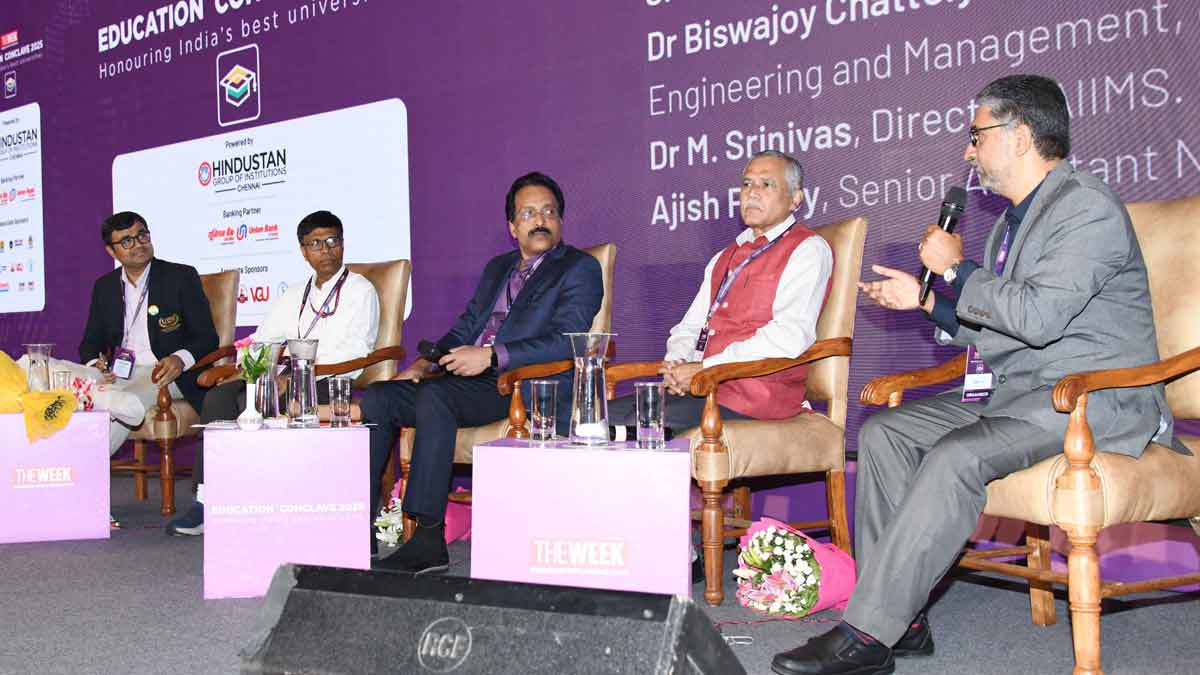
In an interesting gathering of minds, at THE WEEK Education Conclave 2025, four distinguished academics gathered for a high-powered discussion on “Shaping a World-Class Student in India”. And enriched the audience with experience-laced ideas of modern education and how to reform education in a rapidly evolving global landscape.
Senior Assistant News Editor at THE WEEK Magazine Ajish P. Joy moderated the session.
Prof. John Varghese, Principal of St. Stephen’s College, Delhi, emphasised the urgency of reimagining Indian education for a global stage.
“Education today is no longer bound by geography—we are part of a global landscape, and India has the potential to lead. We have seen Indian students heading some of the world’s top universities," Verghese said, emphasising that both the government and private sector must work together to nurture this potential.
He also spoke on the New Education Policy (NEP), which he claims is a step forward. "But it doesn’t address every challenge—we’ve identified many gaps that still need attention," he said.
Varghese also pointed out a big-scale lag in the education system. "Technology evolves every three months, students adapt within six months, teachers take two years, and institutions need five. This gap leaves students underserved."
Prof. Varghese called for a systemic overhaul. “Our education system must stop seeing technology and change as threats and instead build frameworks where teachers become co-learners and mentors. Teachers must be equipped not just to teach but to guide, partner, and grow with their students.”
Another speaker on the panel, S. Somanath, former ISRO Chairman, raised a fundamental question in the discussion: "Are we aiming to build world-class students, or should the focus first be on creating world-class institutions? He argued that the foundation of excellence lies in the institutions themselves, which can lead to the production of world-class individuals.
Drawing attention to the situation in Kerala, he pointed out that a large number of higher education seats remain vacant, not necessarily due to a lack of aspiration among students, but because the institutions themselves are not seen as aspirational. "World-class status takes time to build," he noted, suggesting that India must invest more deliberately in institutional quality and vision.
Somanath cited the widespread migration from regions with weak educational ecosystems, where academic standards are poor and institutions fail to attract talent. He highlighted that many engineering colleges across the country offer sub-par education, resulting in confusion about the outcomes and career prospects for students. "If society doesn’t perceive an institution as high-quality, it won’t attract the right students—or the right faculty," he said, underlining the urgent need for quality enhancement.
Dr Biswajoy Chatterjee, Vice-Chancellor of the University of Engineering and Management, Jaipur, addressed the growing disconnect between engineering education and industry expectations. He pointed out that many engineering colleges today are struggling with either an oversupply of seats or very few applications—highlighting an urgent need to reassess their relevance and output quality.
The core issue, he argued, lies not just in skill development but in the kind of individuals these institutions are producing. Technical proficiency alone, he warned, is not enough. A skilled person without fine character can be detrimental to society.
He also stressed the importance of industry readiness. Graduates, he said, should be equipped to contribute from day one, without needing extensive on-the-job training.
Dr M. Srinivas, Director of AIIMS, asserted that institutions like AIIMS not only meet world-class standards but also play a critical role in producing world-class professionals. "The foundation of such excellence lies in building an ecosystem and platform of a high level. One that is adaptive to today’s evolving challenges and aspirations."
Highlighting the importance of modernisation, Dr Srinivas noted that AIIMS has proactively integrated advanced simulation laboratories, digitisation initiatives, and collaborative opportunities for young learners. The focus, he said, must move beyond examinations toward preparing students to meaningfully contribute to the nation. This includes bridging the significant gap between the rapid evolution of global medical needs and the infrastructure available within Indian institutions.
He also addressed the heavy reliance on imported medical equipment, with over 80 per cent still sourced from abroad. To tackle this, AIIMS is now working closely with domestic innovators and manufacturers to reduce imports and build indigenous capabilities in medical technology. Integration of such tools into training and research is seen as vital for long-term self-reliance in healthcare.
Speaking about the broader medical education landscape, Dr Srinivas pointed to the substantial increase in postgraduate medical seats over the last decade, which has helped reduce the long-standing gap in availability. With over 700 medical institutions across the country, the sector now offers opportunities not just for clinical practice, but also for academic and allied fields such as paramedical sciences, biology, microbiology, and chemistry. These graduates, he said, will play a key role not just in India but across the Global South—helping to address critical healthcare and education needs in developing regions.
