



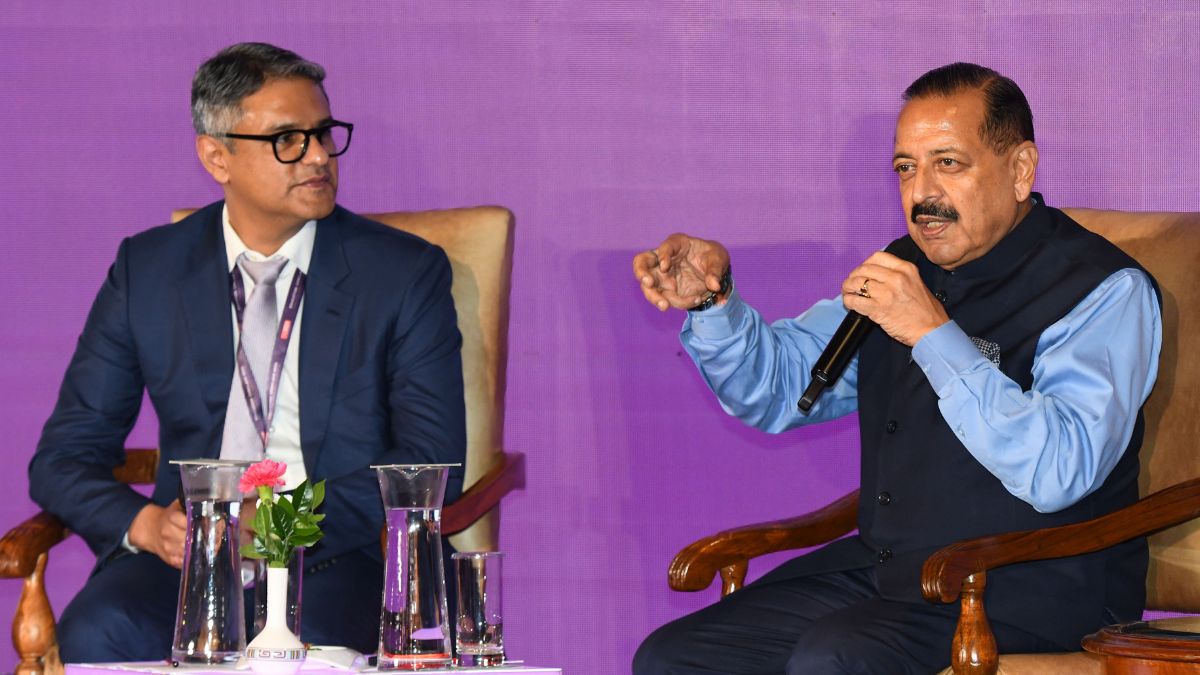
“India is no longer a seeker, it is sought after. No longer a follower, but followed,” said Dr Jitendra Singh, Minister of State (Independent Charge) for Science and Technology, while addressing students at THE WEEK’s first Education Conclave in Delhi. Speaking about India’s growing role in global space and science collaboration, Dr Singh underscored the transformation of India's scientific standing on the world stage.
“India is now open to collaborations in space programmes. Take NISAR, for example—an Indo-US joint mission where both ISRO and NASA have contributed. It will be a game-changer for disaster management and aviation,” he said, emphasising that the world is now approaching India for partnerships, rather than the other way around. Even in case of astronaut Subhanshu Shukla, they (US agency) wanted Indian collaboration, he said.
The minister chose to forgo a traditional keynote address and instead opted for an interactive session with students. Moderated by Riyad Mathew, Chief Associate Editor and Director of THE WEEK, the conversation was lively, motivational, and wide-ranging.
“I came here to learn,” Dr Singh said. “What I have learnt in life is that the best thing to be is a lifelong learner. Every day, do something that adds to your learning,” the minister said, answering the question of a young student who wanted to know about the speaker’s best learning.
Dr Singh talked about importance of three ‘A’ – awareness, aptitude, and avenues. On self-awareness, he advised students, “Ask yourself: What are your interests? What are you meant for? Often, there’s a tendency to either overestimate or underestimate oneself. Know your capacity, realise it, and focus on it. Once that’s done, opportunities will follow.”
Responding to a student’s concern about the government’s outreach to youth, he said: “The problem is not lack of initiatives, but lack of awareness. The times are changing fast—but our mindset is not. Today, everything is online, but we still look for information in newspaper advertisements.”
He cited inspiring examples, such as a girl from a terror-affected area of Kashmir who cracked the IIT-JEE by “studying 14 hours a day for 18 months” using only a mobile phone and without any formal coaching. In Bihar, he said, groups of boys take their iPads to railway stations for Wi-Fi access and study for hours.
“There are age-specific and gender-specific schemes out there. Just type your age and interest area into Google, and you’ll find the platform,” he advised students.
He cautioned, however, that after centuries of colonial rule, there is still a tendency to look towards the government for everything. “To reach global standards, we have to work ourselves. The government is now open to private sector integration in a big way.”
While it is easy to launch a startup today, sustaining one remains a challenge, he admitted. “Industry must not operate in silos. Startups should not be seen in isolation. Private players must become more than just knowledge partners. When they spend money, they become stakeholders.”
“Ten years ago, the public sector alone handled areas like space and nuclear energy. Today, over 300 startups are involved in the space sector. We still need infrastructure like launching stations, and while private players may not do that immediately, I believe they will rise to the occasion.”
The minister also highlighted India’s focus areas for students, including biotechnology—one of the most sought-after fields during the COVID-19 pandemic—and the role of the BioRRAP portal, which links research projects across institutions and sectors.
On future challenges and opportunities, Dr Singh said the biggest shift came with the National Education Policy (NEP). “Earlier, if your parents were doctors, you were expected to be one too. But if you didn’t make it, you were left confused—doing graduation, then post-graduation, then PhD. NEP broke that chain. Now students can follow their aptitude.”
He described his own journey as one of practical ambition rather than lofty idealism. “I didn’t aim to be a scientist or a minister—I just wanted to be a medical practitioner. But look at how far we’ve come. I wish I were born in this era—the best time for Indian youth.”
He stressed that public and private sectors must not work in silos. “Industry will only come in where there's profitability. So, make them knowledge partners. When they invest money, they stay interested.”
He added that ecological and environmental efforts must become citizen-led movements. Citing an example, he said, “In Katra, 800 kg of fake cheese was caught. Someone may think of profits, but it affects their own children too. These are concerns of humanity.”
On the government’s push in Artificial Intelligence, he warned against being carried away by hype. “Yes, we have a dedicated AI mission. But we must evolve a hybrid model—AI and HI—Human Intelligence. AI should assist, not override. I made sure that even when AI flagged complaints, a human voice followed up to ensure satisfaction.”
From deep ocean missions to digital transformation, Dr Singh painted a picture of a changing India—one that is not just transforming itself, but shaping the global conversation.
