



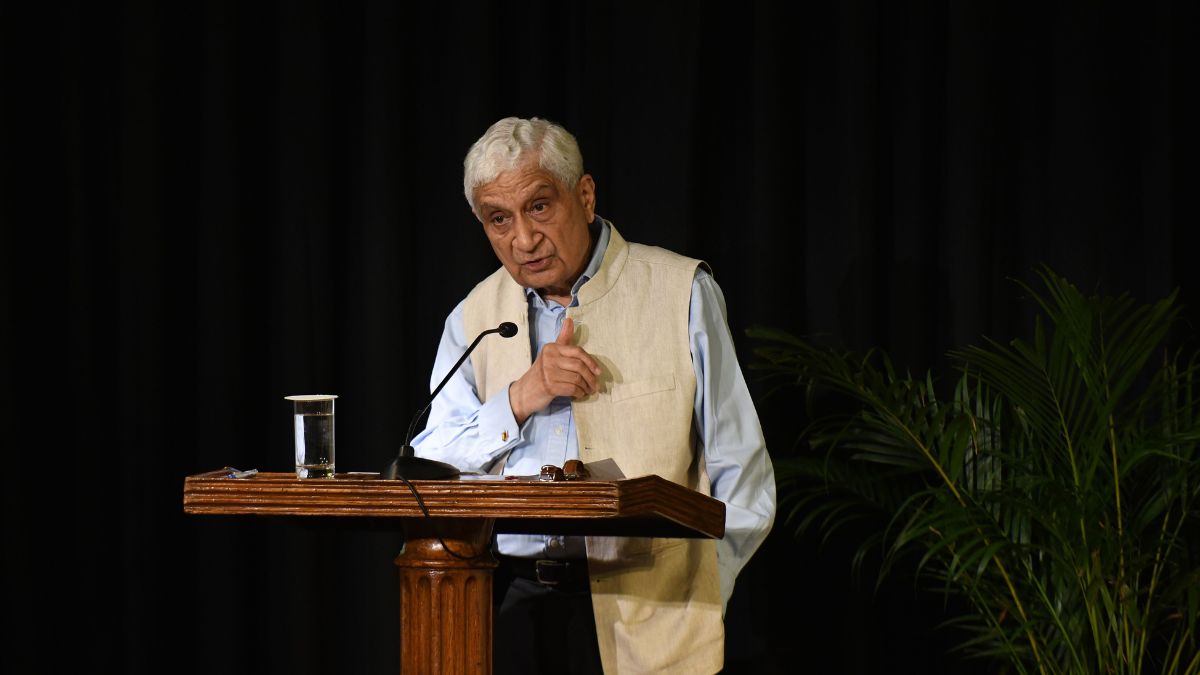
"There is a quiet crisis in higher education in India that runs deep. It is visible," said Deepak Nayyar, eminent academician and Emeritus Professor of Economics at Jawaharlal Nehru University, on Wednesday as he delivered the BG Deshmukh Lecture 2025 on 'The Crisis of Higher Education in India: Disturbing Present and Worrisome Future'.
According to Nayyar, this crisis is caused by underfunding, lack of autonomy, and political interference. "It is no accident that our universities have not produced any Nobel laureates in the past 25 years. And I think they never will in the next 25 years, the way we are going,” he said.
According to the professor, "The educational opportunities for school-leavers are simply not enough, and those that exist are not good enough. The pockets of excellence are outcomes of an enormous reservoir of talent and Darwinian selection processes. It does little for those with average abilities or without social opportunities."
The academician also pointed out how there has been a steady rise in the number of Indian students going abroad for higher education, the numbers rising from roughly 50,000 in 2000 to 350,000 in 2015, and 600,000 in 2019. It grew further to 900,000 in 2023, with Indian students overseas spending a whopping $27 billion in 2023, comparable to India's foreign exchange earnings through tourism in the same year. Notably: "A large proportion of those who go for higher education from India don't return," Prof Nayyar pointed out.
Here, it's to be noted that the "spread of education in society provides the foundation of success in countries that are latecomers to development," he highlighted.
The professor strongly emphasised the impact of political intervention on higher education, stating that such an intrusion is nothing new, with the 1975-77 Emergency being a turning point, but accelerated after the BJP came to power and Narendra Modi assumed the office of the Prime Minister in 2014. "The last five years, since 2019, have seen a rapid acceleration in the process. It has now reached a stage where the future of public universities in India is at grave risk."
It's happening in two ways: "First, there is a visible emergence of institutionalised control mechanisms that design what universities can or cannot do," Prof Nayyar said. And "second, appointments in universities, which would be the domain of universities alone, are increasingly influenced, if not shaped by the political motivation, and the invisible hands of governments in office. Now, even admission processes have been centralised by the National Testing Agency," he said, adding that the ideology of the BJP and the RSS is now having a profound impact on higher education in India.
