



For decades, we have treated maps as the homework of grumpy geography teachers—all coloured pencils and scale ratios. But as the recent headlines suggest, a map isn’t just a guide to where you are; it is an advertisement of where you want to be. We are witnessing the evolution of maps from the schoolroom to the war room, transitioning from the classroom through the era of “cartographic aggression” to the polite, yet pointed, “cartographic diplomacy”.
Back in the 1950s, India got a crash course in cartographic aggression from China, which practised what can only described as the art of the land grab without putting your boots on. It was the geopolitical equivalent of a roommate quietly moving the “room divider” six inches into your space while you were out for lunch. China began publishing maps that claimed swathes of Indian territory as their own. It was a bold move: why bother with political niceties when you can simply redraw the border on a glossy piece of paper and wait for diplomacy, or the soldiers, to catch up?
In this world, a printing press can be as dangerous as a battle tank. By the time you have finished saying, “Wait, that’s not where the line is supposed to be drawn,” the other side has already filed the map in a dozen international libraries. And in this particular instance, the Chinese followed up the cartographical aggression with the real thing—a physical invasion that we ruefully remember as the 1962 war, in which some of that territory taken by the maps was actually seized by soldiers.
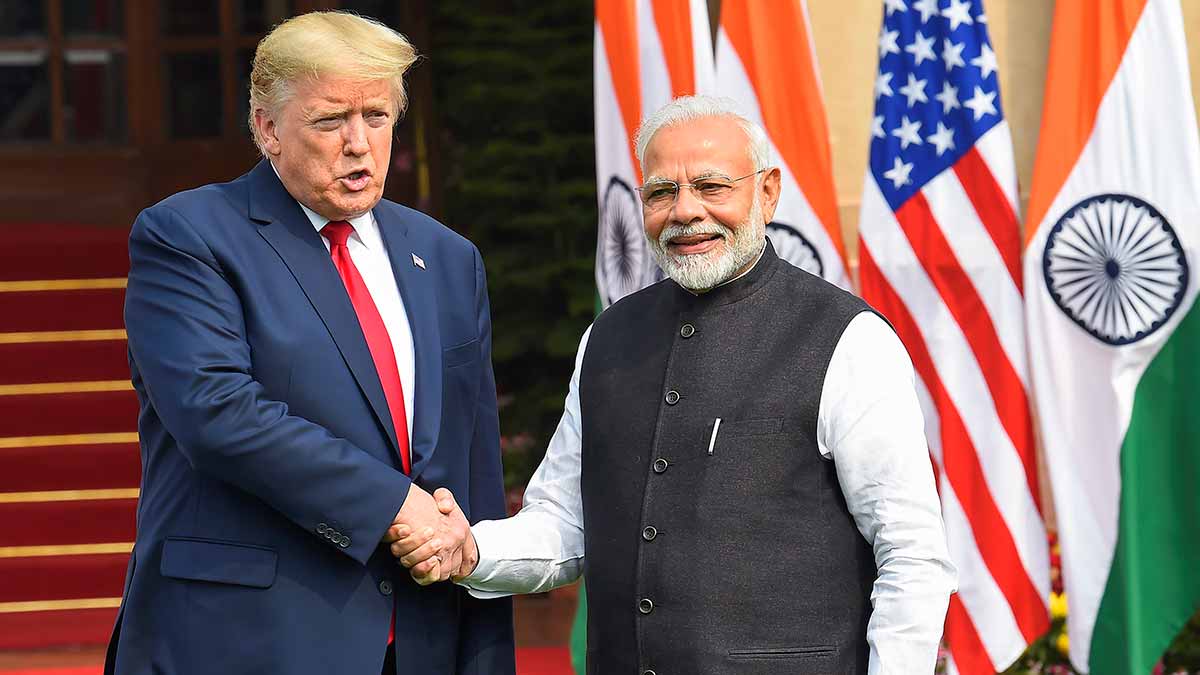
Fast forward to today, and the US has decided to play the game with a friendlier, yet equally calculated, Sharpie pen. By quietly releasing a map that depicts PoK and Aksai Chin as integral Indian territory, the Trump administration has engaged in cartographic diplomacy. Think of it as the ultimate grand gesture in a diplomatic courtship or the bunch of roses strategically timed for Valentine’s Day. It is the international relations’ version of changing your Facebook relationship status to “it is official” before the first date is even over. It’s Washington saying: “We see you, we like you, and we’re willing to forget 30 years of ‘neutral’ grey shading to prove it.”
The fact that the US issued such a map has been widely noticed and commented upon in the Indian media. No surprise: in a country where books are banned for carrying the wrong maps, and magazine pages are blacked out for the same sin when they cross customs, an unsolicited cartographic expression of friendship is bound to get the media to sit up and take notice. Why do lines on paper matter enough to justify such reams of newsprint being expended on noticing them? Because maps are what Gen-Z calls the ultimate “vibe check” of global politics. After all, cartographic aggression has been used against us to create a “new reality” through stubborn persistence. Cartographic diplomacy, then, can be used to signal a new partnership through a partner announcing recognition of your claims. It is rather like changing your status update on Facebook and hoping the object of your affection will notice. We did.
In both cases, geography is less about mountains and rivers and more about ego and influence. A map is no longer just a tool to help you find your way; it is a highway hoarding for your political inclinations. In other words, geography may be destiny, but cartography is desire.
Atal Bihari Vajpayee, as prime minister, famously reminded us that you can’t change your geography. But cartographers can certainly change the way your geography is depicted—and therein lies the rub. In the 21st century, we don’t just fight for the high ground; we now fight for its high-resolution rendering on a map. Whether it’s an aggressive claim or a diplomatic high-five, the lesson is clear: keep your friends close, your enemies closer, and your cartographers on a very high retainer.
The next time you look at a map, don’t just look for the lines. Look for the subtext behind them. Because in the world of “cartographic diplomacy”, a single line can be worth a thousand trade deals—and a whole lot of bruised, or inflated, egos!
editor@theweek.in
