



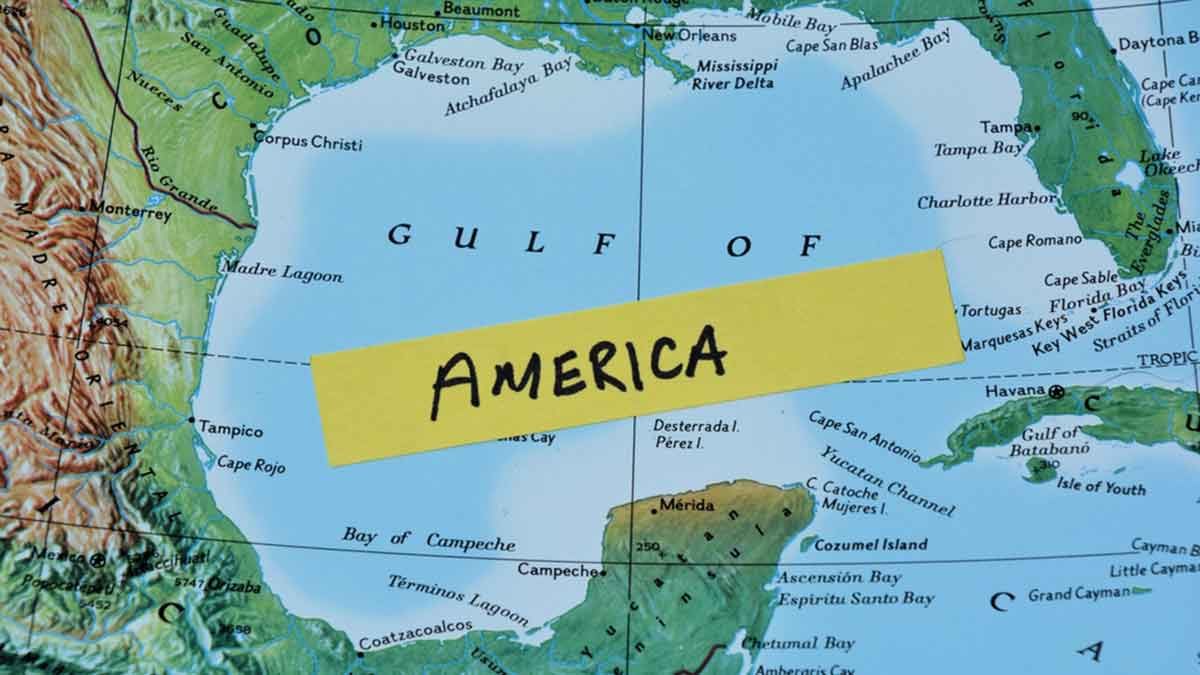
The world of nomenclature, usually a sedate affair of committees and consensus, has found itself on a rather exhilarating rollercoaster ride lately, courtesy of a certain President Donald Trump. Take, for instance, his bold declaration that the Gulf of Mexico should henceforth be known as the ‘Gulf of America’. Because, you know, it just sounds more… American.
This particular geographical rebrand, enshrined (at least in spirit) through Executive Order 14172, “Restoring Names That Honor American Greatness”, sent cartographers into a mild existential crisis and had search engines frantically debating whether to accept the old or the new. It even sparked a minor international incident with the Associated Press, which, in a rare display of journalistic defiance, stated it would continue to refer to the body of water as the ‘Gulf of Mexico’, leading to a petulant cutback in their White House access. Apparently, some names just aren’t up for debate in the world’s oldest democracy.
The president’s next pronouncement, that the capital’s football team’s name, Washington ‘Commanders’, should revert to the politically-incorrect ‘Redskins’, perfectly encapsulates his philosophy on renaming: if it isn’t ‘great’, or if it was changed for ‘woke’ reasons, it’s ripe for a re-do. But why stop at a football team? For Trump, the act of renaming isn’t just about updating a map or a sports roster; it’s an art form, a branding exercise, and a power play. He’s had unparalleled success branding everything from towering buildings with his own surname to attempting to redraw the very lines on our globes. (Greenland is still in his sights.)
Trump’s most prolific renaming efforts have been directed squarely at his political adversaries. Why engage in lengthy policy debates when a pithy, often unflattering, moniker can do the trick? Florida Governor Ron DeSantis, once a formidable challenger, found himself etched in the public consciousness as ‘Meatball Ron’. Hillary Clinton, his 2016 adversary? ‘Crooked Hillary’. Joe Biden became ‘Sleepy Joe’. Others received equally memorable labels: ‘Little Marco’ for Marco Rubio, ‘Crazy Bernie’ for Bernie Sanders, ‘Lying Ted’ for Ted Cruz (though, in a twist, Cruz later became ‘Beautiful Ted’ when his political allegiance shifted), ‘Nervous Nancy’ for Nancy Pelosi, and ‘Birdbrain’ or ‘Tricky Nikki’ for Nikki Haley. The strategy is clear: reduce your opponent to a simple, often derisive, shorthand that sticks.
One might wonder, is this just a modern quirk, a product of our tweet-happy times? Not at all. As linguist Norazha Paiman eloquently puts it, “To name is to collapse infinite complexity into a manageable symbol, and in that compression, whole worlds are won or lost.” Throughout history, naming has been a potent tool in the arsenal of colonisers. When the British, for example, systematically renamed places across India or Africa, they weren’t simply updating maps; they were, as Paiman notes, “restructuring the conceptual frameworks through which people could relate to their own territories”. It was an act of linguistic conquest, asserting dominance and reshaping identity. Today, many countries are still in the arduous process of shedding these colonial aliases, reclaiming their historical and cultural nomenclature.
Trump is doing in his own country what the British did in ours. But will these new names, particularly those seeking to reverse ‘politically correct’ shifts or simply to assert nationalistic pride, actually stick? Similar attempts have failed. Remember ‘freedom fries’? That was a rather desperate attempt by some in the George W. Bush-era US government to rebrand ‘French fries’ after France’s opposition to the Iraq War. It was a short-lived culinary war cry, but ultimately, the ‘French fry’ stubbornly regained its Gallic identity.
However, based on early evidence, the ‘Gulf of America’ might just have more staying power, at least within North American borders. Perhaps it is the sheer audacity of it, or the presidential seal of approval, but it seems some geographical rebranding can, indeed, make waves.
So, what’s next on the renaming frontier? Will we see the Atlantic Ocean become the ‘American East Coast Water Body’? Will countries be rechristened based on their perceived ‘greatness’? Only time will tell, but meanwhile, in the whimsical world of nomenclature, Trump continues to prove that a name, far from being just a name, can be a battleground, a brand, and sometimes, an embarrassing joke.
editor@theweek.in
