



Patriotism is a noble sentiment. It is another matter that Samuel Johnson called it the last refuge of a scoundrel. That was in another age and another context. Suffice to say, it is a positive sentiment and a unifying one in these times of strife. But, as is said, even nectar is poison if taken to excess.
We have had, and will continue to honour, a splendid national anthem all these 80 years, widely lauded for its rhythmic simplicity and its 52-second brevity, if you count out Japan’s 34-character ‘Kimigayo’ for its brevity, or England’s one-liner ‘God save the king’. No offence meant, Blighty; to each blighter, his poison.
The country, its leaders, its constitutional worthies, its soldiers, its school-goers, and of late its cinema-goers, have been doing well and straight up with Jana Gana Mana, though many busybodies have questioned whether Gurudev Tagore’s Bharata Bhagya Vidhata was the Creator of the world or the king of England. After all, he had composed the poem for the 1911 Lahore Congress, which was taking place around the time George V was setting his booted foot in Bharat. Tagore has sworn by all the vidhatas that he meant the Almighty, but the controversy has lingered on.
Anyway, as Justice D.Y. Chandrachud observed while hearing whether cinema-goers should stand up when the anthem is being played, we have been asked of late “to wear our patriotism on our sleeve”. No harm; we all like to listen to its lyricism, its rhythmic simplicity, its brevity, and its subtle expression of love towards Bharat.
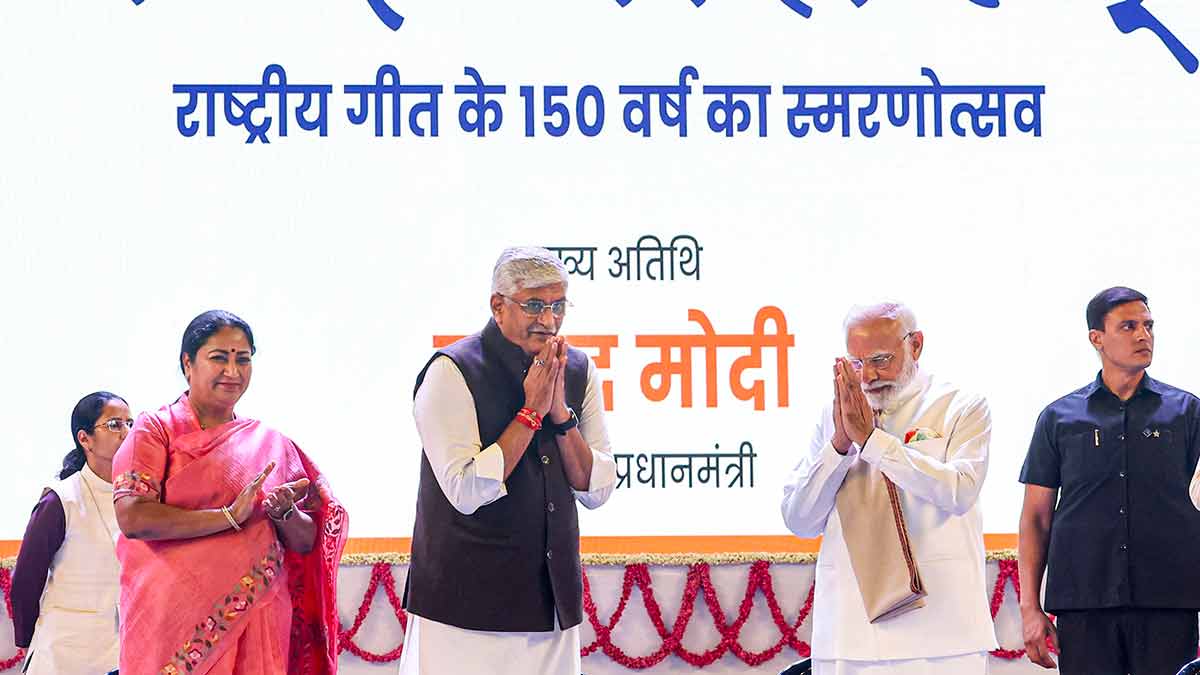
Now comes a double whammy—we are being asked to wear our patriotism on both sleeves. The rulers have elevated Vande Mataram to near-anthem status, and decreed that both shall be played at official events, may be played in schools, that the masses will sing along on most occasions, and that we will have to stand still for full three minutes and 10 seconds, apart from the 52 seconds for Jana Gana Mana.
Stand at ease! I am not here to write another treatise on whether Nehru and co dropped the song’s two stanzas so as to appease the Muslims, or whether Bankim Chandra wrote the poem on a particular date, as is claimed now. We thought poets don’t just sit down and write one whole poem in one go, except impulsive versifiers like Lord Byron who could write one while undressing. That was writing at the drop of a shirt.
My worry is about certain points in the order. One, the masses ought to sing along whenever the song is sung. At the moment, how many of even our super patriots know the full song by heart?
Two, since most Indians will take a few years to memorise the heavy-duty Sanskrit words in the song for joining mass recitation, printed lyrics may be circulated. Chances are that several of us may leave the printed sheets on our seats after those events, which may be trampled upon inadvertently, leading to brawls, riots and prosecutions.
Three, since schools ‘may’, and not ‘must’, start classes with mass singing, a few schools or classes may opt out, leading to fracas between pro-singers and non-singers among teachers and parents.
Four, you needn’t stand up if a newsreel or a film shows a clip of the song as part of the story-line. But super patriots may still do, and urge others to follow, leading to brouhahas.
Five, the order says “it is not possible to give an exhaustive list of occasions on which mass singing” is expected. The result: unlisted solemn events could end in brawls between pro-singers and non-singers.
And one final question: as Chandrachud wondered, “Where do we stop this moral policing?”
prasannan@theweek.in
