

Parliament’s first session of every year, usually the budget session, and the first session after a new house is constituted, open with an address by the president. It expounds on the government’s activities and achievements during the previous year, and sets out the policies, projects and programmes it wishes to pursue. The ruling side then moves a motion of thanks to the president; the house debates the motion; and the prime minister replies to the debate before it is put to vote and passed, most of the time without amendments.
The Lok Sabha missed one of the steps this year; the motion was passed without the prime minister replying to the debate.
It is a time-honoured tradition of courtesy extended to the head of state, evolved since the monarchy’s Restoration in 1668 which also established parliament’s supremacy in England. The king made a speech at the beginning of every session, and the house debated over the government’s policies contained in the ‘humble address’. The system has been ‘tightened up’ since 1714 during queen Anne’s reign, and over the years has evolved in most Westminster democracies as one of the most important debates in the house wherein members get to discuss matters of national or international importance.
The motion usually gets passed since the government has the majority in the lower house, though there have been occasions when it didn’t. Stanley Baldwin’s minority government failed to get its motion of thanks to king George V passed in 1924, and the government had to resign. A.B. Vajpayee’s motion of thanks to president Shankar Dayal Sharma in 1996 wasn’t put to vote, because his minority government fell on its 13th day.
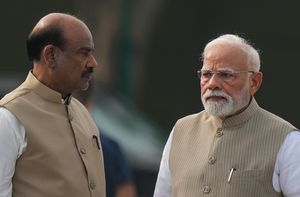 Lok Sabha Speaker Om Birla and Prime Minister Narendra Modi | PTI
What happened this time is unprecedented. The prime minister didn’t reply to the debate over the motion of thanks, with the speaker saying, he had “received credible information that some members of the Congress party could have approached the prime minister's seat and caused an unforeseen incident”.
Several issues arise. One, if there was such information, the house had the right to know where from such “credible information” had come. After all, the speaker is more of a custodian of the interests of house, than of the government. As much was established when William Lenthall told king Charles I who had marched into parliament with 400 armed men in 1642 to arrest five members: “May it please Your Majesty, I have neither eyes to see nor tongue to speak in this place but as this house is pleased to direct me whose servant I am here; and I humbly beg Your Majesty's pardon that I cannot give any other answer than this to what Your Majesty is pleased to demand of me.”
Speaker Om Birla’s concern was, "If such an incident had occurred, it would have severely damaged the dignity of the nation.” Indeed, it would have. But the speaker could have summoned the CISF to stand guard outside the house, and summoned them inside as watch-and-ward staff (a practice started recently, after the tradition of having the houses’ own watch-and-ward staff, started by the first Indian speaker of the Central Legislative Assembly Vithalbhai Patel, was dispensed with), if things went out of hand.
Now, the whole world has come to know that the government wanted to avoid a discussion over the charges that ex-Army chief Gen. M.M. Naravane has raised in his ‘non-book’ about the Galwan incident. Both the government and the speaker have fallen in the house-trap set by the opposition, who are moving to get the speaker impeached.
The result, the dignity of both the nation and Parliament are being damaged.
prasannan@theweek.in