



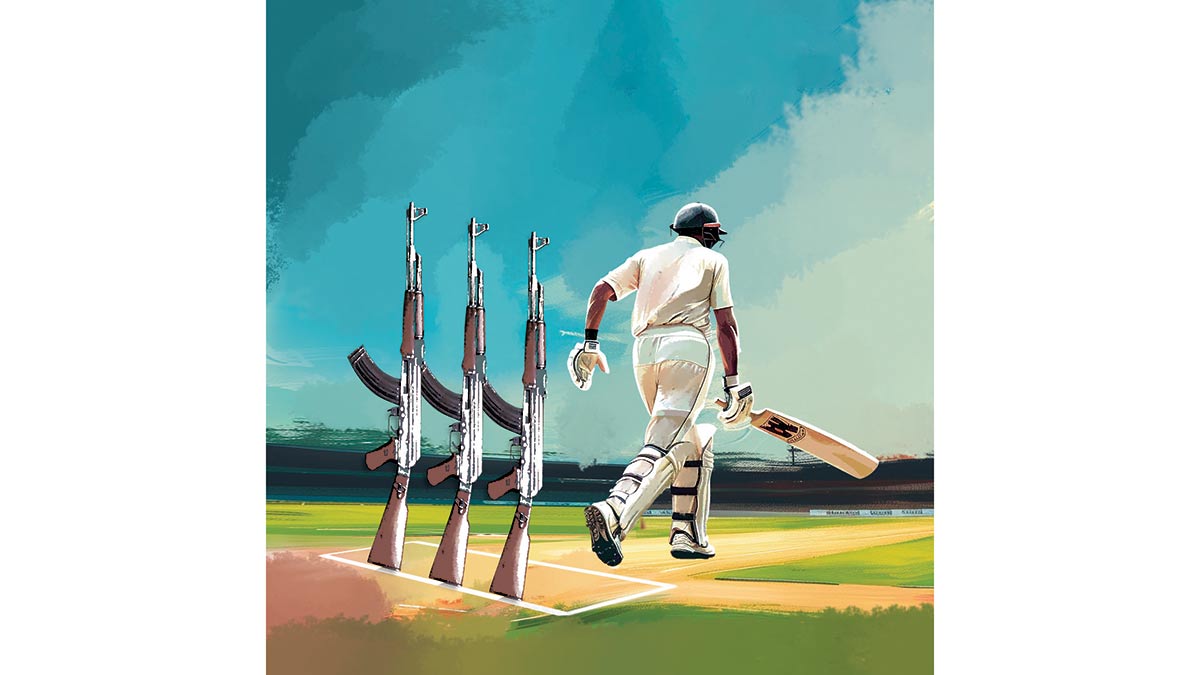
We jealously guard our borders. We also guard our feuds with neighbours from third party meddling. Whenever a third power offers to talk things out between us and the Pakistanis, we quote chapter and verse from the Shimla scripture and say, “Sorry, no table for three.”
India and Pakistan no longer play cricket on each other’s pitches. Yet, we have no qualms about taking our nasty sporting wars to third country playfields. We render their pitches into mock battlegrounds where we play shamelessly to each one’s raucous home galleries. And ever since fans clashed by the night in Leicester over the 2022 Asia Cup match, the constabulary in English towns have been on their sweating toes every time an Indo-Pak match took place in some cow corner of the cricketing world.
Last month’s Asia Cup matches in Dubai took the cake, but not the cup–literally. The Indian captain refused to shake the Pak skipper’s hand; a Pak player gesticulated a fighter plane crash with his fingers raised to six; another one fired imaginary shots from his bat raised in the manner in which Ajmal Kasab had raised his accursed AK-47 while sashaying into the Mumbai train terminus; and India refused to take the cup from the match-conducting ACC’s president who happened to be a minister in Pakistan. Sadly, there were no angels in white in the whole episode.
Having been a victim of Pakistani terror at Pahalgam only months ago, Team India might have found it tough to shake a Pakistani hand. Understood. But gentlemen, if we didn’t want to touch a Paki with a barge-pole, with a willow bat or with a wicket-keeper's gloved palm, why the hell did we agree to play them? We could have boycotted the match, as some Shiv Sainiks have been saying.
The Sainiks are the kind who would plough out a pitch rather than let Pakistanis play on it. They dug out the Wankhede the night before a 1991 match, and the Feroze Shah Kotla in 1999. I guess it’s time the teams got nightwatchmen to guard the grounds before the games get afoot.
A boycott would have wrecked the ICC, you say? My padded left foot! Didn’t the ICC keep apartheid South Africa out for 21 years from 1970? The western world boycotted the 1980 Moscow Olympics after the Soviets invaded Afghanistan. The Soviets hit back by boycotting the next one at Los Angeles.
Carl von Clausewitz thought war is a continuation of diplomacy by other means. Modern thinkers have sought to correct him saying, war is a failure of diplomacy. They innovated international sports to create atmospheres of trust. Pierre de Coubertin, father of modern Olympics, drew upon the same spirit that inspired ancient Greeks to forget their feuds and enter truces that ensured athletes and fans from feuding states could travel safely to the games and return peacefully.
We too have tried cricket for peace or truce. When he got tied down in Afghanistan and wanted calm on his border with India, Zia-ul-Haq invited himself to a match in Jaipur. Pervez Musharraf, who fought us in Kargil and frothed at us in Agra, finally tried truce at a 2005 cricket match in Delhi. Yousuf Raza Gilani came to watch a match in Mohali with Manmohan Singh and agreed to a slew of confidence-building measures.
Now, the two countries are turning sports into a continuation of war. We are using strategic vocabulary to describe defeat and win; we are turning sportsmen into gladiators; we are making match money, we are killing the game; we are winning matches, but we are losing the sport.
Remember, a willow, whether it is from Kashmir or Yorkshire, is not a Kalashnikov.
prasannan@theweek.in
