



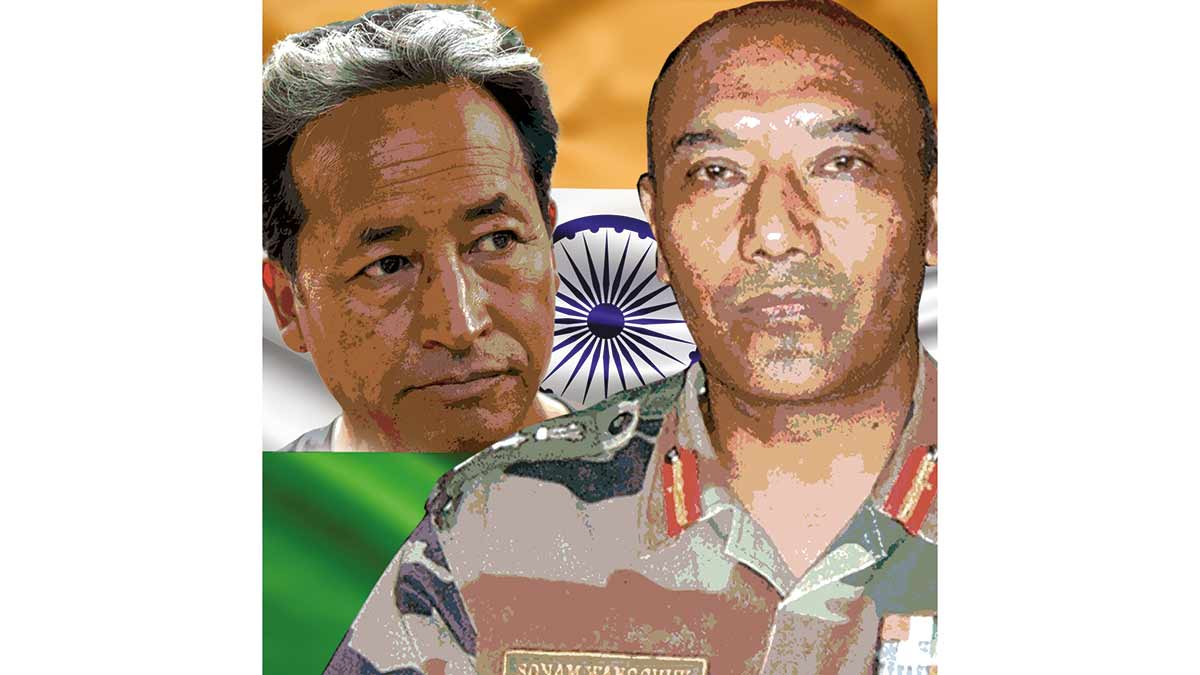
Two Sonam Wangchuks have done India proud in recent times—one a soldier, the other a civilian. Both have fought, or been fighting, battles to save their native Ladakh for India. One got a Maha Vir Chakra and retired as a colonel. The other got a Magsaysay and is in jail.
First about the soldier. Sonam joined the Army in 1987, fought insurgents in the northeast and the LTTE in Sri Lanka, and was posted to Ladakh Scouts as a major when the Kargil war broke out. There he scored the first victory for the Indian Army by capturing Chorbat La, earning an MVC.
The Kargil war was all about saving Ladakh. Pakistanis had occupied the heights in the winter of 1998-99, and were firing at Indian convoys carrying food, fuel and firearms up the highway to Ladakh. Their plan, which was to cut India’s main supply line and capture Ladakh, was foiled because two Ladakhi yak-herds alerted the Army about the intrusion. The timely alert enabled India to launch operations before the enemy came in force.
The other Sonam too had been working to save Ladakh—not only from the Chinese and Pakistanis, but also from perdition. Ragged in his Srinagar school for his rustic accent and mountain ways, he ran away to Delhi where he worked his way to a BTech, and an architecture degree from France. Then he returned to serve his people, improve their lives, reform their schools, innovate ways to store stream water as ice stupas (how natively innovative!), save glaciers, and preserve their fragile culture and frigid environment.
He had also been ticking the right boxes of patriotism. When the Chinese came into Galvan in 2020, he mobilised his people against them and got them to boycott Chinese goods. When he heard that our troops in Ladakh were freezing at their icy posts, he innovated heat-trapping solar-powered tents for them. When rulers in Delhi scrapped the special status of Jammu & Kashmir and separated Buddhist-majority Ladakh, he hailed the decision which, he and his co-Ladakhis thought, would free them from the misrule of Srinagar, get them jobs, and give them a free hand to preserve their culture, promote their language, and let them live their lives their way.
Sadly Delhi rule was found to be worse than Srinagar’s. It didn’t give them jobs, it let outsiders into Ladakh causing fears of a cultural invasion and an environment disaster, and it hasn’t given them a representative government. Sonam launched protests; Delhi has thrown the man from snowland into a jail in blazing-hot Rajasthan.
As the two yak-herds proved in Kargil, as have several tribes in the northeast over the decades, the natives on the frontiers are the eyes and ears of the army. Winning their hearts and minds is not the job of the army alone, but also of the nation’s rulers in Delhi. Delhi’s bold move to scrap J&K’s special status has brought peace to the valley; in the process it has kindled unrest among a most loyal people on a fragile frontier.
Delhi sees the trees, but misses the woods. From Jawaharlal Nehru to Narendra Modi, India’s rulers have been mistaking border security for national security. A boundary is a line; a border is the land up to the line; a frontier is the vast marches on both sides of the line. Boundaries are manned by the paramilitary. Borders are guarded the military. Frontiers need strategists and statesmen to manage.
We guard the borders and boundaries, but neglect the frontiers. In the process, we also turn loyal frontiersmen into resentful rebels—on the Naga hills, in the Manipur valley, and now on the Ladakh mountains!
prasannan@theweek.in
