



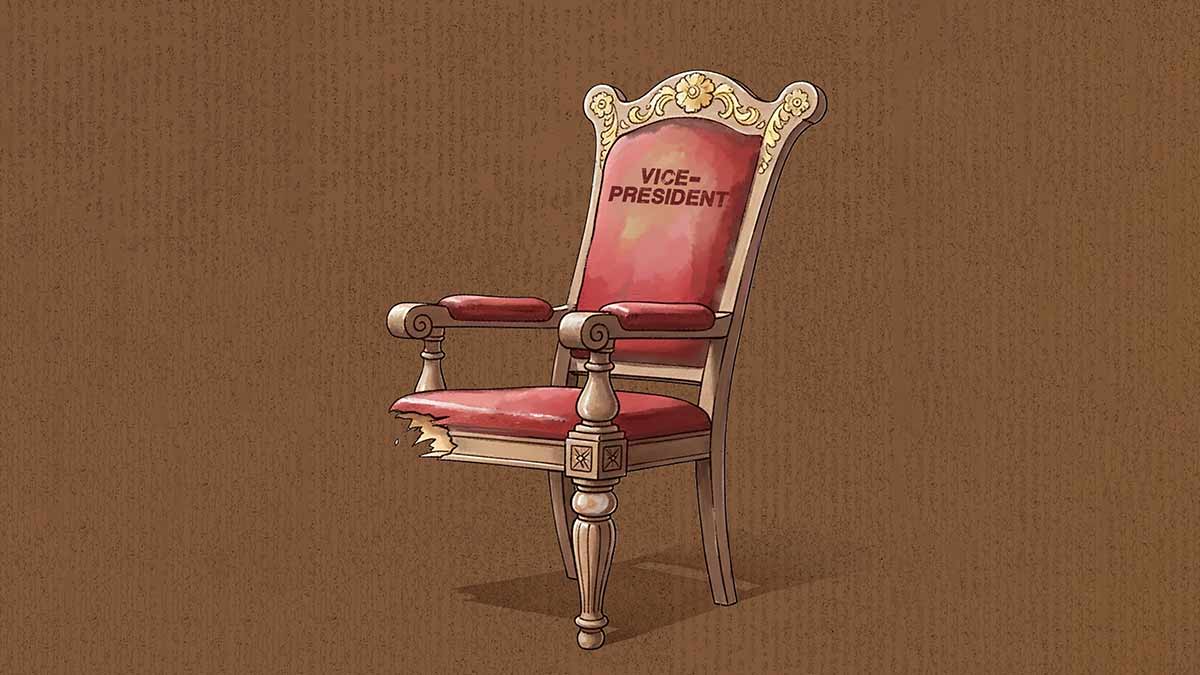
Thomas Marshall, vice-president under Woodrow Wilson from 1913 to 1921, once lamented: “Once there were two brothers. One ran away to sea; the other was elected vice-president of the United States. And nothing was heard of either of them again.”
Vice-presidents of yore made no news—in India or the US. Who remembers S. Radhakrishnan or Zakir Husain as VPs? We remember their presidencies. How many remember G.S. Pathak? The job, as John Garner who was Franklin Roosevelt’s veep from 1933 to 1941, said, was as "useful as a cow's fifth teeth".
No longer so. VPs make news these days. Look at J.D. Vance! He has emerged as Don Trump’s hatchet man.
There used to be a pattern to the vice-presidency in India. The first three became president, the next three didn’t, the three after them did, and the three who followed didn’t. The pattern got broken when a fourth VP in a row, Venkaiah Naidu, missed the top job.
A few created constitutional history—M. Hidayatullah as the first judge to get the job, and also as the only one who has been chief justice, vice-president and acting president. When Zakir Husain died in office and V.V. Giri quit to contest as president, Hidayatullah, then CJI, was sworn in as acting president. Later he was elected unopposed as vice-president. B.D. Jatti created a flutter when he initially refused the Janata regime’s request to dismiss nine Congress state governments.
A few of the recent ones brought vibrancy to the post—Hamid Ansari with his intellectual acumen (also as the only one to get a second term after S. Radhakrishnan), Naidu with his popularity (he loved hosting events, holding book launches, and meeting people), and Jagdeep Dhankhar with his brash conduct.
Dhankhar will go down in history as the only VP who was threatened with impeachment. He goes unmourned. He angered those whom he tried to please, and alienated the opposition with his partisan conduct in the Rajya Sabha.
Dhankhar’s exit was dramatic. He wanted to get the motion to impeach Justice Yashwant Varma moved in the Rajya Sabha which he presided over, rather than in the Lok Sabha where the government wanted to put up its show. In the end, he quit over ‘health’ reasons.
That was Dhankhar’s second quit ‘act’. Back in 1990, he had grabbed headlines by resigning as a deputy minister in protest against V.P. Singh sacking deputy prime minister Devi Lal. The next morning he quietly took back the resignation.
Much of the role, rules, and traditions around the presidency is derived from the British monarch’s, but the Brits have no parallel to our vice-president. Our veep, if at all, is modelled after the US’s—to the extent of he (no woman till date) being the ex-officio chairman of the upper house. That’s what earns him his pay. The VP is the only official who doesn’t get any salary or perks for his designated post. His pay, Rs4 lakh currently, is for his work as Rajya Sabha chairman. But when he acts as president, he is entitled to the salary and privileges of the president.
The vice-president’s, if you ask me, is a tougher grind than the president’s. Dear old Shankar Dayal Sharma once broke into tears, trying to run an unruly house. It’s worse these days.
There are ceremonial tasks, too. The VP is chancellor of the Panjab, Delhi and Pondicherry Universities, visitor to Makhanlal Chaturvedi University of Journalism, and president of the Indian Institute of Public Administration. All these would now be tasks before C.P. Radhakrishnan or B. Sudershan Reddy, whoever among them makes it.
Good luck, gentlemen! We will see one of you in the house.
prasannan@theweek.in
